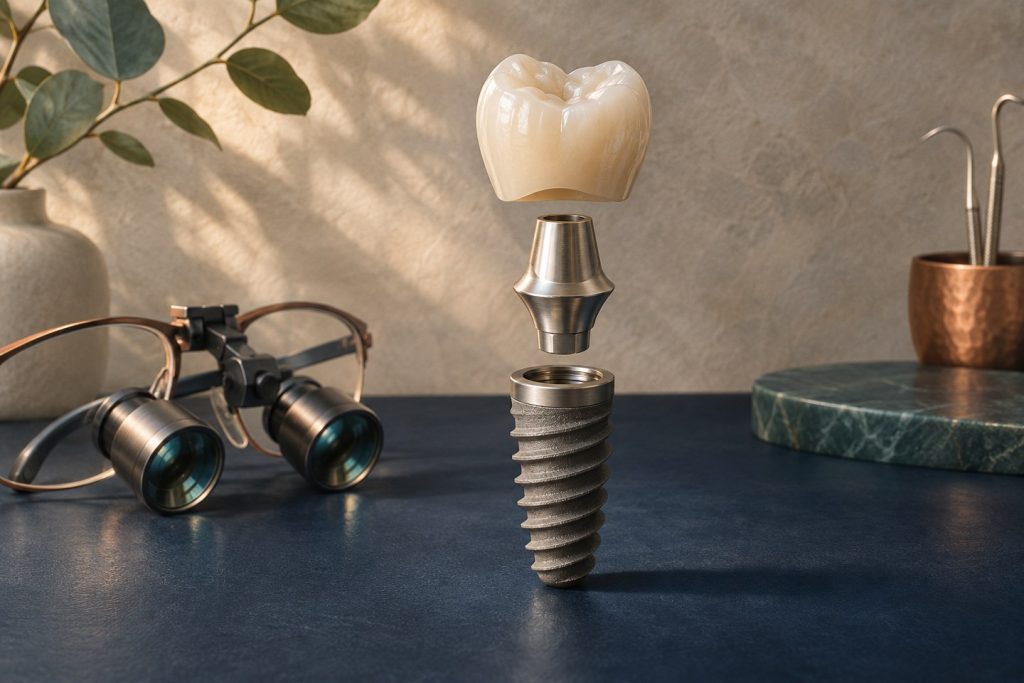
An implant restoration is an assembly that carries force from the occlusal surface to the jaw. Every junction in the assembly can affect how the restoration is positioned, cleaned, repaired and monitored. A patient who describes a “loose implant” could have a loose crown, an abutment screw problem or a mobile fixture. The first step in making sense of those possibilities is to identify the junctions and understand what each part does.
Follow the load from crown to bone
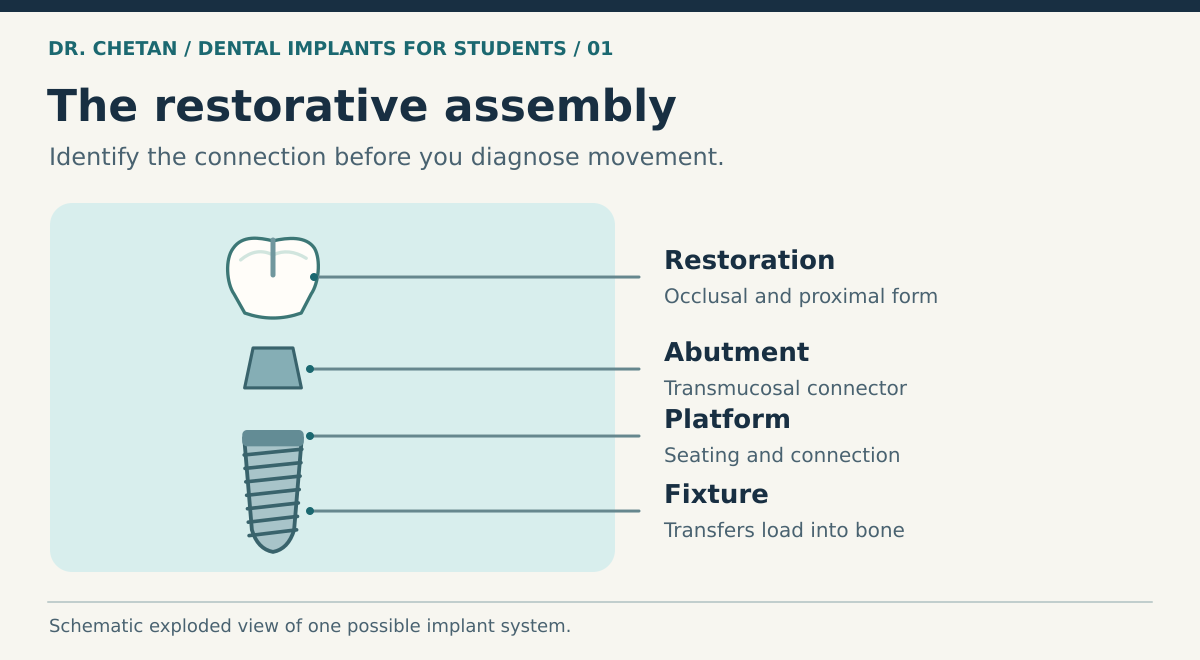
A fixture is the device placed in bone. Its body commonly has a threaded profile and a coronal platform where a component seats. An abutment creates the transition from the fixture to the restoration. The crown replaces the visible tooth and carries proximal and occlusal contacts. A separate prosthetic screw may secure the abutment to the implant. In some restorations the crown is bonded to a titanium base outside the mouth and the resulting assembly is secured through an access channel. The number of visible pieces depends on the design. [1]
The screw is tightened to create preload, an initial tensile force in the screw that clamps the joint. Inadequate seating, incorrect tightening or repeated forces across an unfavourable connection can contribute to loss of stability. Recurrent loosening deserves investigation of fit, component compatibility, bite and loading. It is possible to have a loose screw over an integrated fixture. Individual manufacturers specify the torque and compatible instruments for their components. [4]
Platform, connection and neck
| Design feature | What you are identifying | Clinical consequence |
|---|---|---|
| Platform and connection | Where the restoration seats and how it indexes into or onto the fixture | Determines compatible components and how the assembly can be repaired. |
| Bone-level or tissue-level design | Intended relationship of the platform or transmucosal collar to the crest and mucosa | Affects where the junction sits and the space available to shape the restoration. |
| Body diameter, length and taper | Overall fixture geometry and thread form | Influences anatomical fit and insertion mechanics, with trade-offs in available bone and component dimensions. |
| Surface | Surface topography and chemistry distinct from thread geometry | Influences interactions with blood, cells and healing bone. |
An external connection engages a feature projecting above the platform. Internal designs engage a recess and may have parallel, conical or combined features. Many designs also have an antirotation index for single units. A platform switch is a horizontal offset created by using a narrower abutment at a wider fixture platform. The offset is distinct from the internal geometry of the connection and cannot compensate for a poorly positioned implant.
Bone-level fixtures typically give the restorative team more control over the transmucosal contour. A tissue-level collar places the junction more coronally by design, which can simplify access in certain sites. A tissue-level implant may still have a separate abutment. Distinguish the location of the junction, the number of components and how the implant heals. These are three different descriptions of the case.
Materials and design choices
Titanium and titanium alloys have the longest widespread clinical track record. Their stable oxide surface participates in the interface with the healing tissues. Zirconia fixtures are available in some systems. A zirconia crown is a different choice and can sit on a titanium fixture. Short follow-up, variations between systems and differences in case selection limit simple material rankings. Fixture dimensions also need context. A narrow implant may preserve more bone in a constrained space, but its components and fatigue demands must fit the proposed site and restoration. Short implants are an option in selected posterior sites where augmentation is an alternative. [3] [2]
Insertion stability depends on the relationship of the fixture design to the prepared bone. A tapered implant can engage certain sites differently from a parallel design, but more engagement is useful only if the final position and tissues remain favourable. The biology chapter explains how mechanical stability gives way to biological support. The placement chapter explains what insertion torque can and cannot tell you.
Temporary, impression and definitive components
A cover screw seals the connection during submerged healing. A healing abutment extends through the mucosa and shapes the opening. Impression copings and scan bodies transfer the implant position into an analogue or digital record. A multi-unit abutment creates a new restorative platform for a multi-implant prosthesis. An implant-level record and an abutment-level record therefore describe different interfaces. If a laboratory prescription simply says “implant impression,” clarify which interface was captured before assuming the components match.
Small differences in component seating can carry through the workflow. An incompletely seated scan body can encode the wrong position even when the image looks smooth. A similar error at the trial or delivery visit can prevent a prosthesis from seating. Check the exact part and the intended connection at each transfer, using a radiograph where the interface cannot be evaluated clinically.
A clinical example
A mandibular molar crown has loosened twice. The existing implant is firm when assessed separately from the crown. The assembly has an old replacement screw, uncertain component provenance and a large contact on a cusp away from the implant axis. The relevant questions are whether the components are compatible, whether the crown seats completely and how the occlusal contact loads the joint. Simply changing the fixture material would do nothing to answer those questions. Record the implant system, platform, restorative component and manufacturer-specific tightening details when treatment is delivered. That record makes the problem much easier to investigate later. Continue with single crowns and short-span bridges.
References and further reading
- U.S. Food and Drug Administration. Dental implant systems, components and materials
- Jung et al. ITI consensus on implant length, design and medications
- Comparative clinical behaviour of zirconia and titanium fixtures. Systematic review of randomised trials
- International Team for Implantology. Clinical performance of screw- and cement-retained fixed reconstructions

Leave a Reply