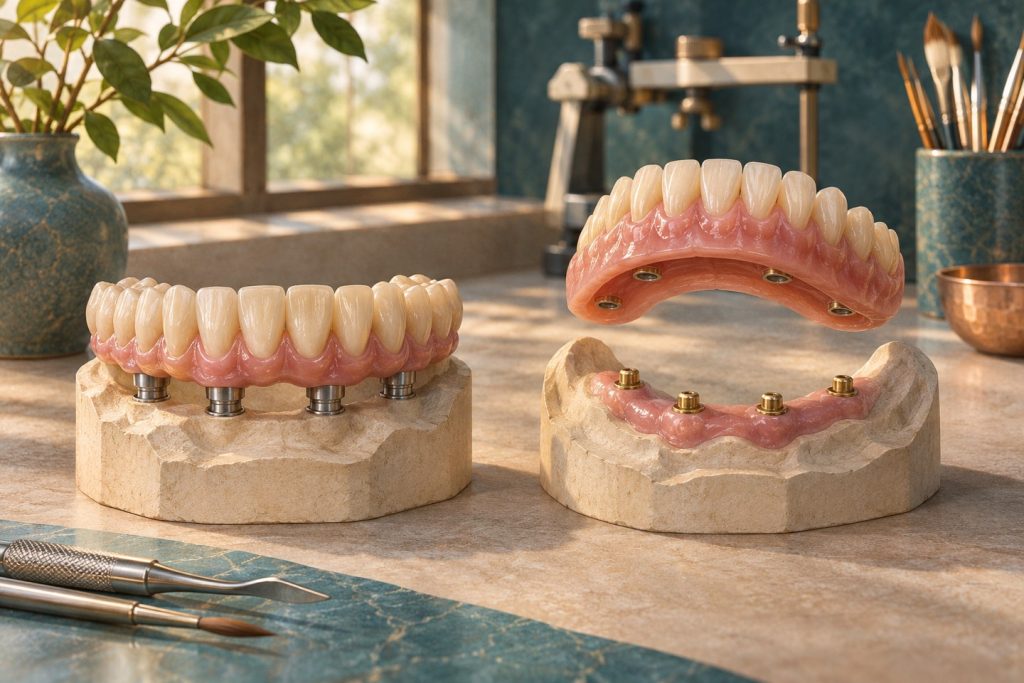
An edentulous arch can be restored in several ways. The surgical question is which sites can hold implants. The prosthetic question comes first. How much tissue must be replaced, what should support the lips, where will the teeth sit and how will the patient clean? Answer these with a diagnostic setup or trial before committing to a number or arrangement of fixtures.
Compare how each design supports the patient
| Design | Support and retention | Recurring service requirements |
|---|---|---|
| Conventional complete denture | Mucosal support, with retention and stability influenced by the tissues, border form and neuromuscular control | Assess the fit, bite and condition of the base. |
| Implant overdenture | Removable prosthesis retained by unsplinted attachments or a bar, with variable tissue support depending on design | Check attachments, base adaptation, hygiene and ability to remove the prosthesis. |
| Fixed complete-arch prosthesis | Fixed to implants, often screw-retained, with a design based on support distribution and tissue replacement | Verify cleaning under the prosthesis, fit, screw joint and material wear. |
A removable flange can replace lip support in a resorbed arch and can be removed for cleaning. Some patients prefer fixed teeth and can maintain them readily when contour and tissue access are designed well. A patient with limited dexterity may struggle with either a tight attachment or a deep space under a fixed prosthesis. Trial the shape and the required movements with the patient. [2]
Plan distribution and loading by arch
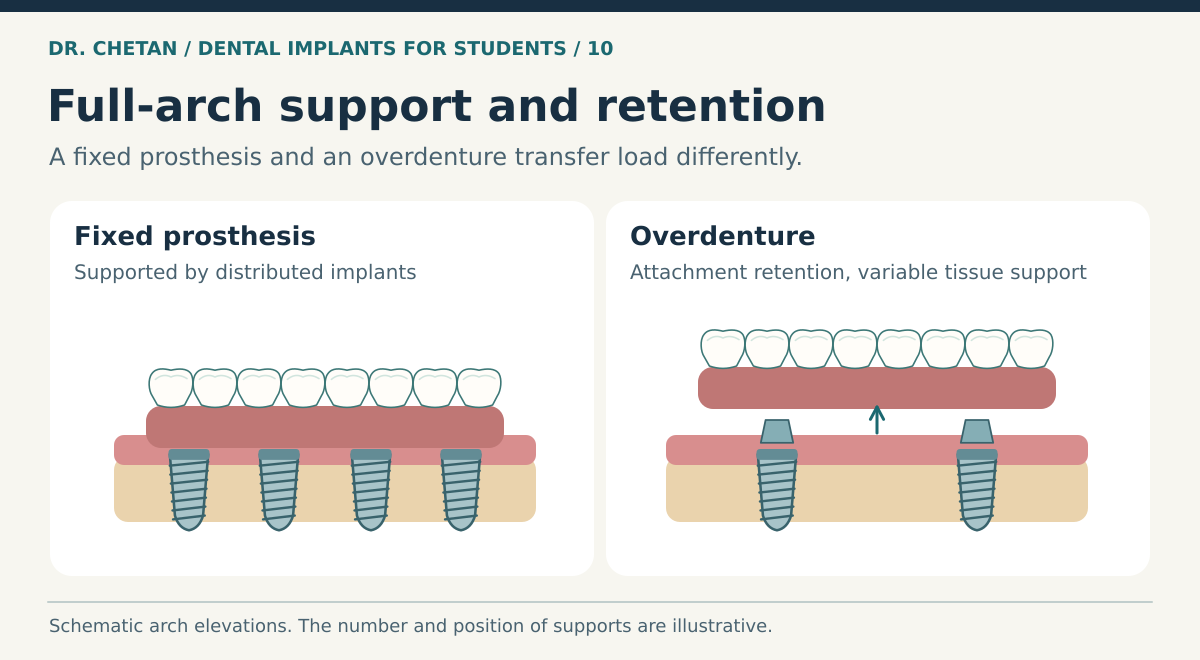
ITI recommends a minimum of four appropriately distributed implants for a one-piece fixed full-arch prosthesis. The recent global consensus on the edentulous maxilla similarly calls for at least four appropriately distributed implants and suggests six for fixed reconstruction to reduce potential complications, with the plan tailored to the patient. A two-implant mandibular overdenture is a well-established option for the lower arch. It should not be extrapolated directly to the maxilla. [3] [1] [4]
Consider arch shape, anteroposterior distribution, available bone, length of any distal cantilever and the consequences of losing one support. More implants may allow different segmentation or provide additional support in selected cases. Their location can also constrain hygiene and complicate placement. A count alone cannot answer these questions. The diagnostic setup should show where the prosthesis–tissue transition will be visible in the smile and what space is available for the framework, teeth and hygiene access.
When immediate loading is considered, assess the stability of the supporting implants, distribution, provisional fit and rigidity, and planned occlusion. The early provisional should protect the healing situation while enabling necessary function and review. A planned fallback may involve protected healing with a different temporary prosthesis. Use the placement and loading terminology to state exactly when the implants and teeth are placed. [1]
Deliver and plan for repair
Confirm the relationship between the arches, incisal display, phonetics, lip support and comfort at the appropriate try-in. For fixed restorations, verify fit across implants or multi-unit abutments. Small inaccuracies are harder to reconcile over a long span. A bar overdenture needs a path of insertion and enough restorative space for the bar, attachments and denture material. Its underside must be cleanable. For a tissue-supported overdenture, the base still needs periodic fit assessment and may require relining.
Explain what will be reviewed and who can manage repairs. A fixed prosthesis may require professional access for screw or material complications. An overdenture may need attachment insert replacement or changes to base fit. Record components and provide a follow-up plan. Consider what the patient would wear if the prosthesis needs laboratory service. [5]
What the provisional can teach you
A provisional can test tooth display, phonetics, lip support and hygiene access. If speech changes, compare tooth position and the shape of the palatal or lingual surfaces. If food repeatedly collects under a segment, check the transition and the patient’s ability to clear it. If an attachment is hard to release, observe the path of removal and whether the patient can manage it unaided. These observations can guide the final shape. Repair frequency, chair time and ease of daily care belong in the comparison of outcomes alongside implant and prosthesis survival. [2]
A clinical example
A patient with a resorbed maxilla prefers fixed teeth. The trial setup shows that removing the labial flange markedly reduces lip support. Moving the teeth facially to recover support would increase the offset from available bone. A removable implant overdenture with a flange and a fixed design with a different tissue transition should be compared with the trial setup in place. The conversation should address smile, speech and cleaning in addition to retention. Continue with prosthetically driven planning and maintenance and failure analysis.
References and further reading
- Global consensus for the edentulous maxilla. Implant number, placement and loading
- Global consensus for the edentulous maxilla. Conventional dentures, overdentures and fixed prostheses
- International Team for Implantology. Number of implants for fixed complete-arch prostheses
- York Consensus Statement. Two-implant mandibular overdentures
- Pjetursson et al. Implant-supported fixed dental prosthesis survival and complications. Systematic review
Leave a Reply