When someone says their implant has failed, the first questions are when the change began and which part is affected. A healing implant can lose integration. A functioning implant can develop progressive bone loss. An integrated fixture can still carry a crown that has fractured or a screw that has loosened. Treatment depends on finding the problem in the assembly, the supporting tissues or both.
Early and late problems require different reasoning
| Presentation | What to establish | Why it changes the response |
|---|---|---|
| New altered sensation after surgery | Distribution, onset, change, imaging and proximity to a nerve | Possible nerve involvement warrants prompt assessment and specialist referral when indicated. |
| Progressive swelling, wound breakdown or graft exposure | Whether infection is spreading and whether the surgical site or graft is affected | Early assessment may change wound management, urgency and prognosis. |
| Movement at a restored site | Whether the crown, abutment or fixture moves | Component repair differs from loss of implant integration. |
| Bleeding or suppuration at a functioning implant | Probing change, biofilm access and bone level over time | Distinguishes inflammation limited to mucosa from progressive loss of support. |
| Fracture or recurrent loosening | Seating, screw and component integrity, geometry, bite and loading | Treat the cause and assess the feasibility of repair. |
Rapid floor-of-mouth swelling or signs of airway compromise after mandibular surgery are an emergency. [7] New sensory disturbance after the expected anaesthetic effect warrants urgent contact with the treating team, prompt documentation and assessment. These findings have different priorities from routine review of a small chip or a worn attachment. [6]
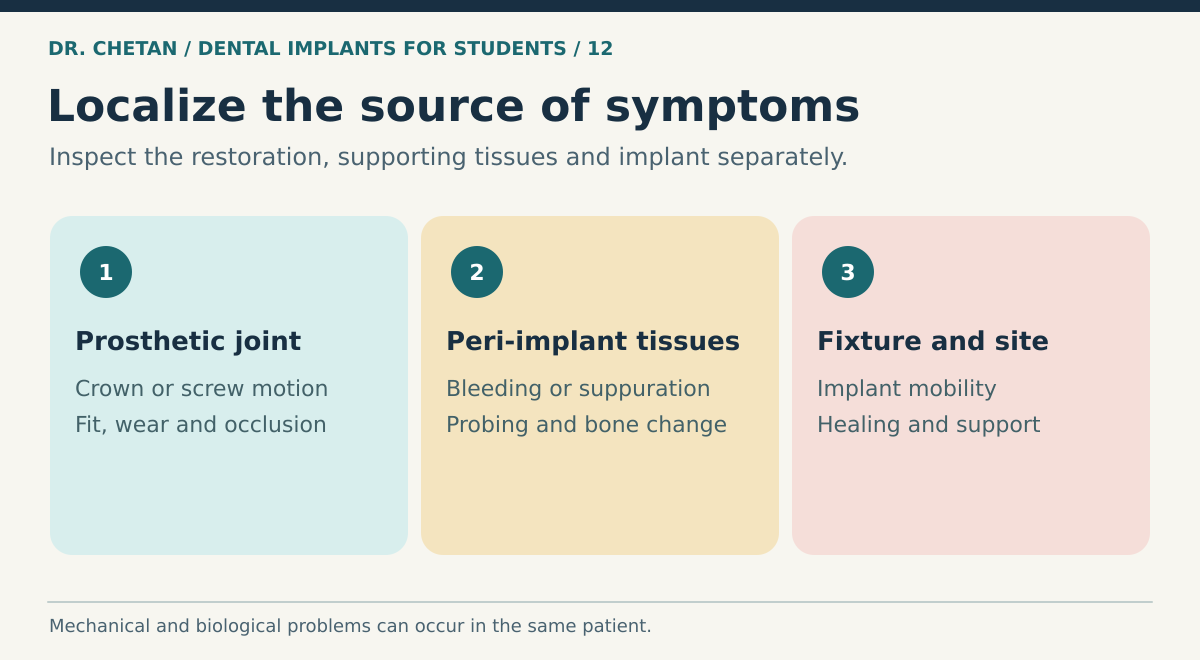
Localize the problem before choosing the repair
Document the onset, whether symptoms occur at rest or on biting and any previous repairs. Assess tissue response and localize movement before deciding on intervention. A radiograph can support assessment of seating, fracture, bone change or nearby anatomy. For a repeated screw problem, evaluate joint seating, component compatibility, framework fit and force direction. Tightening a loose screw may restore stability temporarily while leaving the underlying issue. A mobile fixture generally requires a different treatment discussion, including the condition of the site and possible alternatives.
An early failure may involve inadequate healing of the bone interface. A late biological complication can involve persistent inflammation and progressive bone loss. Some patients present with both technical and biological problems. Overcontour, for example, can interfere with hygiene while a poorly directed force contributes to recurrent screw problems. For disease definitions and treatment sequencing, use the peri-implant disease chapter.
Make recall depend on risk and findings
At delivery, record the implant system, component details, tissue findings and an appropriate baseline radiograph. Demonstrate a cleaning method with the delivered prosthesis and observe whether the patient can reproduce it. Review history of periodontitis, past inflammation, smoking, home care, restoration access and previous complications when setting the recall interval. Reassess the interval when risk changes. Follow-up should evaluate both the tissues and the restoration, and imaging should answer a clinical question. [4] [5]
Survival often means the fixture remains in place at the stated follow-up. Success depends on a study’s criteria, which may include tissue health, comfort or absence of complications. Prosthetic survival describes the replacement rather than the fixture. A 2019 review estimated ten-year implant survival at 96.4%, with a sensitivity analysis that accounted differently for missing follow-up estimating 93.2%. These estimates apply to the studies and their definitions. They cannot tell a patient how many repairs, appointments or changes in the restoration they will need. [1] [3] [2]
Decide what is maintainable before replacing a failed fixture
Evaluate the cause of failure and the consequences of removing or retaining the restoration. Review available bone, tissue volume, anatomy and alternative prostheses with the patient. If placement position or poor access contributed to disease, putting a replacement fixture in the same location may recreate the original problem. For a bridge or complete arch, determine how the remaining supports and the provisional will function if one fixture is removed. Treatment may involve a different distribution, a removable design or staged reassessment. Document the expected service needs and review the outcome after the revised plan. [4] [2]
A clinical example
A full-arch patient returns with a recurrent prosthetic screw problem and bleeding beneath a posterior segment. The restoration must be assessed for fit and load, while the tissues need examination and comparison with baseline. Improving hygiene access without checking the joint leaves part of the problem unexplained. Changing a screw without investigating the tissue findings leaves another part untreated. A documented plan can include immediate stabilization, diagnosis of tissue disease, correction of the underlying prosthetic design and a reassessment visit. Revisit components and connections, single crowns and bridges, and full-arch prosthodontics for the decisions that can make these repairs easier.
References and further reading
- Howe, Keys and Richards. Ten-year dental implant survival and sensitivity analysis
- Pjetursson et al. Implant-supported fixed dental prosthesis survival and complications. Systematic review
- Jung et al. Implant-supported single crown survival and complication rates. Systematic review
- Herrera et al. Prevention and treatment of peri-implant diseases. EFP S3 guideline
- Berglundh et al. World Workshop consensus report on peri-implant diseases and conditions
- Inferior alveolar nerve injury after implant placement. Systematic review of early diagnosis and treatment
- Immediate bleeding complications in dental implant surgery. Systematic review
Leave a Reply