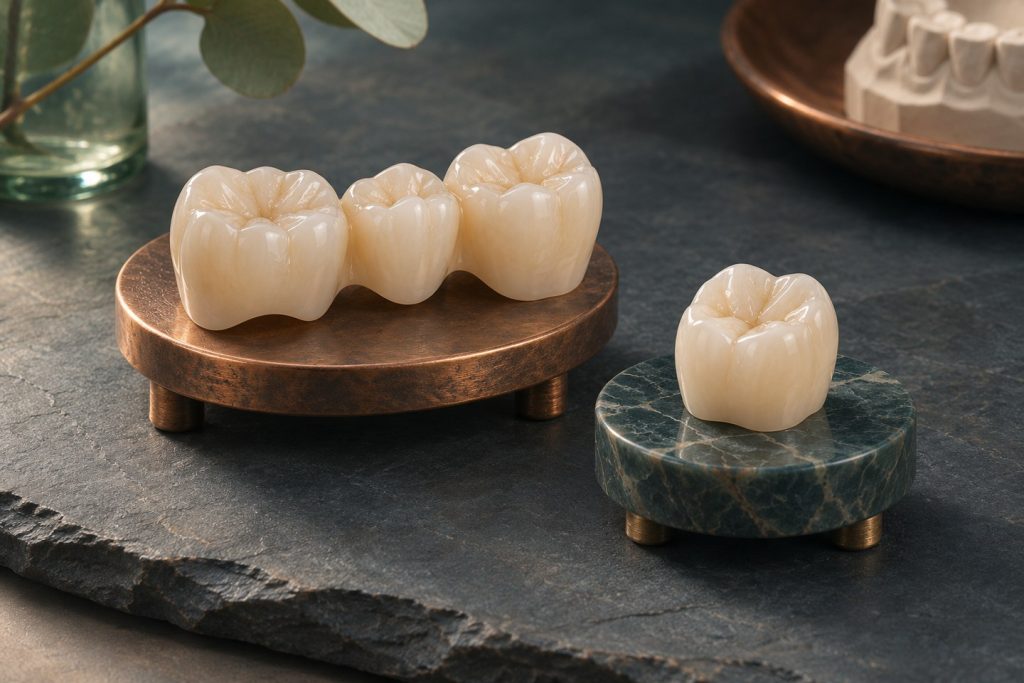
An implant prosthesis is a structural and biological design. It must seat accurately, resist load, provide the intended contacts and leave the patient room to clean. Those demands are connected. A bridge that fits the implants but blocks interdental access creates a maintenance problem. An esthetically ideal crown outline may need to be adjusted if the screw access exits through a visible surface.
Decide how the prosthesis will be supported
A single implant crown is a separate unit supported by one fixture. A short-span fixed dental prosthesis can include one or more pontics. The implant number and distribution depend on span, available sites, restorative space and expected forces. A longer cantilever creates a larger moment when force acts farther from support. That risk needs to be assessed alongside framework rigidity, opposing dentition and parafunction. Joining a natural tooth to an implant introduces supports with different mobility. Consider it only with a clear indication and a design that accounts for those differences. [3]
A bridge plan should show the position of the pontic and a route to clean the mucosal surface and around both abutments. Individual crowns may simplify separate servicing and cleaning where fixture positions and spaces are favourable. A splinted plan changes load distribution and can complicate repair when one unit or support develops a problem.
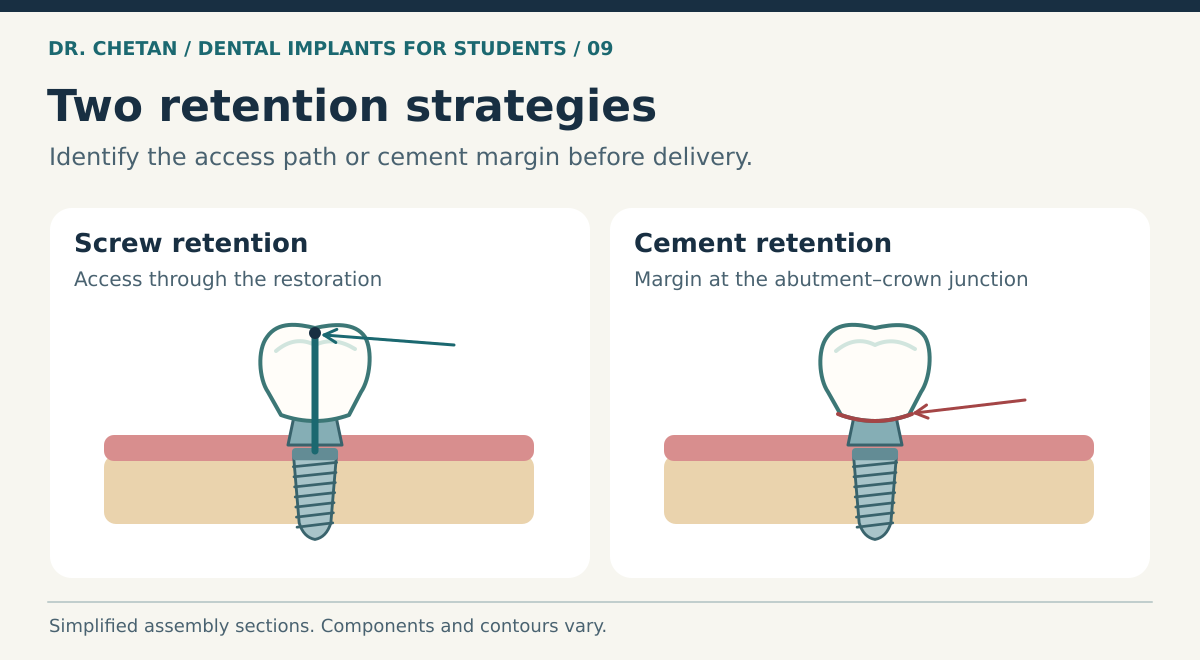
Retention is a restorative choice
| Retention | Where it helps | What to assess |
|---|---|---|
| Screw-retained | Planned retrieval and avoidance of intraoral luting cement | Access channel position, material thickness, correct seating and screw-joint demands. |
| Cement-retained on an abutment | Some positions where a screw channel would exit unfavourably | Accessible margin, abutment retention, complete cement removal and retrieval plan. |
| Crown bonded to a titanium base and screw-retained | Combines a restorative material with a system-specific connection | Bonding interface, component compatibility, restorative space and access channel. |
Both screw and cement retention can perform clinically. Their complications differ. Excess submucosal cement can contribute to inflammation. The access channel and screw joint introduce mechanical and esthetic considerations. Some systems offer angled screw-channel components within defined limits. Confirm that the chosen component and driver are compatible and that the restoration retains adequate material thickness. [1] [2]
Record the implant position and verify the fit
A conventional impression transfers implant or abutment position through a coping and analogue. Digital workflows use a compatible scan body and library to locate the interface. The scan body must seat completely and match the selected digital component. Multiple supports and long spans increase the importance of checking the record and the fit. At delivery, inspect seating, contacts and occlusion. A radiograph can help where seating is not visible. For a bridge, a verified framework fit reduces avoidable strain on the connection. A screw should not be used to pull an obviously misfitting framework into place.
Assess the bite in maximum intercuspation and excursions, taking into account the site, arch relationship and opposing dentition. Evidence for a single universal implant occlusal prescription is limited. Control unintended contacts and distribute force in line with the treatment design. Where parafunction is relevant, plan monitoring and consider protective options on an individual basis. Record component details, torque and access closure, and establish a clinical and radiographic baseline. [5]
Select materials in the context of space and service
Ceramic, metal-ceramic and other restorative designs have different requirements for thickness, support and laboratory processing. A monolithic restoration can avoid a separate veneering layer, while a veneered design can offer additional esthetic control in selected cases. Ask the laboratory to review limited restorative space, proximal connector dimensions and the location of an access channel before fabrication. Material choice also affects how a restoration can be adjusted, polished or repaired. When reviewing outcome studies, separate restoration survival from the frequency of events such as chipping or screw loosening. A design can survive while requiring repeated interventions. [2] [3]
A clinical example
Two posterior implants are being restored with a three-unit bridge. The trial restoration seats, but the pontic and a bulbous proximal contour block the cleaning device the patient can use. Correcting the contour before delivery is part of completing the treatment. Once the design is confirmed, demonstrate cleaning with the actual prosthesis and record the result. Mechanical and biological complications can occur despite high survival rates, which makes maintenance access a treatment outcome in its own right. Continue with full-arch prosthodontics or failure analysis and maintenance.
References and further reading
- International Team for Implantology. Clinical performance of screw- and cement-retained fixed reconstructions
- Jung et al. Implant-supported single crown survival and complication rates. Systematic review
- Pjetursson et al. Implant-supported fixed dental prosthesis survival and complications. Systematic review
- International Team for Implantology. Influence of restorative procedures on esthetic outcomes
- Herrera et al. Prevention and treatment of peri-implant diseases. EFP S3 guideline

Leave a Reply