One toothpaste promises whitening, another promises gum care, and a third says “natural.” Which should you take home?
Start with fluoride and your actual dental needs, then consider comfort and cost. A product that sounds more specialised is not automatically the right one. This guide focuses mainly on adults; children need age-appropriate amounts and supervision.
Start by checking the fluoride
Fluoride helps strengthen enamel and supports replacement of minerals lost during early decay. It is a preventive ingredient, not a way to grow back the missing structure of a cavity. [1]
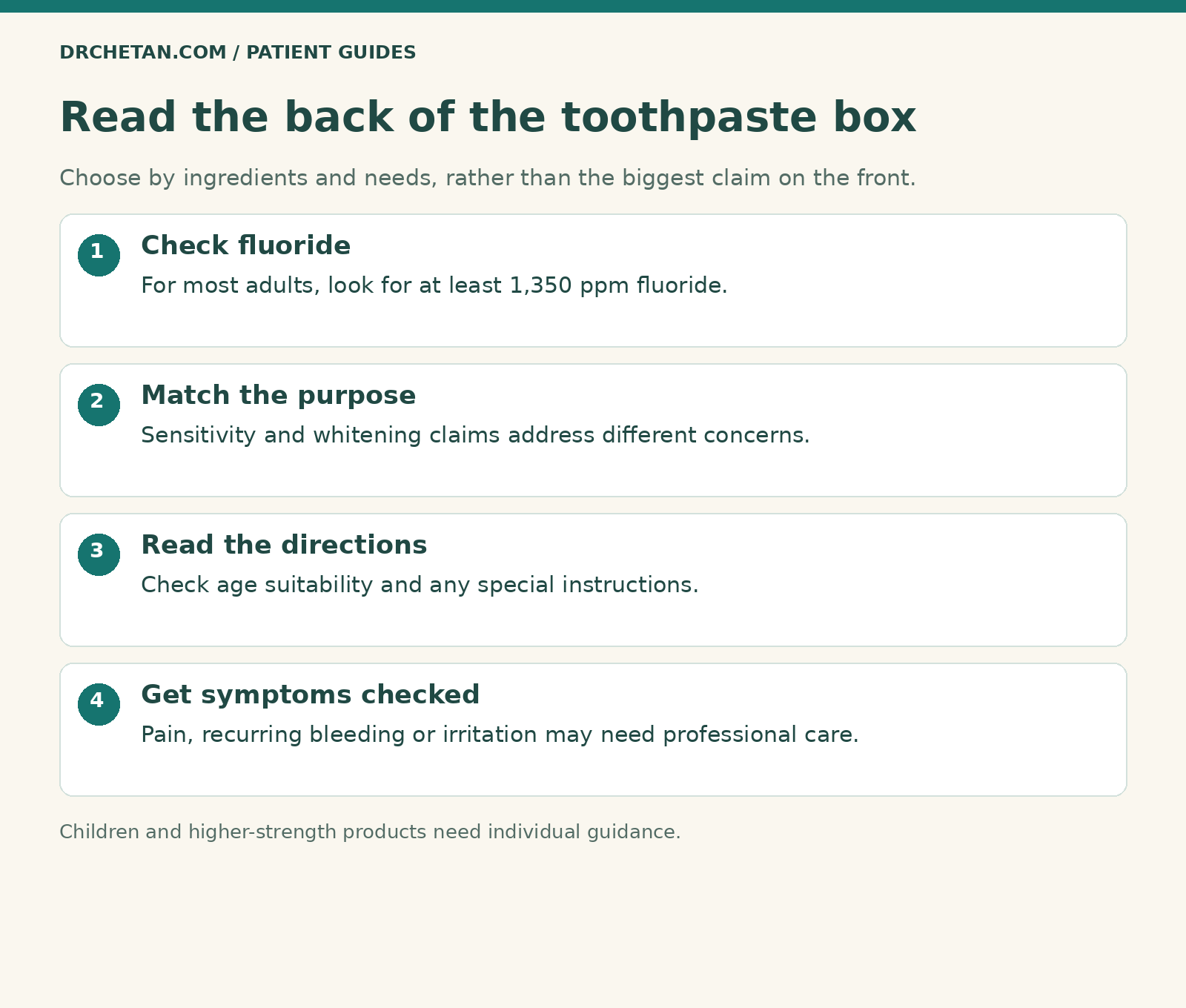
For most adults, NHS guidance recommends toothpaste with at least 1,350 ppm fluoride; ordinary family products often contain 1,350–1,500 ppm. Look for the fluoride concentration on the packaging. Ppm means “parts per million,” a measure of concentration. [2]
Do not assume every product on the same shelf contains fluoride. A “herbal,” charcoal or premium-labelled paste still needs its ingredient list checked. If you cannot identify the fluoride content, ask your dentist or pharmacist rather than choosing by packaging alone.
How to read a toothpaste label
| Label detail | What it helps you decide |
|---|---|
| Fluoride content | Whether it provides the expected cavity-prevention ingredient. |
| Active ingredients and purpose | Whether it targets sensitivity, plaque or another stated concern. |
| Age and use instructions | Who may use it and whether special directions apply. |
| Warnings | When to stop, seek advice or avoid swallowing. |
Fluoride may be supplied as sodium fluoride, sodium monofluorophosphate or stannous fluoride. Toothpastes also contain cleaning, flavouring and texture ingredients. The name of one ingredient alone does not establish how well the complete formulation will suit you. [3]
For example, if you are comparing two boxes, turn them over. First find fluoride. Next ask whether you need a sensitivity product. Then check whether the directions and flavour are comfortable for daily use. That short sequence is more useful than trying to rank every claim on the front.
When a sensitivity toothpaste may help
A desensitising toothpaste can reduce sensitivity in suitable cases, often after repeated applications rather than one brushing. But the cause matters: exposed dentine, decay, a crack and a faulty restoration do not all need the same care. [4]
Common sensitivity ingredients include potassium compounds, stannous fluoride and arginine. Different formulations work in different ways; follow the product directions and your dentist’s plan rather than frequently changing tubes before you can assess the result. [3][5]
Tell your dentist what triggers the pain and how long it lasts. A new pain in one tooth, pain on biting or continuing discomfort is a reason to get the tooth checked. Toothpaste is not a diagnostic test, and improvement does not establish that every underlying problem has been treated. [4][6]
What whitening toothpaste can and cannot do
Whitening toothpastes commonly help remove surface stains using polishing or other cleaning agents. This differs from a dentist-supervised bleaching treatment that changes natural tooth colour. A paste cannot promise the same result for every type of discolouration. [7]
Teeth naturally vary in shade. Crowns, implants and dentures do not whiten like natural teeth, so a wish for a brighter smile is worth discussing before buying several products. Professional whitening may also cause temporary sensitivity or gum irritation. [8]
Do not try to make toothpaste “stronger” with lemon juice, vinegar or aggressive homemade scrubs. Prolonged acid contact can damage enamel, and there is no reliable basis for assuming that a charcoal product is safe and effective just because it is natural. [9]
If a tooth has changed colour by itself, particularly after an injury or with symptoms, arrange an examination. Cosmetic packaging cannot explain why an individual tooth looks different.
What about gum-care and tartar-control claims?
Some formulations contain ingredients intended to reduce plaque, gingivitis or tartar accumulation. They can be part of a suitable routine, but they do not replace brushing technique, interdental cleaning or needed professional treatment. [3][7]
Hardened tartar needs professional removal. A toothpaste labelled “tartar control” is not a way to remove an established hard deposit yourself. Recurring bleeding or swollen gums deserves a dental assessment. [10]
High-fluoride, children’s and irritation concerns
Higher-fluoride products: these are for selected people at higher decay risk and should be used on a dentist’s advice. They have age and product-specific directions. Do not buy the strongest available tube for the whole family or copy another person’s prescription. [11]
Children: adults should dispense the appropriate amount and help with brushing. NHS guidance uses a smear under age three and a pea-sized amount from three to six. Fluoride strength and supervision should be discussed with the child’s dental team. Do not treat a cartoon on the box as the only selection criterion. [2]
Irritation: flavourings and other ingredients can occasionally irritate the mouth. If you notice a reproducible burning, peeling or sore-mouth reaction, stop that product and discuss an alternative. Bring the tube or its ingredient list. Avoid deciding on your own that fluoride is the cause. [3]
Make the chosen toothpaste part of an effective routine
Use it with gentle brushing for about two minutes twice daily, including before bed. Clean every surface and spit out the excess rather than immediately rinsing it away. Continue daily cleaning between teeth; toothpaste cannot compensate for surfaces the brush never reaches. [2][10]
You do not need to keep changing products to make the routine feel active. If the chosen paste meets your needs and is comfortable, affordability and consistent use are practical advantages. At your check-up, ask whether your decay risk or symptoms mean the plan should change.
Questions patients often ask
Is an expensive toothpaste always better?
Price does not tell you whether the formulation fits your needs. Compare fluoride, purpose, instructions and comfort.
Can I use a sensitivity paste if I also want whitening?
Some products combine claims. Check that the actual formulation suits your symptoms, and get ongoing sensitivity assessed rather than pursuing a stronger whitening effect. [3][4]
Can toothpaste repair a cavity?
Fluoride can support early remineralisation before a hole forms. It cannot restore missing tooth structure. A suspected cavity needs assessment. [1]
Should I stop fluoride because my area has fluoride in the water?
Do not make that decision from a general claim about a region. Discuss your actual water source, overall exposure and dental needs with your dentist, particularly for children. [1]
References and further reading
- NIDCR: Fluoride
- NHS: How to keep your teeth clean
- American Dental Association: Toothpastes
- ADA MouthHealthy: Sensitive teeth
- Oral Health Foundation: Sensitive teeth
- NHS: Toothache
- ADA MouthHealthy: Toothpaste
- NHS: Teeth whitening
- ADA MouthHealthy: Natural teeth whitening
- American Dental Association: Dental floss and interdental cleaners
- UK Department of Health and Social Care: Delivering Better Oral Health — fluoride
Sources checked 30 October 2026. This guide provides general patient information; your dental team can advise on your individual needs.

Leave a Reply