Brushing is something most of us do every day. That familiarity makes it easy to stop paying attention to how we do it: the same quick movements, the same starting point and, sometimes, the same areas left behind.
A useful brushing routine is gentle, thorough and repeatable. You should be able to reach your back teeth, clean the surfaces facing your tongue and spend time where the teeth meet the gums. A comfortable soft-bristled brush and fluoride toothpaste are a good starting point.
This guide explains a practical manual-brushing routine for adults. If your dentist has shown you a different method for your particular needs, follow their advice.
The daily routine to aim for
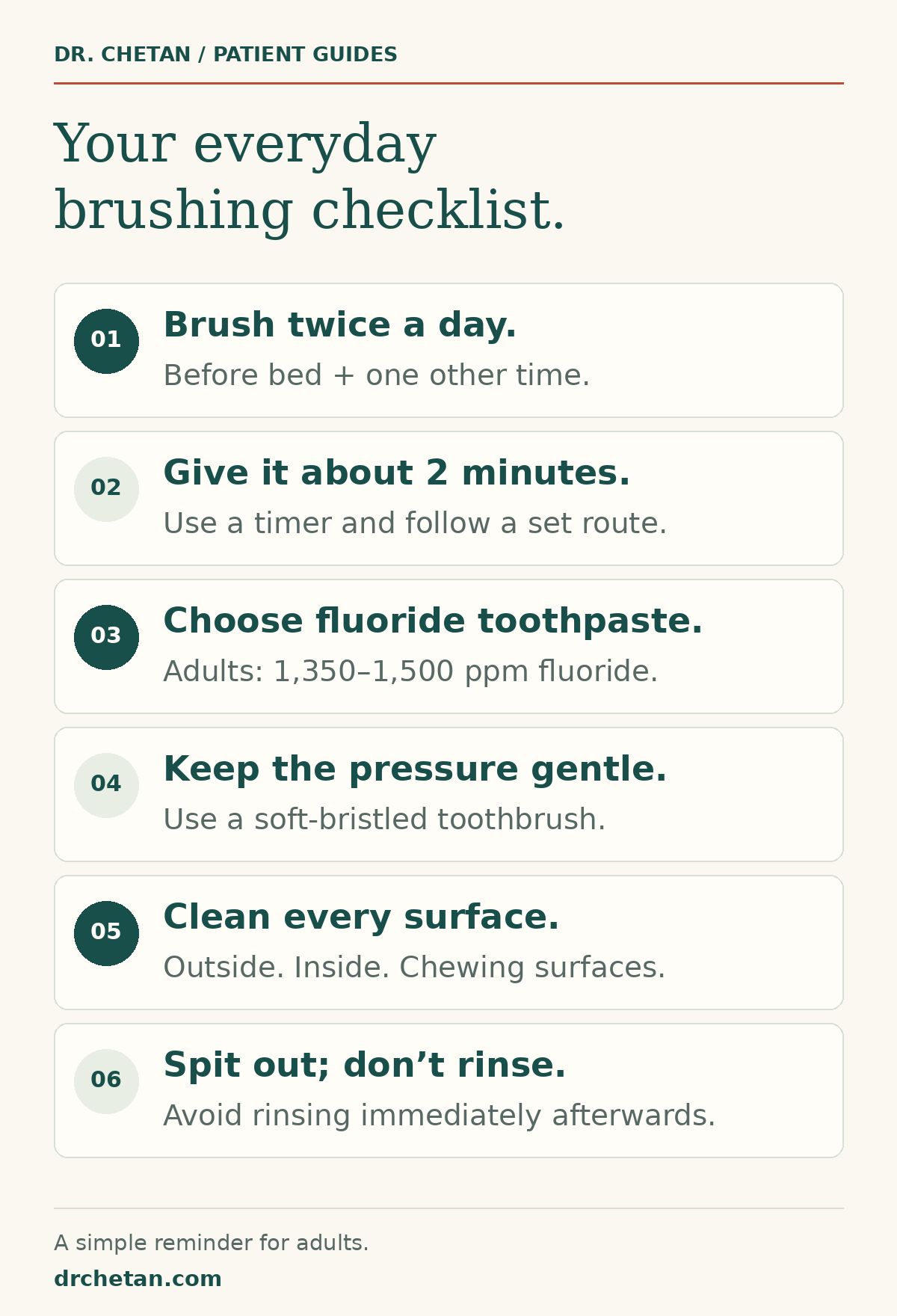
- Brush twice a day for about two minutes each time.
- Make one session the last thing before bed, with another at a convenient time during the day.
- For adults, choose toothpaste containing 1,350–1,500 ppm fluoride unless your dentist recommends otherwise.
- Spit out excess toothpaste after brushing rather than immediately rinsing it away.
The steps below turn those recommendations into a routine you can follow at the bathroom mirror.
Why brushing matters even when no food is stuck
Your toothbrush does more than clear away visible food. Plaque is a film containing bacteria that collects on teeth. It contributes to tooth decay and gum disease, so cleaning needs to cover the teeth consistently, even when your mouth looks clean.
Think about the difference between tidying the middle of a room and cleaning its edges. It is easy to give the most visible areas plenty of attention while repeatedly missing less obvious places. With brushing, those places often include the tongue-facing surfaces and the back of the last tooth.
Choose a brush you can control comfortably
Use a soft-bristled toothbrush with a head that fits your mouth and lets you reach the back teeth. A large head is not automatically more effective: reach and control matter.
Check the toothpaste label for its fluoride concentration. The number may be printed on the back of the tube or carton as “ppm fluoride.” Higher-strength prescribed toothpaste is for people who need it; use it according to your dentist’s instructions.
You do not need an advertising-style ribbon of toothpaste running along the entire brush. A pea-sized amount is used in adult brushing guidance from Kent Community Health NHS Foundation Trust.
How to brush your teeth, step by step
1. Start at the gumline
Place the brush so its bristles point towards the line where the teeth meet the gums, at roughly a 45-degree angle. You do not need to measure the angle precisely. Aim for gentle contact along this margin rather than pushing the bristles forcefully into the gum.
2. Use small, controlled movements
Move the brush gently back and forth in short, tooth-wide strokes. Work along a small area, then move to the next. Avoid broad, vigorous scrubbing across an entire row of teeth.
3. Follow the outside surfaces all the way around
Clean the surfaces facing your cheeks and lips in both jaws. Follow a route you can remember rather than jumping between whichever teeth catch your attention. Include the back teeth.
4. Repeat on the inside surfaces
Clean the surfaces facing your tongue and the roof of your mouth. Behind the front teeth, hold the brush more vertically and use gentle up-and-down strokes.
5. Clean the chewing surfaces
Move onto the biting surfaces of the back teeth. These are separate from the inside and outside surfaces; remember to include them in the same session.
6. Finish by checking your route
Have you covered outside, inside and chewing surfaces in both jaws? Keeping that question in mind is more useful than simply brushing the front teeth for longer.
A simple way to organise two minutes
Here is one practical way to remember your route. Divide your mouth into four sections and allow roughly 30 seconds for each:
| Section | What to include |
|---|---|
| Upper right | Outside, inside and chewing surfaces |
| Upper left | Outside, inside and chewing surfaces |
| Lower left | Outside, inside and chewing surfaces |
| Lower right | Outside, inside and chewing surfaces |
This is a suggested memory aid, not a requirement to follow that exact order. A phone timer can help you learn what two minutes feels like. The purpose is to give every section attention, rather than spend most of the session in one place.
Spit out the toothpaste; do not immediately rinse
When you finish, spit out the excess toothpaste. Avoid immediately swishing with water, which washes away and dilutes the fluoride remaining from the toothpaste.
If you use a fluoride mouthwash, choose another time of day, such as after lunch. Do not use it to wash away toothpaste immediately after brushing. Follow its directions, including advice about waiting before eating or drinking.
The distinction is simple: rinse the toothbrush to clean it, but do not immediately rinse the toothpaste off your teeth.
Brushing does not replace cleaning between teeth
The surfaces between neighbouring teeth need attention too. Clean between your teeth daily using floss or appropriately sized interdental brushes, depending on the spaces and your dentist’s advice.
If this feels awkward, take the cleaning aid to your next appointment and ask for a demonstration. Learning where it should go is often easier with someone showing you in your own mouth.
What if you use an electric toothbrush?
A manual or powered toothbrush can be effective. The key is cleaning all the surfaces, consistently and gently. Some people find a powered brush easier to use.
Do not assume that the manual strokes in this guide should be copied exactly with every electric brush. Follow the instructions supplied with your model and ask your dentist to demonstrate its use. The brushing head still needs to visit all the areas of your mouth; it cannot cover the teeth you skip.
What if your gums bleed when you brush?
Bleeding gums deserve a dental assessment. They can be a sign of gum disease, particularly when accompanied by swelling, soreness or persistent bad breath. Do not dismiss recurring bleeding as something that is simply normal for you.
Continue cleaning gently rather than abandoning oral hygiene, and book an appointment so the cause can be checked. Brushing harder is not the solution.
If a particular tooth hurts when you brush, mention that too. A brushing guide cannot identify the cause of pain in an individual tooth.
Common habits to change
Using force to feel cleaner. Use gentle pressure and soft bristles. Vigorous scrubbing is unnecessary and can damage the gums or tooth surfaces.
Letting the brush become badly worn. Replace it, or the powered-brush head, about every three to four months, and sooner if the bristles become frayed or matted.
Treating two minutes as the only goal. Use the timer alongside a consistent route. Time spent repeatedly brushing the same teeth is time unavailable for the areas you miss.
Sharing a toothbrush. Keep your own brush, even within a family.
Look after the toothbrush too
Rinse it thoroughly after use, store it upright and allow it to air-dry. Avoid routinely enclosing a damp brush in an airtight container. You do not need to microwave it or put it in a dishwasher.
Put a replacement reminder in your calendar, but also look at the bristles. A reminder is helpful only if it does not make you ignore a visibly worn brush.
Questions patients often ask
Do I need an expensive toothbrush?
An expensive brush is not essential. A suitable manual brush can work well; choose one you can use comfortably and thoroughly. A powered brush may be helpful if it makes your routine easier.
Does mouthwash replace brushing?
No. Keep brushing and cleaning between your teeth as the foundation of your routine. If a mouthwash is recommended, use it alongside those habits and at the advised time.
Can I follow this routine for a young child?
Young children need help or supervision, and their toothpaste amounts differ by age. Do not use the adult toothpaste-amount advice in this article as a guide for a toddler. Ask your dentist for age-appropriate instructions.
How can I tell whether my technique needs improvement?
Ask your dentist or hygienist to watch you demonstrate it. Bring your usual brush. A short demonstration can turn advice such as “clean the inside surfaces” into a movement you can actually repeat at home.
Start with one practical change tonight: choose a route through your mouth, use gentle pressure and follow it all the way around.
References
- American Dental Association, MouthHealthy: Brushing Your Teeth.
- American Dental Association: Toothbrushes.
- UK Department of Health and Social Care: Delivering Better Oral Health — summary guidance tables.
- NHS: How to keep your teeth clean.
- Kent Community Health NHS Foundation Trust: Brushing your teeth.
- NHS: Gum disease.
- American Dental Association, MouthHealthy: Toothbrushes.
- University of California, San Francisco, California Childcare Health Program: Toothbrush Care is Important.
- NHS: Children’s teeth.
- NHS: Tooth decay.
- North Tees and Hartlepool NHS Foundation Trust: A Guide to Toothbrushing.
Leave a Reply