
A detailed guide for dental students, covering permanent and primary teeth, chart orientation, notation conversions, common mistakes, and revision questions.
The same tooth can be written as 36 in FDI notation, ?6 in Palmer notation, and #19 in the Universal system. Those identifiers all refer to the permanent mandibular left first molar.
At first, this can feel like learning three unrelated lists. It becomes easier when you recognise that every system answers the same question: which exact tooth are we discussing? The systems simply organise that information differently.
This guide explains the rules before asking you to memorise individual codes. Read the orientation section first, work through each system, and then practise converting a code into a tooth name before translating it into another system.
In this guide:
- What you will learn
- Why dentistry needs tooth numbering systems
- Begin with the patient’s perspective
- Permanent and primary teeth: establish the dentition first
- The three systems at a glance
- 1. FDI tooth numbering system
- 2. Palmer notation system
- 3. Universal tooth numbering system
- How to convert between FDI, Palmer, and Universal
- Mixed dentition: identify each tooth independently
- Eight common mistakes to avoid
- A simple revision method
- Practice questions
- Frequently asked questions
- Final revision checklist
- References and further reading
What you will learn
- How to orient a dental chart using the patient’s right and left.
- How permanent and primary dentitions are represented.
- How FDI, Palmer, and Universal notation identify teeth.
- How to convert between systems without guessing.
- How missing teeth and mixed dentition affect charting.
- How to avoid common examination and record-writing errors.
Why dentistry needs tooth numbering systems
A description such as “the lower molar on the left” is incomplete. It does not distinguish the first, second, or third molar, and it does not explicitly establish whether the tooth is primary or permanent.
A precise tooth name contains several pieces of information: dentition, arch, side, tooth class, and position within that class. For example, “permanent mandibular left first molar” identifies one specific tooth. A notation system compresses that description into a recognisable code.
That is useful in case sheets, radiographic discussions, referrals, examination answers, and communication between dental professionals. However, a code is only clear when the numbering system is known. The number 11 means different teeth in FDI and Universal notation.
For a student learning the systems, writing both the code and the full tooth name is a useful habit: FDI 11 — permanent maxillary right central incisor. You can gradually become faster without sacrificing the underlying meaning.
Begin with the patient’s perspective
Right and left always refer to the patient’s right and left. They do not change because you are standing in front of the patient or looking at a chart.
In a conventional chart drawn as though you are facing the patient, the patient’s right appears on the left side of the page. The patient’s left appears on the right side of the page. Always check orientation labels on an unfamiliar chart rather than assuming that every illustration uses the same view.
The mouth is divided into four quadrants:
| Quadrant | Meaning | Useful abbreviation |
|---|---|---|
| Upper right | Maxillary right | UR |
| Upper left | Maxillary left | UL |
| Lower left | Mandibular left | LL |
| Lower right | Mandibular right | LR |
The midline separates the right and left halves of each arch. When a system counts teeth from the midline, it starts at the central incisor and moves towards the back of the mouth.
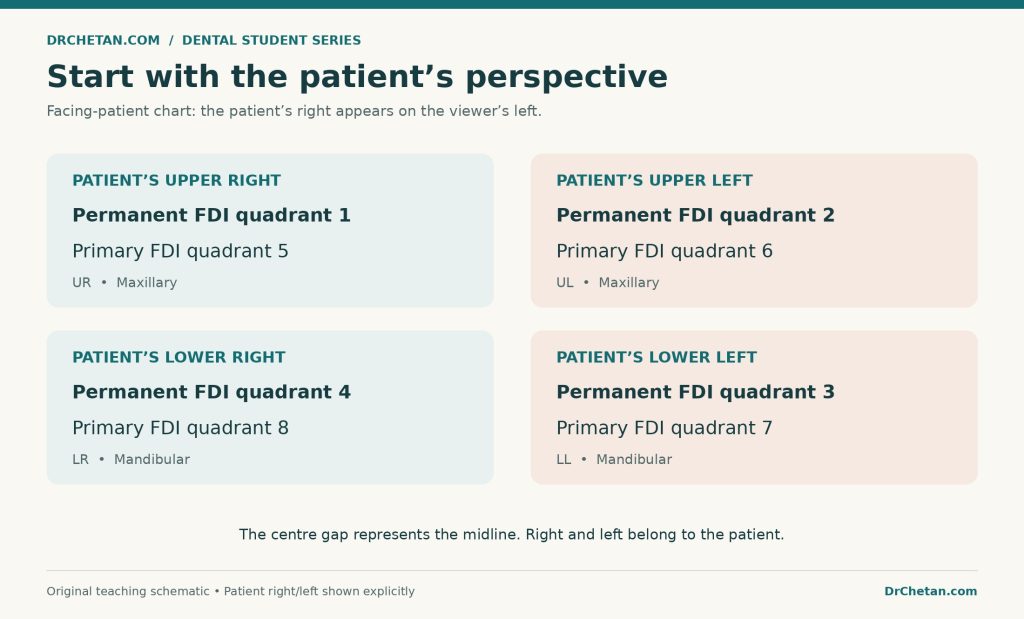
Figure 1. Patient right is on the viewer’s left in this facing-patient schematic. Each box gives the permanent and primary FDI quadrant digits.
Permanent and primary teeth: establish the dentition first
A complete permanent dentition has 32 teeth when all four third molars are included, with eight tooth positions in each quadrant. The sequence from the midline is central incisor, lateral incisor, canine, first premolar, second premolar, first molar, second molar, and third molar.
A complete primary dentition has 20 teeth, with five in each quadrant: central incisor, lateral incisor, canine, first molar, and second molar. Primary teeth are also called deciduous teeth, milk teeth, or baby teeth.
There are no premolars or third molars in the primary dentition. This matters particularly in FDI and Palmer notation: the fourth position represents a permanent first premolar but a primary first molar.
These are complete-dentition reference patterns, not a statement that every patient has every tooth erupted or present. Tooth identity is not determined by counting how many teeth happen to be visible.
The three systems at a glance
| Feature | FDI | Palmer | Universal |
|---|---|---|---|
| Basic method | Quadrant digit plus tooth-position digit | Tooth-position number or letter plus quadrant bracket | Continuous sequence around the arches |
| Permanent teeth | Quadrants 1–4; positions 1–8 | Numbers 1–8 in each quadrant | Numbers 1–32 |
| Primary teeth | Quadrants 5–8; positions 1–5 | Letters A–E in each quadrant | Letters A–T |
| What identifies the quadrant? | First digit | Bracket orientation | Position in the overall sequence |
| Example: permanent lower left first molar | 36 | ?6 | #19 |
The Universal system is commonly used in the United States. FDI is the two-digit approach associated with ISO 3950. Palmer identifies the quadrant visually through a bracket. Learn the system required by your department while being able to recognise all three. [1–3]
1. FDI tooth numbering system
FDI notation uses two digits with separate jobs:
- The first digit identifies the quadrant and distinguishes permanent from primary dentition.
- The second digit identifies the tooth’s position from the midline within that quadrant.
Think of the digits as an address: first choose the correct part of the mouth, then choose the position within it. Do not treat the code as one continuous count from tooth 1 onwards.
Permanent FDI quadrant digits
| First digit | Permanent quadrant |
|---|---|
| 1 | Upper right |
| 2 | Upper left |
| 3 | Lower left |
| 4 | Lower right |
Permanent FDI tooth-position digits
| Second digit | Permanent tooth counted from the midline |
|---|---|
| 1 | Central incisor |
| 2 | Lateral incisor |
| 3 | Canine |
| 4 | First premolar |
| 5 | Second premolar |
| 6 | First molar |
| 7 | Second molar |
| 8 | Third molar |
How to decode a permanent FDI tooth
Consider 24. The first digit, 2, means the permanent upper left quadrant. The second digit, 4, means the first premolar. Therefore, FDI 24 is the permanent maxillary left first premolar.
Now try 46. The first digit, 4, identifies the permanent lower right quadrant. The second digit, 6, identifies the first molar. FDI 46 is the permanent mandibular right first molar.
The reverse process is equally useful. To write the permanent upper right canine, first select quadrant 1 and then position 3: 13.
For revision, notice the four permanent first molars: 16, 26, 36, and 46. They share the same second digit because they have the same position within their respective quadrants.
Primary FDI quadrant digits
Primary quadrants follow the same order of sides and arches, but the first digits are 5, 6, 7, and 8.
| First digit | Primary quadrant |
|---|---|
| 5 | Upper right |
| 6 | Upper left |
| 7 | Lower left |
| 8 | Lower right |
The second digit runs from 1 to 5:
| Second digit | Primary tooth counted from the midline |
|---|---|
| 1 | Central incisor |
| 2 | Lateral incisor |
| 3 | Canine |
| 4 | First molar |
| 5 | Second molar |
For example, 55 is the primary upper right second molar; 61 is the primary upper left central incisor; 74 is the primary lower left first molar; and 83 is the primary lower right canine.
Compare 14 with 54. Both belong to the upper right side, and both end in 4. However, 14 is a permanent first premolar, whereas 54 is a primary first molar. The dentition changes the tooth classes present in that quadrant.
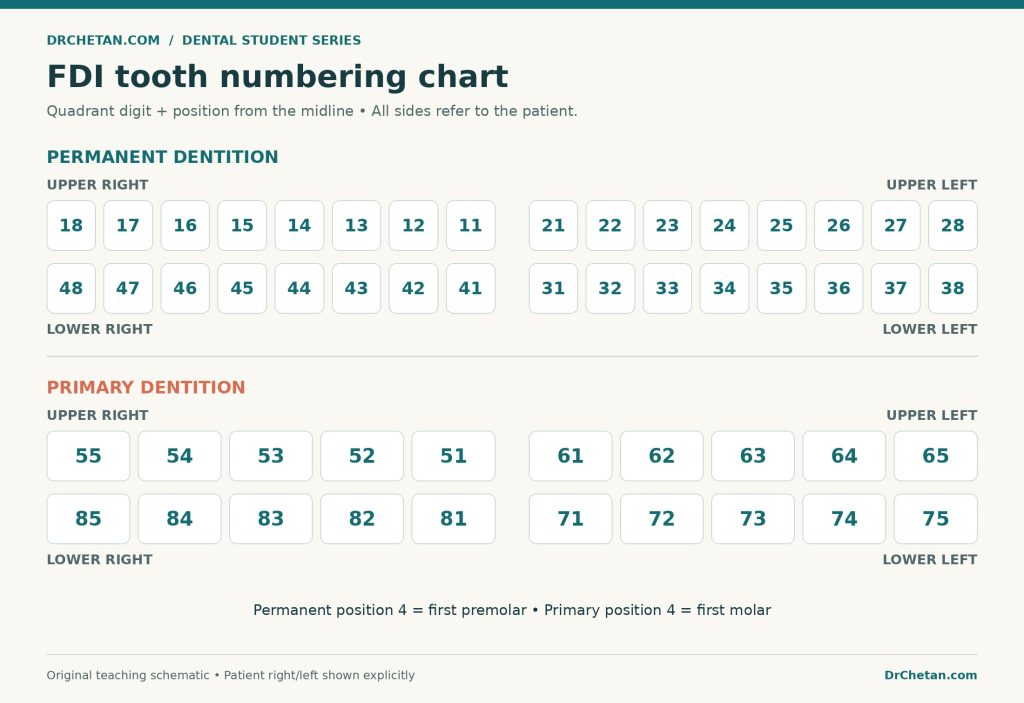
Figure 2. FDI codes for the standard permanent and primary dentitions. The centre gap marks the midline; the lower row is not read as a continuous numerical sequence.
How should FDI numbers be spoken?
Read the digits separately: 16 is “one-six,” 24 is “two-four,” and 85 is “eight-five.” This keeps the quadrant and position apparent. In teaching and communication, also state “FDI” whenever the system could be unclear.
For example, FDI 11 is the permanent upper right central incisor. Universal #11 is the permanent upper left canine. Reading the system label matters more than assuming that everyone interprets a bare number identically.
Quick validity check for FDI tooth codes
For the standard individual teeth covered here, a permanent code has a first digit from 1 to 4 and a second digit from 1 to 8. A primary code has a first digit from 5 to 8 and a second digit from 1 to 5.
Therefore, 19 does not identify a standard permanent tooth: position 9 is not part of that quadrant. 56 is not a standard primary tooth code: there is no sixth primary tooth position. Codes for oral regions or special coding situations are outside this introductory tooth chart.
2. Palmer notation system
Palmer notation also counts outward from the midline. Its distinguishing feature is the quadrant bracket. The tooth-position number or letter identifies which tooth within the quadrant; the bracket identifies where the quadrant is located. [2]
For permanent teeth, Palmer uses 1–8 with the same positional sequence used by the second digit of permanent FDI codes. A permanent first molar is position 6 in every quadrant, but 6 alone is incomplete because it could refer to four different teeth.
Palmer quadrant brackets
| Patient’s quadrant | Bracket | Example using the permanent first molar | Full tooth name |
|---|---|---|---|
| Upper right | ? | 6? | Permanent maxillary right first molar |
| Upper left | ? | ?6 | Permanent maxillary left first molar |
| Lower right | ? | 6? | Permanent mandibular right first molar |
| Lower left | ? | ?6 | Permanent mandibular left first molar |
To understand the brackets, imagine the horizontal and vertical dividing lines on a facing-patient chart. The corner encloses the tooth’s quadrant. Upper-quadrant brackets have their horizontal line below the number; lower-quadrant brackets have it above. The vertical line sits towards the midline.
For the patient’s right side, the bracket is to the right of the tooth number in this notation. For the patient’s left side, it is to the left. Practise the four first-molar examples together rather than memorising a bracket without a tooth.
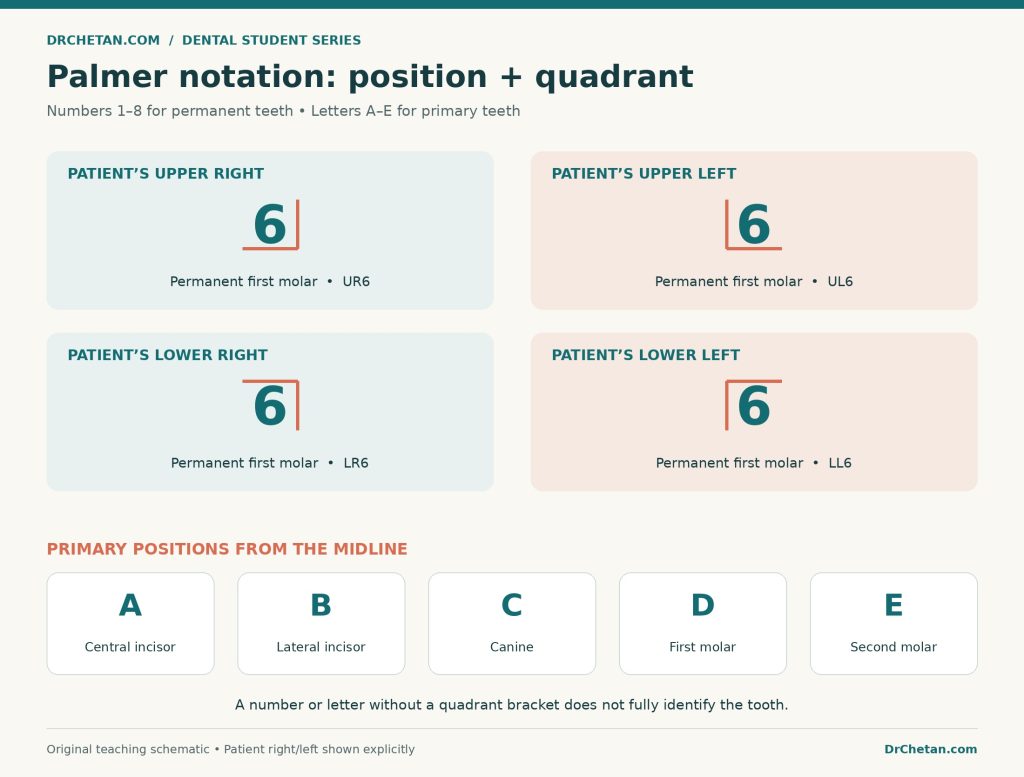
Figure 3. Palmer notation requires both the tooth position and the quadrant bracket. Primary letters restart from A at the midline in every quadrant.
Primary teeth in Palmer notation
Primary Palmer notation uses A–E within each quadrant:
| Letter | Primary tooth |
|---|---|
| A | Central incisor |
| B | Lateral incisor |
| C | Canine |
| D | First molar |
| E | Second molar |
The bracket is still required. E? identifies the primary upper right second molar. ?A identifies the primary upper left central incisor. ?D identifies the primary lower left first molar.
Do not transfer the meaning of a Universal letter directly into Palmer. Universal A means the primary upper right second molar, whereas Palmer A with its quadrant bracket means a primary central incisor in the specified quadrant.
What about UR6, UL6, LR6, and LL6?
These are useful alphanumeric quadrant-and-position shorthand. For example, UR6 means the permanent upper right first molar, and LLE means the primary lower left second molar when that shorthand convention is being used.
This is a convenient way to convey the same location when a plain-text system cannot display a Palmer bracket reliably. However, it is not the graphical bracket itself. If an examination specifically requests Palmer notation, practise writing the appropriate bracket clearly.
3. Universal tooth numbering system
The Universal system assigns a unique number to each standard permanent tooth position. Instead of restarting at the midline in every quadrant, it follows a continuous route around both arches.
For permanent teeth, the route is:
- Start at the patient’s upper right third molar: #1.
- Continue along the upper arch to the upper left third molar: #16.
- Move to the lower left third molar: #17.
- Continue along the lower arch to the lower right third molar: #32.
The four corner teeth—1, 16, 17, and 32—are useful anchors. Remember them first, then use the direction of counting to locate other teeth.
Permanent Universal landmarks worth learning
| Tooth group | Universal numbers |
|---|---|
| Upper central incisors | #8 upper right; #9 upper left |
| Lower central incisors | #24 lower left; #25 lower right |
| First molars | #3 upper right; #14 upper left; #19 lower left; #30 lower right |
| Third molars | #1 upper right; #16 upper left; #17 lower left; #32 lower right |
For example, #8 is the permanent maxillary right central incisor. Immediately across the midline is #9, the permanent maxillary left central incisor. In the lower arch, #24 and #25 meet across the midline.
The # symbol is commonly used when writing Universal permanent tooth numbers. Still, an explicit system label is preferable whenever a document or conversation could involve more than one notation.
Primary teeth in the Universal system
For primary teeth, Universal notation uses A–T as one continuous sequence, rather than repeating A–E in each quadrant. [3,4]
- A is the primary upper right second molar.
- The sequence continues across the upper arch to J, the primary upper left second molar.
- K is the primary lower left second molar.
- The lower sequence continues to T, the primary lower right second molar.
The primary central incisors are E and F in the upper arch, and O and P in the lower arch. These are letters; take care not to confuse the letter O with zero when reading or typing a record.
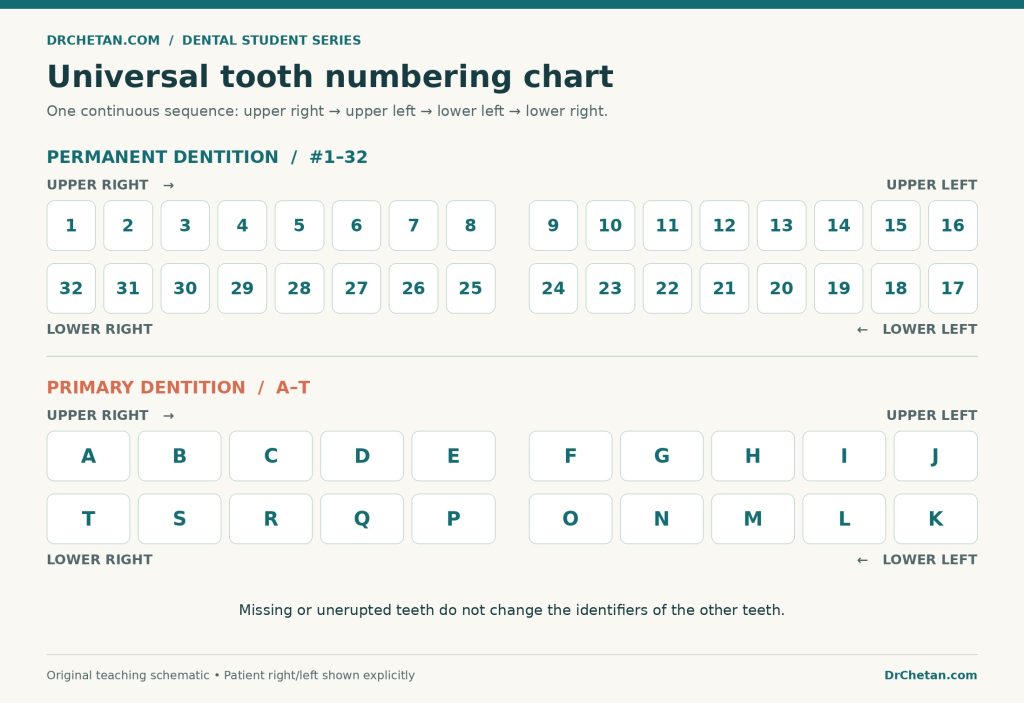
Figure 4. Follow the arrows to understand the Universal sequence. The lower row appears in reverse numerical or alphabetical order from left to right on this facing-patient chart.
What happens if a tooth is missing?
The remaining teeth keep their identities. Do not move every subsequent Universal number forward because a third molar is absent, a tooth has been extracted, or a tooth has not erupted.
For example, the upper right second molar remains #2 even if the upper right third molar, #1, is not present. Record presence, absence, eruption status, and relevant findings separately according to the charting convention in use. Numbering describes the tooth’s identity, not its order among the teeth visible today.
How to convert between FDI, Palmer, and Universal
The most dependable learning method is code ? full tooth name ? new code.
Do not begin with a universal arithmetic shortcut. Permanent and primary sequences differ, and the position meaning changes with the dentition. Naming the tooth provides a bridge that makes mistakes easier to recognise.
Worked example 1: FDI 46 to Palmer and Universal
- FDI quadrant 4 means permanent lower right.
- Position 6 means first molar.
- Full identity: permanent mandibular right first molar.
- Palmer: 6?.
- Universal: #30.
Worked example 2: Universal #14 to FDI and Palmer
- Locate #14 in the upper arch: permanent upper left first molar.
- FDI uses quadrant 2 and position 6: 26.
- Palmer uses upper left bracket with position 6: ?6.
Worked example 3: Universal K to FDI and Palmer
- K is the primary lower left second molar.
- Primary lower left is FDI quadrant 7, and the primary second molar is position 5: 75.
- In primary Palmer notation, a second molar is E; the lower left bracket gives ?E.
Worked example 4: Palmer 4? to FDI and Universal
- The upper right bracket identifies the quadrant.
- The number 4 identifies the permanent first premolar.
- Full identity: permanent maxillary right first premolar.
- FDI: 14. Universal: #5.
Useful conversion examples
| Full tooth identity | FDI | Palmer | Universal |
|---|---|---|---|
| Permanent upper right central incisor | 11 | 1? | #8 |
| Permanent upper left canine | 23 | ?3 | #11 |
| Permanent upper left first premolar | 24 | ?4 | #12 |
| Permanent upper right first molar | 16 | 6? | #3 |
| Permanent upper left first molar | 26 | ?6 | #14 |
| Permanent lower left first molar | 36 | ?6 | #19 |
| Permanent lower right first molar | 46 | 6? | #30 |
| Permanent lower right third molar | 48 | 8? | #32 |
| Primary upper right central incisor | 51 | A? | E |
| Primary upper right second molar | 55 | E? | A |
| Primary lower left second molar | 75 | ?E | K |
| Primary lower right second molar | 85 | E? | T |
Mixed dentition: identify each tooth independently
In mixed dentition, primary and permanent teeth are present together. Each tooth retains the notation appropriate to its own identity. Do not try to number the entire mouth using only the primary pattern or only the permanent pattern.
For example, a primary lower right second molar and a permanent lower right first molar can be present in the same quadrant. Their FDI codes are 85 and 46, respectively. Their Universal identifiers are T and #30. Their Palmer identifiers are E? and 6?.
This example is useful because the teeth are neighbours in the arch but belong to different dentitions. The change from a primary quadrant code to a permanent quadrant code is intentional.
If a patient has additional teeth, unusual anatomy, or an uncertain tooth identity, do not invent an extension to a basic chart. Supernumerary and other special documentation conventions need separate attention. This guide’s reference charts cover the standard 32 permanent and 20 primary tooth positions.
Eight common mistakes to avoid
- Using the viewer’s right and left. Begin with the patient’s perspective and check the diagram’s orientation.
- Writing a number without establishing the system. FDI 11 and Universal #11 identify different teeth.
- Treating FDI as one long numerical sequence. Decode the quadrant and position separately.
- Leaving the bracket out of Palmer notation. A position such as 6 does not establish a quadrant.
- Assuming Palmer A equals Universal A. Their primary-letter rules are different.
- Calling a primary position-4 tooth a premolar. Primary fourth and fifth positions are molars.
- Renumbering after a tooth is missing. Identity does not shift with the number of teeth present.
- Using the permanent FDI quadrant digit for a primary tooth. Primary upper left is quadrant 6, not quadrant 2.
A simple revision method
Begin with one tooth position in all four quadrants. The permanent first molars work well: FDI 16, 26, 36, and 46; Palmer 6?, ?6, ?6, and 6?; Universal #3, #14, #19, and #30.
Then practise the primary second molars: FDI 55, 65, 75, and 85; Palmer E?, ?E, ?E, and E?; Universal A, J, K, and T. Keep the quadrant order consistent while you practise.
Next, move inward from these familiar anchors. Say the full tooth name before writing a new code. When an answer is wrong, identify whether the error came from the dentition, arch, side, tooth class, or position. That tells you exactly what to revise.
Finally, practise in both directions. Recognising that 36 is a lower left first molar is one skill; producing 36 when given the full tooth name is another. Written recall helps you test both.
Practice questions
Answer before checking the explanations. Wherever a question asks for a tooth name, include whether it is primary or permanent.
| No. | Question |
|---|---|
| 1 | Which tooth is FDI 13? |
| 2 | Which tooth is FDI 37? |
| 3 | Which tooth is FDI 64? |
| 4 | Write the FDI code for the primary lower right central incisor. |
| 5 | Which tooth is Universal #9? |
| 6 | Which tooth is Universal #19? |
| 7 | Which tooth is Universal K? |
| 8 | Write the Palmer notation for the permanent upper left first premolar. |
| 9 | Which tooth is Palmer E?? |
| 10 | Convert FDI 26 to Universal notation. |
| 11 | Convert Universal #30 to FDI and Palmer notation. |
| 12 | Convert Universal A to FDI and Palmer notation. |
| 13 | Why is FDI 56 not a standard primary tooth code? |
| 14 | If Universal #1 is absent, does the upper right second molar become #1? |
| 15 | Do FDI 11 and Universal #11 identify the same tooth? |
Answers with explanations
- Permanent maxillary right canine. Quadrant 1 is permanent upper right; position 3 is the canine.
- Permanent mandibular left second molar. Quadrant 3 is permanent lower left; position 7 is the second molar.
- Primary maxillary left first molar. Quadrant 6 is primary upper left; primary position 4 is the first molar.
- 81. Primary lower right is quadrant 8; the central incisor is position 1.
- Permanent maxillary left central incisor. Universal #8 and #9 are the upper central incisors on the right and left, respectively.
- Permanent mandibular left first molar. Its FDI code is 36 and its Palmer notation is ?6.
- Primary mandibular left second molar. Universal’s lower primary sequence begins at K on the patient’s left.
- ?4. The bracket identifies upper left and 4 identifies the permanent first premolar.
- Primary mandibular right second molar. E is the primary second molar; the bracket identifies lower right.
- #14. FDI 26 is the permanent upper left first molar.
- FDI 46; Palmer 6?. All three identify the permanent lower right first molar.
- FDI 55; Palmer E?. Universal A is the primary upper right second molar.
- There is no primary sixth tooth position. The first digit selects a primary quadrant, whose second-digit positions stop at 5.
- No. It remains #2. A missing tooth does not change the identities of other teeth.
- No. FDI 11 is the permanent upper right central incisor; Universal #11 is the permanent upper left canine.
Frequently asked questions
Which tooth numbering system should a BDS student learn first?
Begin with the system used by your department so that your practical records and teaching discussions are consistent. Then compare it with the other two. FDI is a useful starting framework because the two digits explicitly separate the quadrant from the tooth position, and that positional sequence helps when learning Palmer.
Does Palmer use numbers or letters for primary teeth?
In the primary Palmer convention covered here, it uses A–E with a quadrant bracket. The letters restart in each quadrant. Universal primary notation uses the longer A–T sequence around the arches.
Why is FDI 85 a molar rather than a premolar?
The first digit, 8, identifies a primary quadrant. Primary dentition has no premolars. Its fifth tooth position is the second molar, so 85 identifies the primary lower right second molar.
Can I identify the correct tooth from an unlabeled number alone?
Not reliably when more than one system could apply. Ask which notation is being used, or look for an explicit system key. A complete tooth name can resolve the ambiguity.
Do missing or unerupted teeth change the numbering?
No. Keep the tooth’s standard identity and record its status separately. A numbering chart is an identity map, not a list that closes its gaps whenever a tooth is absent.
Final revision checklist
Before accepting your answer, check dentition ? arch ? patient’s side ? tooth position ? notation system.
FDI combines a quadrant digit with a position digit. Palmer combines a position number or letter with a quadrant bracket. Universal follows a continuous permanent-number or primary-letter sequence. Once you can explain the tooth’s full identity, the code becomes much easier to understand and remember.
References and further reading
- International Organization for Standardization. ISO 3950:2016 — Dentistry — Designation system for teeth and areas of the oral cavity. Standard overview.
- Independent Health and Aged Care Pricing Authority. ICD-10-AM/ACHI/ACS Clinical updates, dental notation section, printed pages 13–15. Educational reference PDF. Used for notation conventions, not as current clinical coding instructions.
- American Dental Association. Universal Tooth Designation System Value Set, July 2024. Tooth-by-tooth mapping PDF.
- HL7 Terminology, code system responsible organisation: American Dental Association. ADA Universal Tooth Designation System.
Related reading on DrChetan.com: Tooth anatomy and its parts and What are deciduous teeth?. These older articles provide background; this guide supplies the notation explanation and new charts.
Leave a Reply