
A crown replaces one visible tooth. A bridge replaces a span of teeth with connected units. Either can be fixed to dental implants, but they place different demands on the bone, the bite and your daily cleaning. If you’re comparing two treatment quotes, first find out which part of the plan each quote describes.
A crown for one missing tooth
With a single implant crown, one fixture in the bone supports a replacement tooth. In a suitable site, the neighbouring teeth can usually be left unprepared. They still matter. The dentist needs enough distance from the nearby roots, a workable bite and a contact between the new crown and adjacent tooth that limits food trapping while allowing cleaning. A front tooth also needs planning for the gum shape and appearance when you smile.
A crown may be attached with a screw or cemented onto an abutment. With a screw-retained design, the small access opening is sealed after fitting. A cemented design has different shape and access considerations, and the team should manage excess cement around the gum. Ask why the recommended attachment suits your site and how a dentist would access the parts if anything loosened.
A bridge for several neighbouring missing teeth
An implant-supported bridge joins multiple replacement teeth together. A replacement tooth in the span without its own support directly beneath it is called a pontic. For example, a three-tooth span might be supported by an implant at each end, with the middle tooth attached to the bridge. That example illustrates the concept. The number and position of implants in your plan depend on bone, gap length, the available space, opposing teeth and expected bite forces.
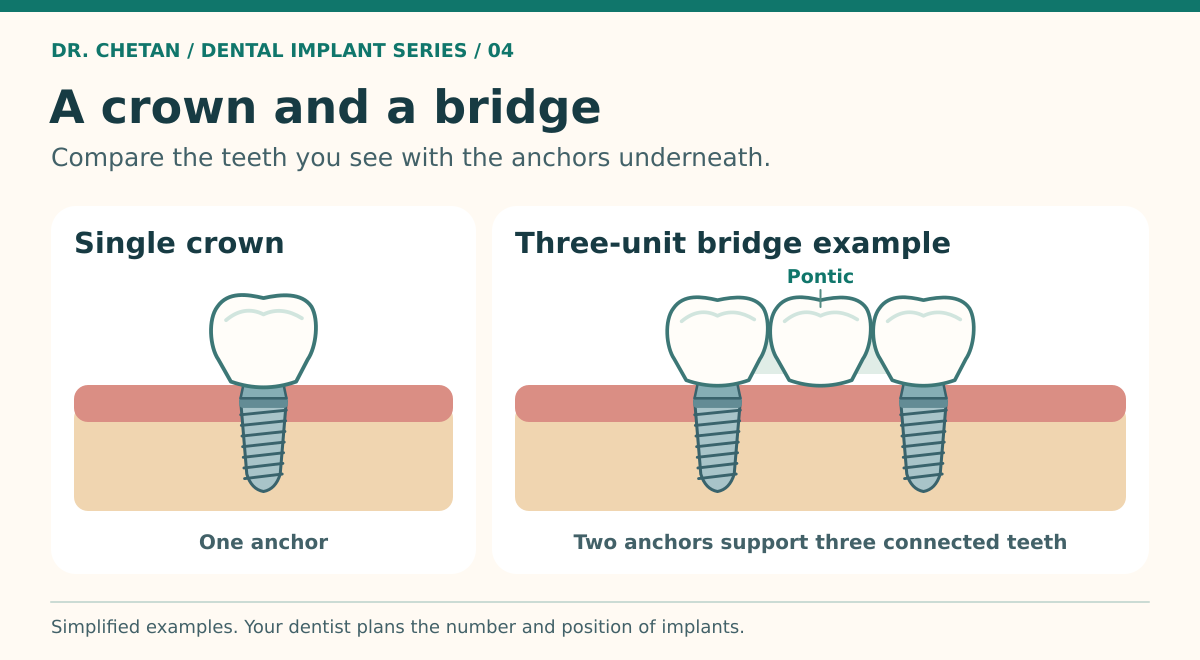
Ask the team to show you both the locations of the fixtures and the number of visible teeth being replaced. Where there is more than one gap with natural teeth between, separate restorations may make more sense than connecting everything. Even when multiple individual crowns are possible, a bridge may be chosen for a specific reason, such as the space available for safe placement. Ask how the proposed design affects future repairs.
What if I prefer to avoid surgery?
| Option | How it is held | What to discuss |
|---|---|---|
| Implant crown | One fixture supports the crown | Surgery, the temporary tooth and access around the gum |
| Implant-supported bridge | Fixtures support connected replacement teeth | Cleaning under the span and repair if one support has a problem |
| Tooth-supported bridge | Natural teeth provide support | The condition of the supporting teeth and how much preparation the design requires |
| Removable partial denture | Teeth, gums or both help support it, depending on the design | Fit, stability, taking it out and cleaning it separately |
A conventional tooth-supported bridge may be reasonable if its supporting teeth already need crowns. For certain small gaps, a resin-bonded bridge can sometimes use less preparation. A removable partial denture can be considered when several separated areas need replacement or when surgery is unsuitable. Ask your dentist to explain what each option would require from the remaining teeth over time.
Try the cleaning method before you commit
Around a single crown, the aim is to clean the gumline and both sides of the crown. For a bridge, the underside also needs attention. A small interdental brush or floss designed to thread under a bridge may help if the team chooses a size and method that fit. A bridge that is hard to reach can be hard to keep clean for years. Ask your dentist or hygienist to show you where the brush should pass and let you try it.
Contact the dentist if the restoration starts moving, if you develop pain when you bite, or if the same spot repeatedly bleeds or traps food. These symptoms have several possible causes. Finding the cause early may make a repair or adjustment simpler. See implant lifespan and long-term care for the difference between a restoration problem and a problem in the supporting tissues.
How to compare written estimates
Check whether the estimate includes assessment, imaging, fixture placement, abutment, temporary replacement, final restoration and review visits. Ask how it changes if you need a graft or if more than one site is treated. If you grind or clench your teeth, discuss whether that affects the design and whether a protective appliance is advised. For an entire jaw, read the separate guide to fixed full-arch teeth and implant dentures. To see where the crown or bridge is fitted in a course of treatment, follow the implant procedure and timeline.

Leave a Reply