
Two people can have the same missing tooth and be offered different plans. One may have room to place an implant once the gap is assessed. The other may need gum treatment, a graft or a different way to replace the tooth. Suitability comes from looking at your mouth, medical history and goals together.
If the tooth is still in place, start by asking whether it can be kept. Its outlook depends on the amount of healthy tooth and bone left, whether gum or root canal problems can be treated, and whether the tooth can be restored. Ask what keeping it would involve and how its outlook compares with the options after extraction.
What the assessment covers
| What the team checks | Why it matters |
|---|---|
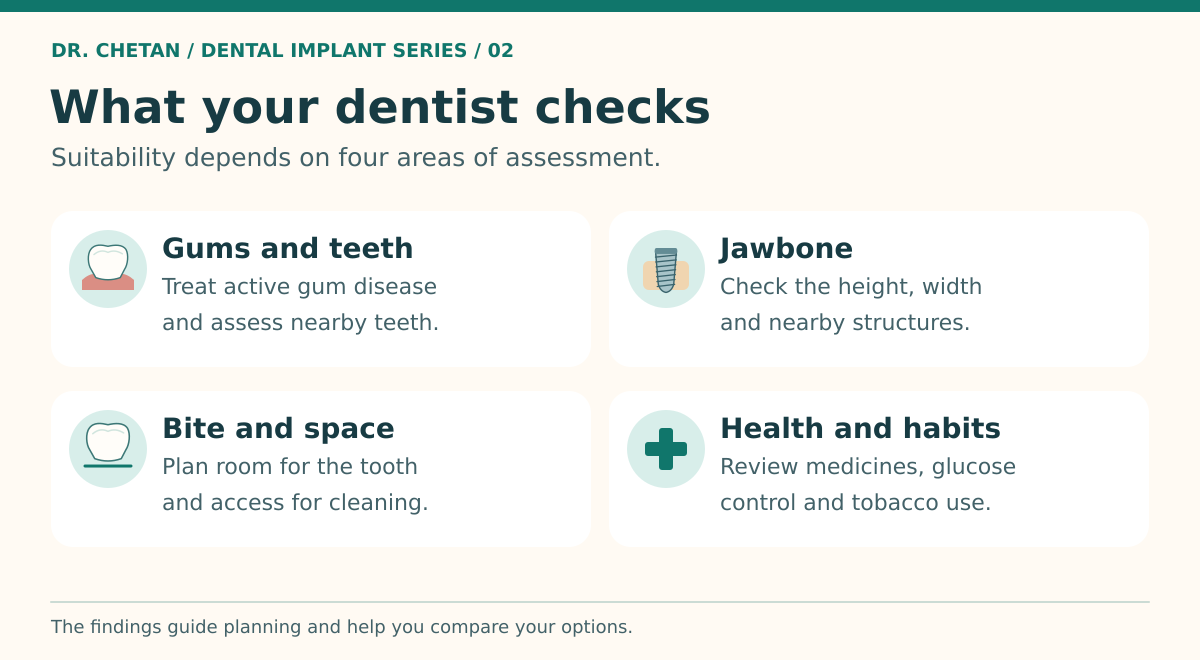
| Gums and remaining teeth | Active disease needs attention. A history of gum disease can call for closer maintenance even after treatment. |
| Bone and nearby anatomy | Height, width and shape affect the implant’s position and its distance from roots, nerves or the sinus. |
| Bite, space and smile | The final tooth needs room, a shape you can clean and a position that works with the opposite teeth. |
| Health, medicines and habits | These can affect healing, bleeding, infection risk or the best time to operate. |
A consultation usually starts with questions, examination and dental X-rays. A three-dimensional scan may help when the team needs more detail about bone or the location of a nerve or sinus. Photographs or a scan of your teeth may help plan the visible restoration. For a front tooth, ask whether the gum outline and the appearance of the temporary tooth are predictable in your case.
Gum disease, smoking and diabetes
If your gums are bleeding or you have active periodontitis, the first step may be to control inflammation and establish a cleaning routine you can maintain. Placing an implant does not remove the factors that contributed to gum disease. Ask how the team will assess that your gums are stable and what follow-up will look like after the new tooth is fitted.
Smoking is linked to poorer healing and a higher risk of implant problems. Tell the team how much you smoke and whether you use other tobacco products. If you’re considering quitting, ask how support can be built into your treatment plan. The team can explain how your habits affect their recommendation and when they would reassess it.
Diabetes calls for an individual assessment. Your dentist may ask about your usual glucose control, recent HbA1c results if available, medication and whether you have complications. If control is poor, the team may advise working with your treating clinician before elective surgery. A medical diagnosis alone rarely explains the entire decision.
Health information to bring
Bring a current list of prescribed and non-prescribed medicines. Highlight blood thinners and medicines used for osteoporosis or cancer that affect bone, such as bisphosphonates or denosumab. Tell the team about head and neck radiotherapy, previous implant problems and relevant medical conditions. Some histories warrant advice from a specialist or your medical team. Ask who will coordinate the plan and keep taking prescribed medicines unless your treating clinicians give you a specific change.
Implants in young patients generally require assessment of whether jaw growth has finished. In adults, age is one factor alongside general health, ability to clean and access to follow-up. If cleaning by hand is difficult, ask to handle an example of the proposed restoration and its cleaning tools before committing. Your dentist may be able to plan larger cleaning spaces or discuss a removable option.
If there is too little bone
Bone can change after a tooth is lost. The question is whether enough bone remains where the replacement tooth needs its support. Sometimes a small graft can be done with implant placement. A larger graft may need a separate healing stage. In other cases, a different implant plan or a bridge or denture can meet the goal. The guide to bone grafts and sinus lifts explains what these decisions mean for your visits.
What to ask before you decide
- Which findings on my exam or scan most affect my options?
- What should be treated or stabilised before surgery, and how will we check that?
- What could I wear or use while the area heals?
- Can you show me how I would clean the proposed tooth or denture?
- What does the written estimate cover, including scans, the temporary tooth and the final replacement?
Ask for the options in writing if you need time to decide. You can use the implant procedure and timeline to check where each visit fits, and the long-term care guide to discuss what happens after the final fitting.
References
- U.S. Food and Drug Administration. Dental implants, benefits and risks
- Leeds Teaching Hospitals NHS Trust. Dental implants patient information
- European Federation of Periodontology. Dental implants for patients
- European Federation of Periodontology. Guideline on prevention and treatment of peri-implant diseases

Leave a Reply