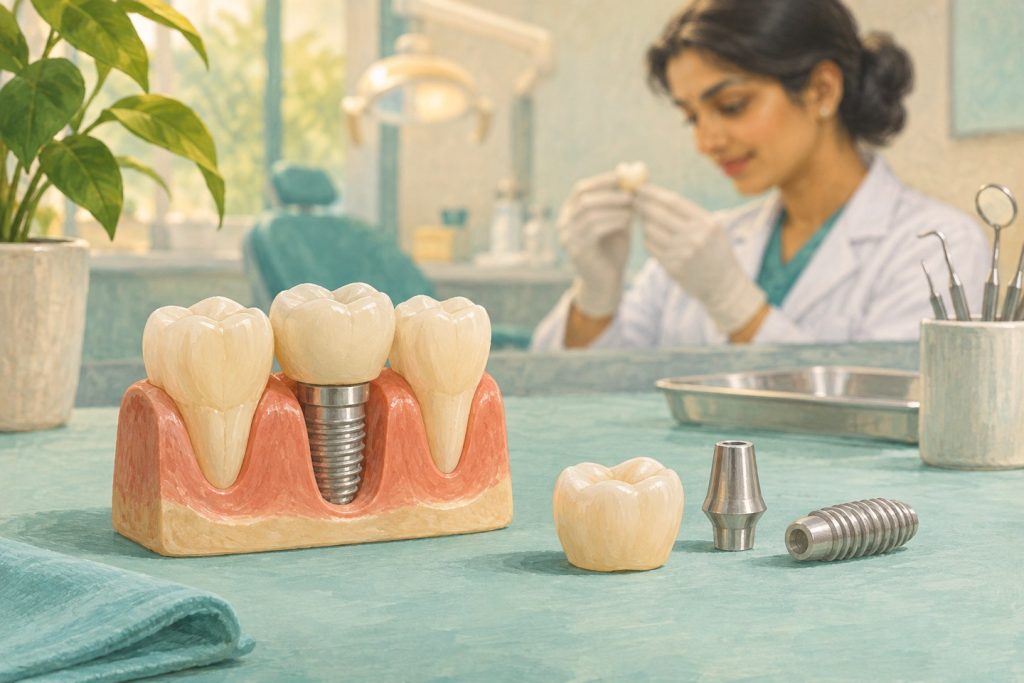
Two clinics might describe a plan as “same-day implants” and mean different things. One might place the implant at the extraction visit. The other might attach a temporary tooth at the implant visit. Either approach can be appropriate in selected circumstances. To compare plans, ask what will happen to the root space, the implant and the visible tooth at each visit.
Implant material and size
Most commonly used dental implants go into the jawbone. Titanium and titanium alloys are widely used and have a long clinical track record. Zirconia is a tooth-coloured ceramic and is also used for some implant fixtures. Research directly comparing the two is more limited for zirconia, particularly over long follow-up and across different systems. Ask why the proposed system is suitable at your site, what evidence supports it and whether replacement components will be available.
A zirconia crown and a zirconia implant describe different parts. A tooth-coloured zirconia crown can be fitted over a titanium implant. If material matters to you, ask the team to list the material of the fixture, connector and crown separately. The illustrated guide to implant parts can help you follow the discussion.
Implants come in different lengths and widths. A narrower implant may fit in selected small spaces. A shorter implant may be considered where vertical bone height is limited. A different dimension also changes the mechanical and anatomical trade-offs. The planned crown, bone, bite and evidence for the specific use matter more than choosing a size from a catalogue.
The two timing decisions
| Decision | What “immediate” can mean | What can make the team wait |
|---|---|---|
| Placement | The fixture goes into the extraction site at the same visit as tooth removal. | The socket or tissues need to heal, bone needs to be rebuilt, or the implant cannot be positioned safely and stably. |
| Restoration or loading | A restoration is connected within about a week in ITI terminology, sometimes on the surgery day. Its contact with the opposing teeth is planned separately. | The implant needs more time to gain support, or a graft, bite or other finding favours a protected healing period. |
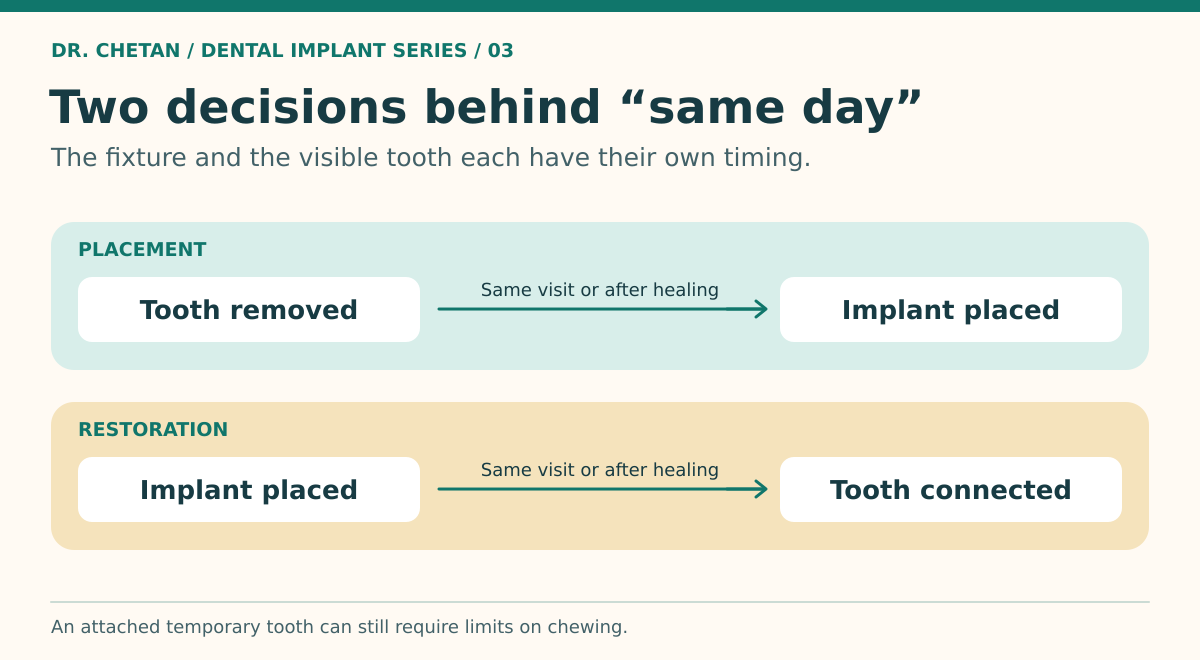
A front tooth can be removed and an implant placed that day, while the temporary tooth is supported by another part of the mouth. Someone with a gap that has been healed for months may instead have the implant and an attached temporary crown fitted during the same visit. Both examples can sound like “same day” in a brochure. Only the second describes an immediate implant-supported restoration. When a temporary tooth is connected but deliberately kept clear of biting contact, your dentist may call it immediate restoration rather than immediate loading.
An immediate temporary restoration may be designed primarily for appearance, with limits on where and what you chew. With a full arch, an early fixed set can also be a provisional that will be replaced after healing. See how fixed full-arch teeth and overdentures differ if you are considering a whole jaw.
What “one stage” and “two stage” mean
In one-stage healing, a small healing component usually extends through the gum while the implant heals. In two-stage healing, the gum covers the implant. A later minor procedure exposes it so a healing connector can be fitted. These descriptions tell you how the gum and implant are managed during healing. A one-stage implant can still need several months before it supports the final tooth.
The choice depends on factors such as stability at placement, whether a graft needs protection, and the planned restoration. You may see a small metal cap at the gum without having a tooth attached yet. If your temporary is removable, have the fit checked so it does not press on the surgical area.
The four questions behind a same-day quote
- Will my existing tooth be removed and the implant placed at the same visit?
- Will I leave with a temporary tooth? What holds it in place, and can I chew with it?
- What is the backup plan if the implant is less stable than expected on the day?
- How many visits are planned before the final restoration, and what is included in the fee?
Ask which of those dates are estimates and what would change them. The procedure and timeline guide shows how the pieces fit together from consultation to final fitting.
References
- U.S. Food and Drug Administration. Dental implants, benefits and risks
- International Team for Implantology. Consensus on implant placement and loading protocols
- 2024 systematic review of trials comparing zirconia and titanium implant fixtures
- Leeds Teaching Hospitals NHS Trust. Dental implants patient information

Leave a Reply