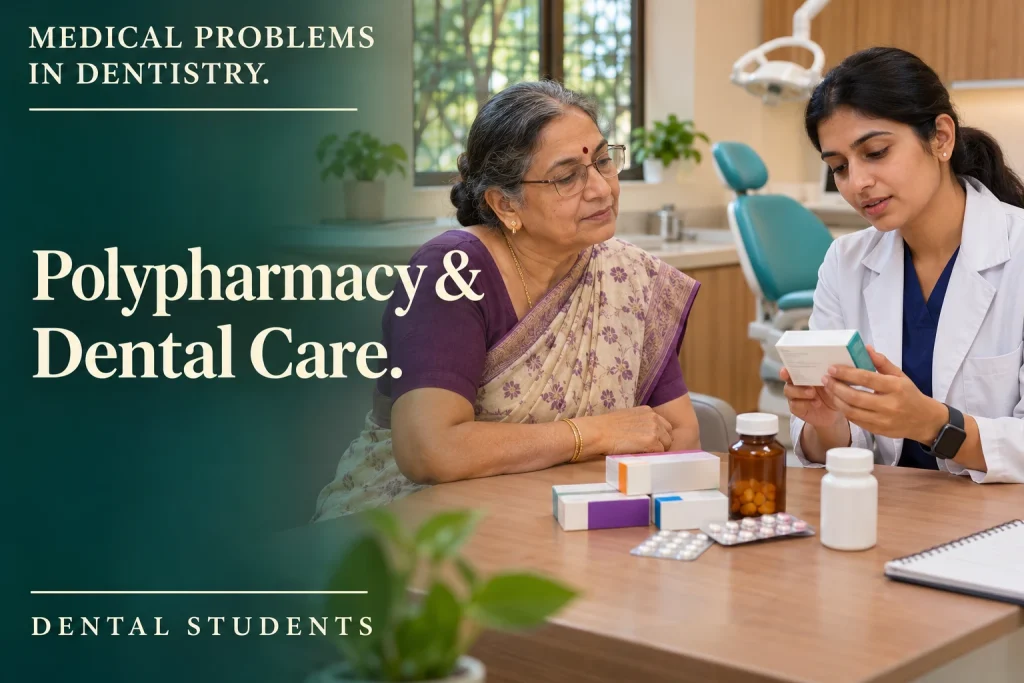
Medical Problems in Dentistry: Article 199 of 215 · Younger and older patients · Complete student guide
Medical Problems in Dentistry · Student guide
Multiple medicines may be necessary and beneficial. The dental problem is deciding whether the actual regimen creates symptoms, interactions or practical difficulties that need attention. Counting tablets cannot establish inappropriate prescribing. A useful dental assessment identifies specific concerns and communicates them to the clinician or pharmacist responsible for wider medication review.
In this guide: Learning objectives · Start with this clinical case · Reconciliation comes before interpretation · Dry mouth needs history and examination · Falls and bleeding require separate reasoning · Adding a dental prescription changes the whole regimen · Communicate a focused plan · Viva and self-check
Learning objectives
- Reconcile the medicines a patient actually takes.
- Connect oral and functional concerns to focused questions without assuming causation.
- Avoid independent withdrawal of essential treatment and document coordinated review.
Start with this clinical case
Fictional teaching case. An older adult brings two medicine lists after a recent hospital stay. They report dry mouth, a fall and bleeding when brushing. A relative suggests stopping the “blood thinner.” First establish the current regimen and examine the oral problem. These three concerns may have different explanations and should not be collapsed into one diagnosis of too many medicines.
Reconciliation comes before interpretation
Ask the patient to describe a normal day of medicine use. Compare this with prescriptions, discharge information and packaging when available. Record names, formulations, doses, timing, indications and changes. Include occasional painkillers, oral gels, sleep products, herbal preparations and medicines obtained without a prescription. Establish who organises and administers them.
If lists conflict, identify the uncertainty and confirm it with the appropriate prescriber or pharmacist. Do not choose the newest-looking sheet by appearance alone. Record the source and date of the reconciled list. NHS SPS describes medication review as a person-centred process considering benefits, problems and the individual’s goals; its UK service arrangements are not Indian administrative requirements.[SMR]
Dry mouth needs history and examination
Several medicines may contribute to dry-mouth symptoms, and cumulative exposure can matter. NIDCR emphasises that dryness is not an inevitable part of ageing. Ask about onset relative to treatment changes, oral comfort, eating, speech, denture use and sleep. Symptoms and measured salivary output are related but distinct; a patient’s complaint should not be dismissed because the mouth appears moist.[OLDERDRY]
Examine for relevant mucosal and dental disease rather than attributing every finding to medicines. Discuss individual prevention and symptom relief, including safe product use. Water, gum or sweets are not universally suitable when swallowing problems, choking risk or fluid restrictions are present. A request for medication review should explain the symptom burden and possible alternatives for the prescriber to consider, rather than instruct the patient to stop treatment.
Falls and bleeding require separate reasoning
A recent fall warrants attention to injury, current symptoms and appropriate medical assessment. Medicines can contribute to falls, but they are one part of a wider picture. Ask about dizziness, loss of consciousness, changes in mobility and recent medication changes. Do not diagnose a drug-induced fall from a medicine list alone. SPS identifies medication review as relevant to people at risk of falls.[FALLS]
For oral bleeding, examine plaque-related inflammation and local causes while asking about spontaneous bleeding, bruising and other relevant history. Identify the exact anticoagulant or antiplatelet and any additional medicines affecting bleeding. A plan for an invasive procedure is a separate question from why gums bleed during brushing. Neither concern justifies automatic withdrawal of an antithrombotic.[ANTICOAG]
Adding a dental prescription changes the whole regimen
| Finding or question | Clinical implication | Student action |
|---|---|---|
| Two inconsistent medicine lists | The true exposure is uncertain | Confirm the active regimen before prescribing |
| Dryness after a recent change | A medicine contribution is possible, not proven | Document symptoms and oral findings; request targeted review |
| A fall with dizziness | Several medical and functional factors may coexist | Assess urgency and communicate the timeline |
| Antithrombotic plus proposed dental medicine | Interaction and bleeding risks may change | Check the exact combination with current guidance |
An apparently familiar antibiotic, antifungal or analgesic can interact with a regular medicine. Use a current resource for the exact pair and review renal or hepatic information where relevant. The drug-interaction check should include the proposed formulation and everything already taken for the current dental problem. Record the practical decision, not only that a database was opened.[INTERACT]
Communicate a focused plan
A useful message to the wider team states the dental findings, symptoms, relevant medicine timeline, proposed intervention and specific advice required. For example, ask whether a persistent dry-mouth burden can be addressed while maintaining the medicine’s therapeutic purpose. Agree who will consider a change and how the updated list will reach the dental practice.
Ask the patient what is hardest about the regimen: remembering doses, opening packaging, cost, side effects or uncertainty about instructions. Include the support person the patient wants, without assuming that a relative replaces them in decisions. Use a written summary and ask the patient to explain the plan back.
In the teaching case, investigate the three concerns individually and resolve the conflicting lists. A focused referral may be appropriate, but urgent illness or injury should not wait for a routine review appointment. Keep necessary dental treatment and prevention moving through an individual plan. This guide does not provide deprescribing, tapering or anticoagulant-interruption instructions; these require the responsible clinicians and current local protocols.
Viva and self-check
Does taking many medicines prove inappropriate prescribing? No. Indications, benefit, harm, actual use and the patient’s goals need review.
Should a student stop a suspected xerogenic medicine? No. Document the concern and coordinate with the responsible prescriber.
Does gum bleeding automatically require antithrombotic withdrawal? No. Assess the oral findings and relevant medical factors, then plan any procedure individually.
Continue through the series
- Previous: Frailty and Multimorbidity: Dental Priorities and Shared Decision-Making
- Next: Planning Prevention and Carer-Assisted Oral Care Across the Life Course
- Browse all 215 student guides by subject
More in Younger and older patients: Medically Complex Children: Dental Assessment and Paediatric Medical Liaison · Frailty and Multimorbidity: Dental Priorities and Shared Decision-Making · Planning Prevention and Carer-Assisted Oral Care Across the Life Course
Continue learning
- Structured medical history and examination
- Medical liaison and referral for complex dental patients
- Explain Sjögren disease and dry mouth to a patient
References and scope
Sources checked on 26 November 2026. This is an original student teaching guide. International clinical recommendations are identified by their issuing organisation. Use current local protocols, appropriate supervision and an individual clinical assessment.
- NHS SPS: A Person-Centred Approach to Polypharmacy and Medication Review
- NIDCR: Dry Mouth and Older Adults — Caregiver Information
- NHS SPS: Reviewing Medicines for People at Risk of Falls
- SDCEP Dental Companion: Interactions With Drugs Prescribed by Dentists
- SDCEP: Drug Interactions
Images are AI-generated educational illustrations of fictional people or equipment, not clinical records or diagnostic photographs.

Leave a Reply