Medical Problems in Dentistry: Article 204 of 215 · Medical emergencies · Complete student guide
Medical Problems in Dentistry · Student guide
Breathlessness during a dental visit needs assessment, not an automatic label of anxiety. A patient with asthma may deteriorate quickly, and life-threatening features require immediate emergency care. The dental team should stop treatment, summon trained help and support the patient while the emergency response is activated. This guide focuses on adult recognition and escalation.
In this guide: Learning objectives · Start with this clinical case · Recognise severity from the whole presentation · Stop dentistry and activate the team · Reliever support has limits and responsibilities · Reassess instead of assuming the first action worked · Handover and preparation for future visits · Viva and self-check
Learning objectives
- Recognise severe and life-threatening features in a breathing emergency.
- Use the patient’s action plan and appropriate trained support.
- Avoid delays caused by assumptions, equipment searches or repeated questioning.
Start with this clinical case
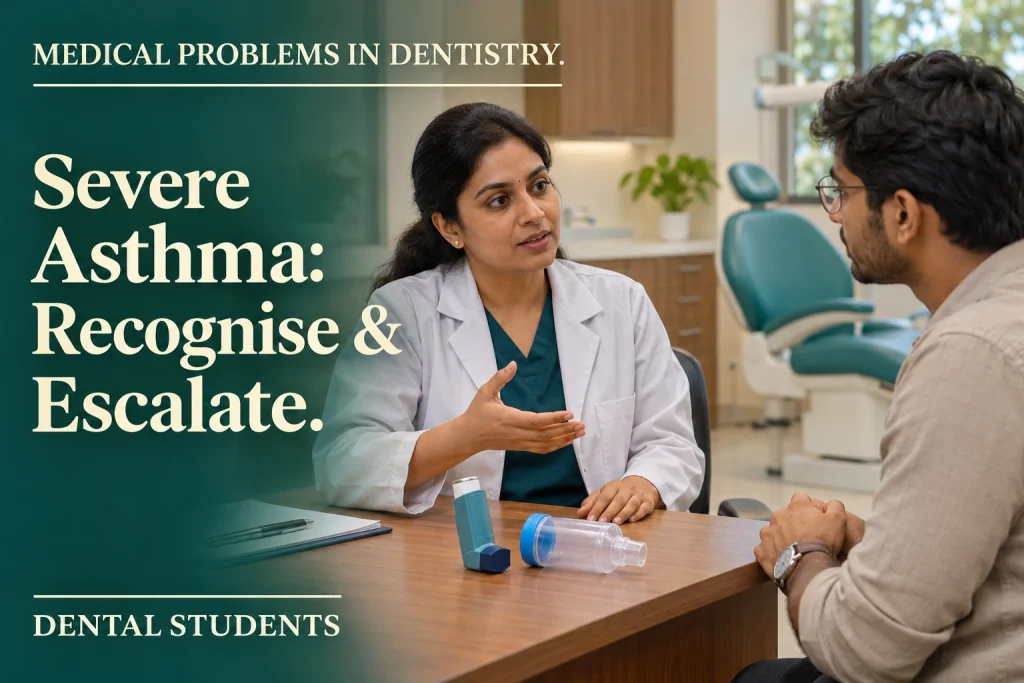
Fictional teaching case. An adult with asthma becomes very breathless and cannot finish a sentence. They are frightened and point towards a bag containing their inhaler. One team member suggests breathing coaching for panic. Severe breathing difficulty needs an emergency assessment now; a presumed emotional trigger does not make the presentation benign.
Recognise severity from the whole presentation
SDCEP identifies inability to complete sentences in one breath as a feature of acute severe asthma. Exhaustion, confusion or reduced consciousness are particularly concerning life-threatening features. The priority for life-threatening asthma is immediate emergency transfer. Do not wait for every listed sign or a numerical threshold before calling for help.[ASTHMA]
Ask brief questions the person can manage, but avoid making them give a lengthy account while struggling to breathe. Observe responsiveness, speech and breathing effort. A previous diagnosis is relevant, yet other causes of acute breathlessness remain possible. Deterioration should change the response even when the initial explanation sounded reassuring.
Stop dentistry and activate the team
Remove the immediate dental task and summon help. A conscious person with asthma is generally supported upright in a comfortable position, as reflected in SDCEP’s guidance. Do not force a distressed, breathing patient flat merely because the event occurred in a dental chair. If consciousness or breathing changes, reassess and use the appropriate emergency pathway.[ASTHMA]
Call emergency services promptly for severe or life-threatening difficulty, deterioration or failure to improve appropriately. In India, 112 includes health emergencies; the clinic should also know its verified local ambulance route. State the breathing problem clearly, give the address and access details and follow dispatcher instructions. Retrieval of an inhaler should occur alongside the call, not postpone it.[INDIA]
Reliever support has limits and responsibilities
RCUK first-aid guidance supports helping a person with asthma use their own reliever inhaler, with a spacer if available. The responsible trained team should follow the person’s action plan and current local emergency protocol. Confirm the actual device and medicine rather than assuming every inhaler has the same purpose.[AID]
NHLBI emphasises an asthma action plan and urgent help when breathing remains very difficult or medicines are not relieving symptoms. Do not keep repeating an ineffective approach while delaying transfer. Controller and reliever roles vary between regimens, so the patient’s prescribed plan matters. Students should not redesign chronic asthma treatment during the emergency.[NHLBI]
Emergency oxygen and medicines require trained use and the approved protocol. This article provides no fixed puff schedule, oxygen flow, injectable treatment or paediatric dose. A written guide cannot verify that the team can operate its own spacer, oxygen equipment or monitoring devices; those skills need practical rehearsal.
Reassess instead of assuming the first action worked
| Finding or question | Clinical implication | Student action |
|---|---|---|
| Unable to speak a full sentence comfortably | The episode may be severe | Obtain trained help and activate emergency care |
| Exhaustion, confusion or falling responsiveness | Life-threatening deterioration is possible | Escalate immediately; do not wait for further history |
| Reliever not producing adequate improvement | The current approach is insufficient | Continue emergency care and arrange transfer |
| Sudden breathing difficulty during a procedure | Asthma is not the only possible cause | Assess the event and communicate possible aspiration or allergy clues |
Document observations and response over time. If an instrument or material may have entered the airway, or if the presentation suggests another emergency, tell the lead clinician and responders. A known asthma diagnosis should not prevent assessment of aspiration, anaphylaxis or another cause. The immediate aim is safe escalation rather than diagnostic certainty.
Handover and preparation for future visits
Communicate onset, severe features, relevant asthma history, the action plan, medicines used and response. Include doses and times if administered by the responsible team. Name the person who made the emergency call and confirm the access arrangements. Do not leave an increasingly unwell patient alone while everyone prepares paperwork.
After the acute episode, ongoing dental care requires an individual review. Ask about recent attacks, hospital care, changes in treatment and what medical advice is needed before another visit. Ensure the patient understands future appointment instructions and can bring the prescribed reliever and action plan. Do not tell them to omit regular treatment unless the responsible medical team has given a specific instruction.
In the teaching case, incomplete speech and marked breathlessness take priority over the suggestion of panic. The team should practise parallel tasks: patient support, emergency activation, appropriate equipment and handover. Use the published emergency-readiness guide for preparation; the current article addresses recognising and escalating an actual chairside breathing emergency.
Viva and self-check
Does anxiety exclude severe asthma? No. Fear may accompany a serious breathing emergency.
Must every listed severe feature be present before calling? No. A concerning presentation or deterioration warrants prompt escalation.
Can repeated reliever attempts justify delaying transfer? No. Severe symptoms or inadequate improvement require emergency care.
Continue through the series
- Previous: Seizures and Status Epilepticus in Dental Practice: Recognition and Emergency Response
- Next: Suspected Stroke During a Dental Visit: Recognising Signs and Activating Emergency Care
- Browse all 215 student guides by subject
More in Medical emergencies: A Collapsed Patient in the Dental Chair: ABCDE, Calling for Help and BLS/AED · Hypoglycaemia in Dental Practice: Consciousness, Recognition and Escalation · Seizures and Status Epilepticus in Dental Practice: Recognition and Emergency Response · Suspected Stroke During a Dental Visit: Recognising Signs and Activating Emergency Care · Choking and Suspected Aspiration in Dentistry: Recognition, Prevention and Emergency Response
Continue learning
- Dental clinic medical emergency readiness
- Structured medical history and examination
- Medical liaison and referral for complex dental patients
References and scope
Sources checked on 26 November 2026. This is an original student teaching guide. International clinical recommendations are identified by their issuing organisation. Use current local protocols, appropriate supervision and an individual clinical assessment.
- SDCEP: Asthma
- NHLBI: Asthma Attack
- RCUK: First Aid Guidelines (2025)
- National Portal of India: Emergency Helpline
- RCUK: Adult Basic Life Support Guidelines (2025)
Images are AI-generated educational illustrations of fictional people or equipment, not clinical records or diagnostic photographs.

Leave a Reply