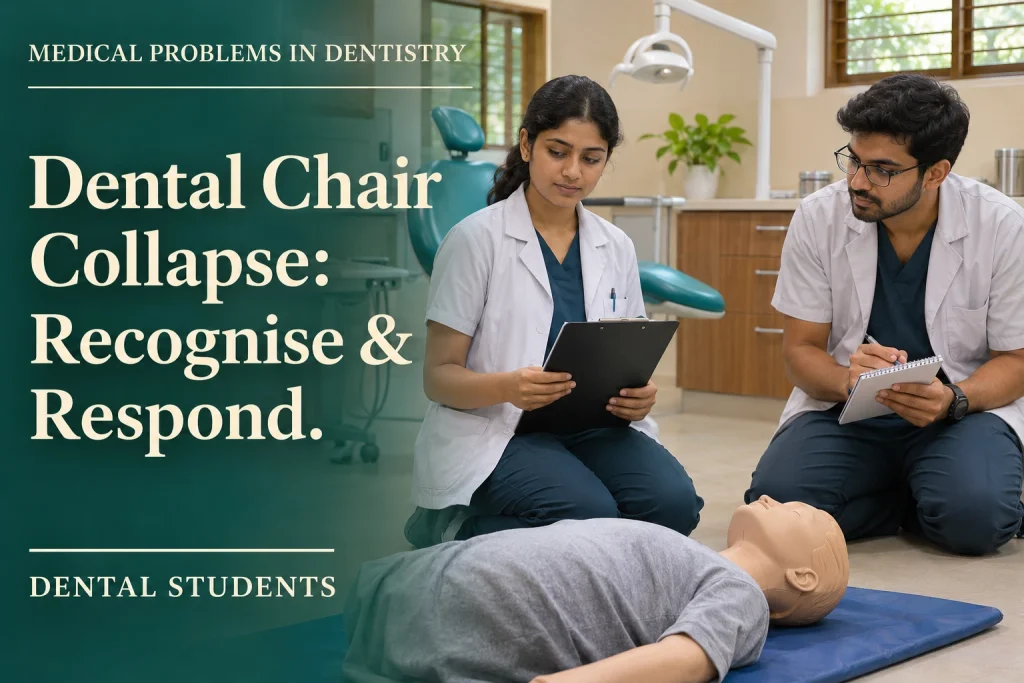
Medical Problems in Dentistry: Article 201 of 215 · Medical emergencies · Complete student guide
Medical Problems in Dentistry · Student guide
Collapse is a presentation, not a diagnosis. During a dental visit the priority is to recognise immediate danger and organise help, while trained team members begin the appropriate response. Do not delay resuscitation while trying to decide whether the event was a faint, seizure, hypoglycaemia or cardiac problem. This guide addresses adult recognition and team decisions.
In this guide: Learning objectives · Start with this clinical case · The first decision is responsiveness and breathing · BLS and AED take priority over a prolonged examination · Where ABCDE fits · Make the team response explicit · Handover, records and learning · Viva and self-check
Learning objectives
- Recognise when an adult needs immediate emergency activation and BLS.
- Use ABCDE without delaying CPR for suspected cardiac arrest.
- Prepare a clear team response and handover.
Start with this clinical case
Fictional teaching case. During treatment an adult stops responding and makes occasional gasping sounds. Someone says they are still breathing and suggests checking the blood pressure first. Unresponsiveness with abnormal breathing should trigger the cardiac-arrest pathway, not reassurance from isolated gasps. Call for emergency help, begin CPR and obtain an AED without waiting for a complete diagnosis.
The first decision is responsiveness and breathing
Stop dental treatment and make the immediate area safe. Call for nearby help. RCUK’s 2025 adult BLS guidance advises activating emergency services promptly for an unresponsive person, with breathing assessed while the call is being connected. If the person is unresponsive and not breathing normally, assume cardiac arrest and start CPR. Agonal gasping is not normal breathing.[BLS]
In India, 112 is the integrated emergency response number, including health emergencies. The clinic should also have verified local ambulance and transfer arrangements. Give the exact address and access information, state that an adult is unresponsive, and describe breathing and actions underway. Follow the dispatcher’s instructions; do not copy the UK number printed in the source guidance.[INDIA]
BLS and AED take priority over a prolonged examination
For suspected cardiac arrest, begin CPR promptly and use an AED as soon as it is available, following its prompts. A trained dental team should apply its current adult BLS protocol and practical skills. An AED should not remain unused because the team wants to finish taking observations. Assign someone to retrieve it while another person provides care.[BLS]
This article does not replace hands-on CPR training, teach advanced airway procedures or provide paediatric resuscitation instructions. Students should practise the actual clinic response with qualified instructors. The point of the recognition pathway is action without avoidable delay, not memorising enough differential diagnoses to feel certain about the cause.
Where ABCDE fits
For a deteriorating patient, ABCDE means Airway, Breathing, Circulation, Disability and Exposure. Address life-threatening problems as they are identified, call for help early and reassess after interventions. Use available team members to perform appropriate tasks simultaneously. ABCDE is an organising framework; it is not a reason to complete five boxes before starting CPR when cardiac arrest is suspected.[ABCDE]
Use equipment and interventions within training and the local protocol. A hospital-oriented ABCDE resource includes procedures and treatments beyond a dental student’s role. Do not turn its intravenous-fluid or advanced-treatment sections into independent chairside instructions. Identify what is required now, what you can safely do and who must provide additional support.
Make the team response explicit
| Finding or question | Clinical implication | Student action |
|---|---|---|
| Unresponsive adult | Emergency help is required promptly | Activate the response and assess breathing |
| Unresponsive with gasping or other abnormal breathing | Suspected cardiac arrest | Begin CPR and obtain/use the AED |
| Unresponsive but breathing normally | Airway protection and monitoring remain essential | Use the appropriate trained response and reassess continuously |
| A change after an intervention | The situation may be improving or deteriorating | Reassess and communicate the change |
Allocate named tasks: patient assessment and care, emergency calling, AED and equipment retrieval, access for responders and recording. A person who has received a task should repeat it back. Avoid several people searching for equipment while nobody stays with the patient. Training should account for a small team as well as a teaching hospital.
Handover, records and learning
Give responders a concise account: what happened, when responsiveness changed, breathing findings, relevant medical history, dental treatment or medicines immediately beforehand, and interventions with times. Include AED use and any observed response. Record facts rather than a confident diagnosis that the evidence does not support. The dental procedure’s timing may be relevant without proving it caused the event.
After transfer, preserve a factual record and follow local incident arrangements. Review the response with the team and offer appropriate support. Useful questions include whether help was called promptly, equipment was accessible, roles were clear and access instructions worked. A debrief should identify specific improvements rather than assign blame.
In the teaching case, intermittent gasps must not delay the response. The key failure would be treating a monitor reading as a prerequisite to action. Use the published clinic emergency-readiness guide for preparation and ongoing training. The current article focuses on the recognition and immediate-response decisions during an adult collapse, not a complete emergency drug formulary.
Viva and self-check
Do occasional gasps prove normal breathing? No. Gasping in an unresponsive person may be a sign of cardiac arrest.
Must ABCDE be completed before CPR? No. Suspected cardiac arrest requires prompt CPR and AED use.
What should the emergency caller communicate? Location, access, responsiveness, breathing and actions underway, then follow dispatcher instructions.
Continue through the series
- Previous: Planning Prevention and Carer-Assisted Oral Care Across the Life Course
- Next: Hypoglycaemia in Dental Practice: Consciousness, Recognition and Escalation
- Browse all 215 student guides by subject
More in Medical emergencies: Hypoglycaemia in Dental Practice: Consciousness, Recognition and Escalation · Seizures and Status Epilepticus in Dental Practice: Recognition and Emergency Response · Severe Asthma in the Dental Chair: Recognition and Emergency Escalation · Suspected Stroke During a Dental Visit: Recognising Signs and Activating Emergency Care · Choking and Suspected Aspiration in Dentistry: Recognition, Prevention and Emergency Response
Continue learning
- Dental clinic medical emergency readiness
- Structured medical history and examination
- Medical liaison and referral for complex dental patients
References and scope
Sources checked on 26 November 2026. This is an original student teaching guide. International clinical recommendations are identified by their issuing organisation. Use current local protocols, appropriate supervision and an individual clinical assessment.
- RCUK: Adult Basic Life Support Guidelines (2025)
- RCUK: The ABCDE Approach
- National Portal of India: Emergency Helpline
Images are AI-generated educational illustrations of fictional people or equipment, not clinical records or diagnostic photographs.

Leave a Reply