Medical Problems in Dentistry: Article 148 of 215 · Disability and special care · Complete student guide
Medical Problems in Dentistry · Student guide
A diagnosis can suggest questions, but it cannot tell you how a particular person communicates, moves, makes decisions or cleans their teeth. Inclusive care begins by asking the patient what would help and then making a workable plan.
In this guide: Learning objectives · Start with this clinical case · Think beyond the dental chair · Build an individual assessment · Adapt care without making assumptions · India-specific rights and decision-making · Prevention, escalation and transition · A teaching handover · Viva and self-check
Learning objectives
- Separate access barriers from medical instability.
- Document communication, positioning and daily-care needs.
- Plan continuity and appropriate referral without assumptions about ability.
Start with this clinical case
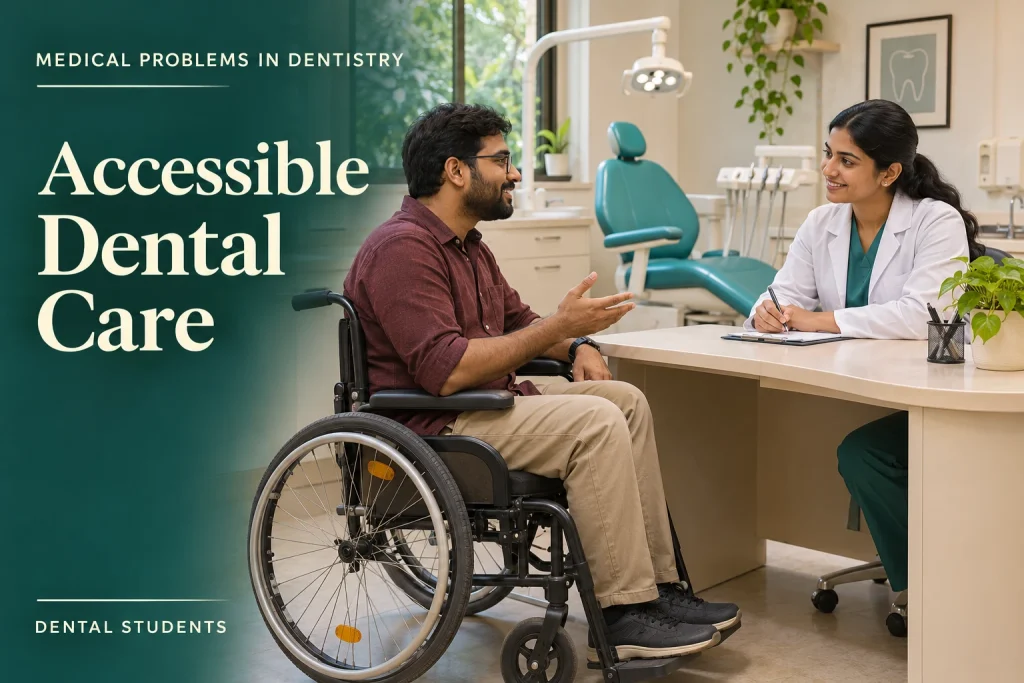
Fictional teaching case. A wheelchair-using adult books a restoration. The clinic has an accessible entrance but a narrow route to the treatment room. Staff ask his companion all the questions. He explains that he communicates independently and has a transfer plan. Identify the access, communication and safety tasks before discussing the tooth.
Think beyond the dental chair
WHO identifies inaccessible facilities, information and attitudes as contributors to health inequity. Access therefore includes booking, transport, entrance, reception, the treatment space, payment and follow-up. A ramp does not solve an inaccessible explanation or a referral letter the patient cannot use. Involve the person in identifying the barrier and the preferred solution.
[WHO]Build an individual assessment
Ask how the patient communicates, what support they want, how they manage daily oral care and what previous visits were like. Review medical conditions, medicines, allergies, swallowing, seizure history and positioning where relevant. NIDCR describes variable physical, communication and oral-care needs among people with developmental disabilities; avoid applying every listed complication to everyone.
[DEV]| Finding or question | Clinical implication | Student action |
|---|---|---|
| Communication | Preferred language, format and response time | Ask the patient and confirm understanding |
| Movement and positioning | Access or transfer support may be needed | Agree a plan; use trained staff and suitable equipment |
| Medical needs | Diagnosis alone does not establish stability | Assess relevant symptoms and medicines |
| Oral self-care | Independence can vary by task | Observe or discuss the actual routine |
| Decision support | A companion may support communication | Clarify their role without bypassing the patient |
| Follow-up | Transport and format can affect attendance | Agree an accessible reminder and review plan |
Adapt care without making assumptions
Ask before moving a wheelchair, touching an assistance device or arranging a transfer. Determine whether the planned examination or treatment requires transfer and whether staff have appropriate training and equipment. A general dental student should not improvise lifting techniques. Positioning must also account for comfort, breathing and swallowing.
CDC describes physical, communication and organisational barriers. Examples in dentistry include inaccessible written instructions, insufficient appointment time and inflexible scheduling. An adjustment should have a named owner: who will prepare the room, arrange the interpreter or check the route before the patient arrives?
[CDC]India-specific rights and decision-making
India’s Rights of Persons With Disabilities Act 2016 addresses equality, accessibility and healthcare. Legal capacity should not be denied because of a disability label; support arrangements require attention to the actual person and applicable law. The detailed consent pathway belongs in a dedicated assessment, not an assumption that the accompanying relative can consent to every procedure.
[RPWD]For the teaching case, speak directly with the adult patient. Ask how he wants his companion involved. Discuss the route and transfer needs before booking a procedure the room cannot accommodate. Explain any limits of the setting and arrange an appropriate alternative with continuity.
Prevention, escalation and transition
Base preventive care on disease and ability rather than a standard leaflet. Agree who cleans which surfaces, which aids can be used and when to review. For children with special healthcare needs, AAPD 2026 emphasises coordination and transition to an adult dental home. Adult arrangements must be planned around local services rather than assuming paediatric care will continue indefinitely.
[AAPDSH]Refer when the required expertise, equipment or medical support is unavailable, with the patient involved and a plan for urgent symptoms. Referral should communicate the dental need and adaptations already tried. Do not make sedation or hospital care the default simply because a disability is recorded.
A teaching handover
Write a short handover in the patient’s preferred form: dental problem, agreed appointment purpose, useful adaptations, support role and contact route. Ask whether it accurately reflects their needs. At review, record what worked and what should change. Keeping a usable record prevents every visit from becoming another unsupported first encounter.
Viva and self-check
Does wheelchair use imply impaired decision-making? No. Assess communication and decisions individually.
MCQ: An accessible entrance alone makes the entire dental service accessible. False. Communication, equipment, scheduling and follow-up also matter.
What is a useful referral? One that explains the dental problem, urgency and specific support needed, with continuity of care.
Continue through the series
- Previous: When a Rare Oral Parasite Is Suspected: Exposure History, Biopsy and Diagnostic Limits
- Next: Autism and Intellectual Disability: Communication, Sensory Needs and Dental Preparation
- Browse all 215 student guides by subject
More in Disability and special care: Autism and Intellectual Disability: Communication, Sensory Needs and Dental Preparation · Cerebral Palsy and Dental Care: Positioning, Swallowing and Prevention · Consent, Supported Decision-Making and Communication in Special Care Dentistry · Hearing, Vision and Mobility Impairment: Practical Dental Access Adaptations
Continue learning
- Structured medical history and examination
- Informed consent in an Indian dental practice
- Medical liaison and referral for complex dental patients
References and scope
Sources checked on 25 November 2026. This is an original student teaching guide. International clinical recommendations are identified by their issuing organisation; Indian legal provisions are identified separately. Use current local protocols, appropriate supervision and an individual clinical assessment.
- WHO: Disability and Health
- NIDCR: Developmental Disabilities and Oral Health
- CDC: Disability Barriers to Inclusion
- India Code: Rights of Persons With Disabilities Act 2016, especially sections 3, 13, 14 and 25
- AAPD: Management of Dental Patients With Special Health Care Needs, revised 2026
Images are AI-generated educational illustrations of fictional people or equipment, not clinical records or diagnostic photographs.

Leave a Reply