Medical Problems in Dentistry: Article 150 of 215 · Disability and special care · Complete student guide
Medical Problems in Dentistry · Student guide
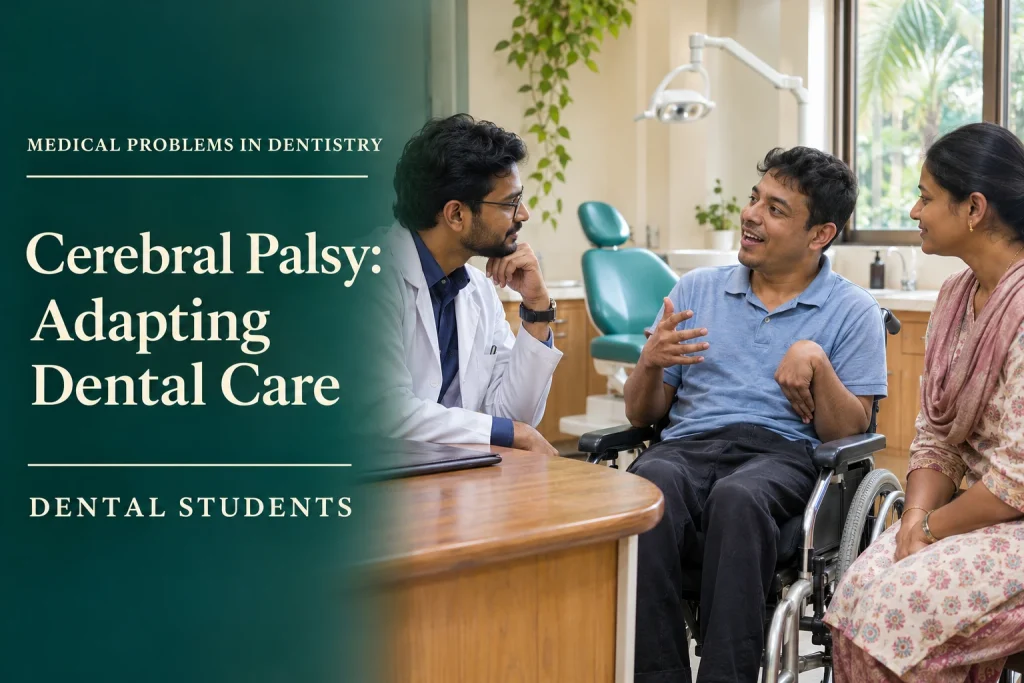
Cerebral palsy describes a group of conditions affecting movement and posture, with widely varying abilities and associated needs. A useful dental plan begins with this person’s communication, comfort, medical history and daily oral care. A difficult movement or unclear speech must not be mistaken for inability to understand.
In this guide: Learning objectives · Start with this clinical case · Start with communication and consent · Take a functional history · Plan positioning instead of forcing a standard setup · Assess swallowing concerns as a separate clinical issue · Match the finding to an action · Make prevention achievable · Escalate for a defined need · Viva and self-check
Learning objectives
- Identify the individual issues that change dental positioning and care.
- Recognise swallowing concerns without improvising transfer or feeding techniques.
- Plan prevention and assistance around actual abilities and preferences.
Start with this clinical case
Fictional teaching case. An adult with cerebral palsy uses a wheelchair and has dysarthric speech. A companion reports coughing with some drinks and recurrent difficulty maintaining a comfortable position. The student proposes a standard fully reclined appointment and asks the companion all questions. What needs clarification first?
Start with communication and consent
Address the patient, ask how they prefer to communicate and allow enough time to respond. Dysarthria can affect speech production without establishing a person’s intellectual ability. Ask permission before involving a companion and clarify what practical information they can help provide.
Do not use speech clarity, involuntary movement or wheelchair use as a shortcut to a capacity judgement. India’s disability-rights framework supports equal legal capacity and appropriate support. Consent arrangements must reflect the actual decision and individual assessment.[RPWD]
Take a functional history
Ask about comfortable positions, pain, fatigue, movement patterns, previous dental experiences and the usual method of receiving care. Review established medical conditions and medicines rather than assuming that every person has epilepsy, reflux or a swallowing disorder. Clarify any recent change from the person’s baseline.
Archived NIDCR cerebral-palsy material helps identify domains worth asking about, but it is not a current manual for transfers, head positioning, restraint or medication use. Individual clinical assessment and appropriately trained staff are essential. This guide does not teach physical handling techniques.[CPARCHIVE]
Plan positioning instead of forcing a standard setup
Ask whether the person normally transfers, what assistance and equipment are used, and whether they wish to remain in their wheelchair for discussion or examination where feasible. Assess what the practice can safely provide. A companion’s willingness to help does not establish that an improvised lift is safe.
If a safe position or transfer cannot be achieved with available trained staff and suitable facilities, arrange appropriate specialist or accessible care. Agree a plan before attempting a procedure. Do not force the head or limbs into a position, and do not interpret an involuntary movement as consent to proceed.
Assess swallowing concerns as a separate clinical issue
Ask about known swallowing assessment, coughing or choking, difficulty managing saliva, changes in intake and advice from the treating team. Reported coughing does not by itself diagnose aspiration, but it is important information for planning care. Seek clarification from the relevant medical or swallowing service when needed.
The proposed procedure, water use, suction, positioning and ability to pause must be considered together. Do not give a universal instruction to tilt the head, recline fully or use a mouthrinse. A person with swallowing concerns needs an individual plan; oral-care advice should also be coordinated with established nutrition and swallowing recommendations.
Match the finding to an action
| Finding or question | Clinical implication | Student action |
|---|---|---|
| Dysarthric speech | Communication may need more time or another format | Ask the patient’s preferred method; do not assume reduced understanding |
| Comfortable position is uncertain | Standard reclining may not be appropriate | Clarify preferences and obtain a safe positioning plan |
| Coughing, choking or known dysphagia | Swallowing safety requires individual consideration | Liaise with the appropriate treating team |
| Limited grip or fatigue during brushing | A standard instruction may be impractical | Explore adaptation or agreed assistance |
| Unsafe transfer with available facilities | The visit needs another access arrangement | Refer or reorganise before attempting treatment |
Make prevention achievable
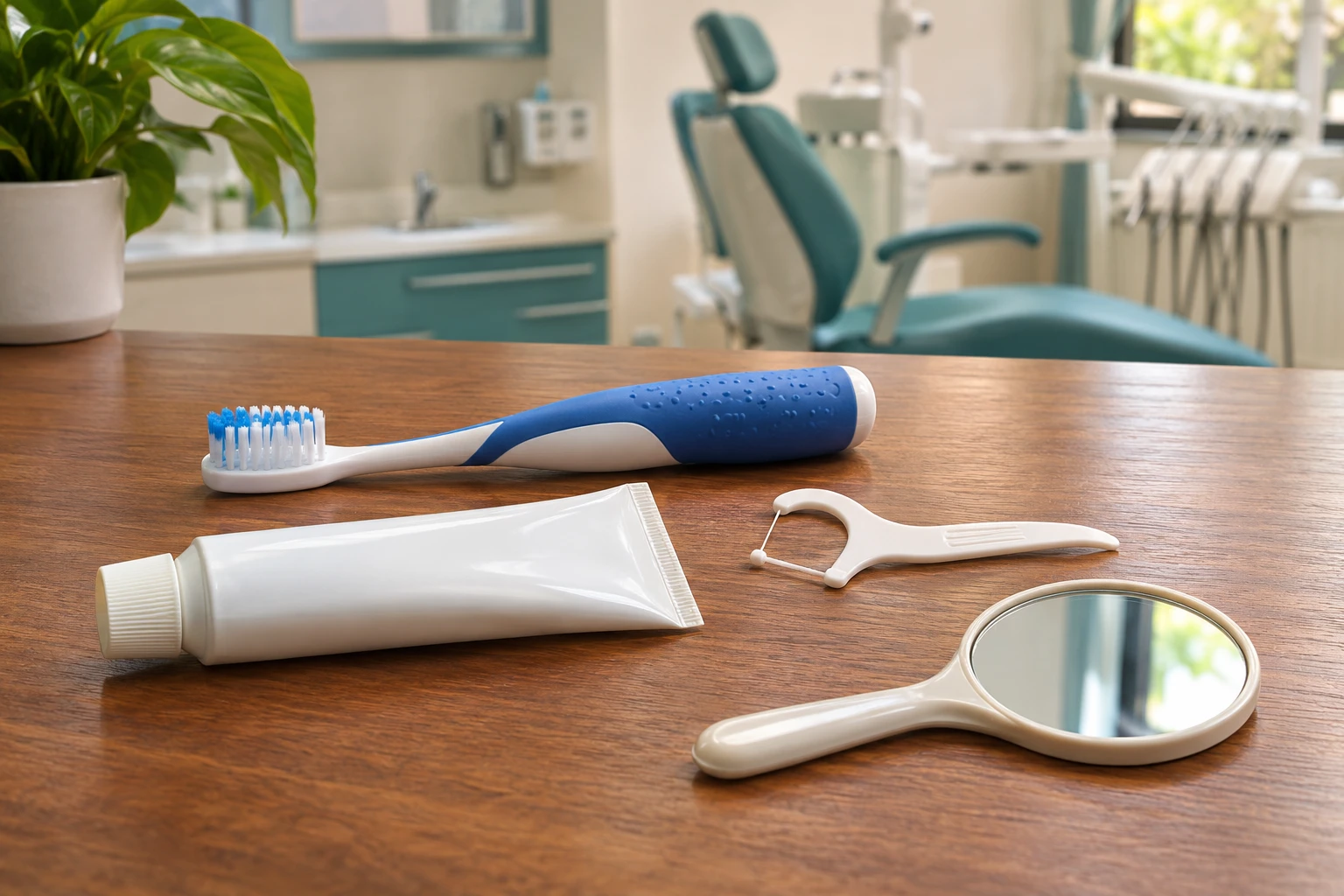
Ask how brushing is currently managed and whether the person wants help. Explore handle grip, reach, fatigue, positioning and who can assist with permission. Try adaptations that address a specific barrier rather than buying equipment because it is labelled for disability. Review whether the change actually improves the routine.[NIDCR]
Consider the person’s oral findings and diet in context. Where nutrition or swallowing is medically managed, do not independently restrict essential intake to simplify dental advice. Prevention and professional follow-up should be coordinated with the broader care plan. Paediatric special-care guidance is useful for individual prevention planning, while its US context should remain explicit.[AAPD]
Escalate for a defined need
Referral may be needed for unresolved swallowing risk, positioning, complex treatment or another medical concern. Explain the specific problem and what adaptations were considered. Sedation or general anaesthesia is not an automatic consequence of cerebral palsy; it requires an appropriate service and individual assessment.
A strong student record states the patient’s goal, communication method, functional concerns, relevant medical information, consent process and next step. Arrange continuing prevention and review so that a specialist referral does not leave the person without everyday dental support.
Viva and self-check
Does dysarthria establish intellectual disability? No. Speech production and understanding must be considered separately.
Why avoid a standard positioning instruction? Comfort, movement, swallowing and transfer needs vary; a universal manoeuvre can be inappropriate.
When is referral helpful? When a defined clinical or access need exceeds the available staff, facilities or expertise, with continuity arranged.
Continue through the series
- Previous: Autism and Intellectual Disability: Communication, Sensory Needs and Dental Preparation
- Next: Consent, Supported Decision-Making and Communication in Special Care Dentistry
- Browse all 215 student guides by subject
More in Disability and special care: Dental Care for Patients With Disabilities: An Individualised Assessment Framework · Autism and Intellectual Disability: Communication, Sensory Needs and Dental Preparation · Consent, Supported Decision-Making and Communication in Special Care Dentistry · Hearing, Vision and Mobility Impairment: Practical Dental Access Adaptations
Continue learning
- Structured medical history and examination
- Medical liaison and referral for complex dental patients
- Informed consent in an Indian dental practice
References and scope
Sources checked on 26 November 2026. This is an original student teaching guide. International clinical recommendations are identified by their issuing organisation. Use current local protocols, appropriate supervision and an individual clinical assessment.
- India Code: Rights of Persons with Disabilities Act, 2016
- NIDCR: Practical Oral Care for People With Cerebral Palsy (archived 2009)
- NIDCR: Developmental Disabilities and Oral Health
- AAPD: Management of Dental Patients with Special Health Care Needs (2026)
Images are AI-generated educational illustrations of fictional people or equipment, not clinical records or diagnostic photographs.

Leave a Reply