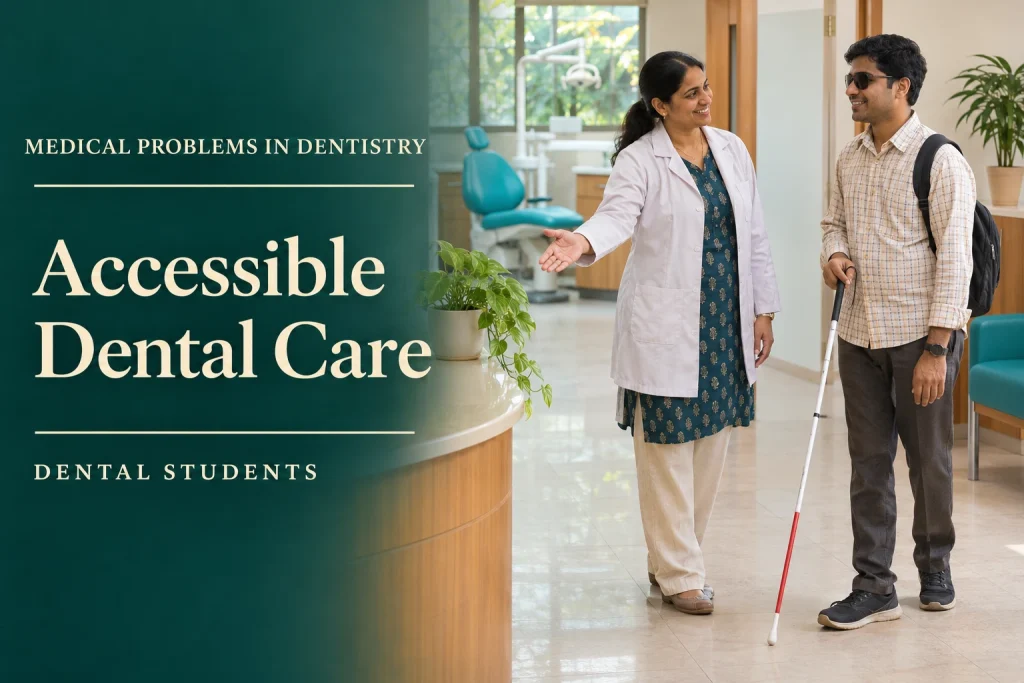
Medical Problems in Dentistry: Article 152 of 215 · Disability and special care · Complete student guide
Medical Problems in Dentistry · Student guide
Access starts before the dental chair. Booking systems, entrances, waiting arrangements, explanations and aftercare can all create barriers. Students should learn to ask which adjustment a person needs and check whether the clinic can deliver it safely, rather than assuming a single adaptation suits everyone.
In this guide: Learning objectives · Start with this clinical case · Ask about access at booking · Adapt communication for hearing needs · Make visual information accessible · Plan mobility and transfer needs in advance · Compare barriers across the visit · Know the Indian standards boundary · Check aftercare and preserve continuity · Viva and self-check
Learning objectives
- Review access across the whole appointment journey.
- Offer communication adjustments while preserving privacy and consent.
- Identify when facilities or trained assistance are needed before treatment.
Start with this clinical case
Fictional teaching case. A patient with hearing impairment receives appointment details only by phone. Another patient with low vision cannot read the aftercare sheet. A wheelchair user reaches the clinic but cannot safely use the treatment area. How would you review these as separate barriers rather than one generic “disabled access” problem?
Ask about access at booking
Offer a way to communicate that the person can use and record their preference with appropriate privacy. Confirm the visit’s purpose, the route to the clinic and any barrier the patient wants addressed. A vague statement that the clinic is “accessible” is less useful than accurate information about the actual facilities.
Ask before arranging assistance. Some people want a supporter involved; others communicate and attend independently. Avoid putting sensitive medical details in a message to a relative just because it is convenient. Check consent and contact preferences.
Adapt communication for hearing needs
Ask whether the patient prefers speech, writing, an interpreter, a communication device or another method. Face the person and reduce unnecessary background noise where feasible. Do not assume that speaking louder, lip-reading or a family member translating will be effective or appropriate.
The consultation and the procedure may require different arrangements. Plan explanations and an agreed pause signal before treatment. Do not remove required infection-control protection during a clinical procedure to make speech easier; find a safe communication arrangement and use appropriate assistance where needed.
Make visual information accessible
Introduce yourself, describe what is about to happen and ask whether assistance is wanted. Offer information in a format the patient can use, such as accessible digital text, larger print or a verbal explanation, according to preference. Ask before touching a mobility aid or attempting to guide the person.
Do not rely on colour alone to communicate a warning or on an image alone to explain a decision. Check whether the person can access appointment instructions, medicine information and the follow-up contact method. Visual impairment does not establish lack of understanding or ability to decide.
Plan mobility and transfer needs in advance
Ask about the person’s usual mobility, preferred examination arrangement and any established assistance needs. Check the route, doorways, waiting space, toilet access and treatment area in the actual clinic. A ramp at the entrance does not resolve every later barrier.
Transfers require suitable arrangements, trained staff and appropriate equipment where indicated. Do not improvise a lift or ask relatives to carry someone because the clinic has no plan. Where safe access cannot be provided, arrange an appropriate alternative and continuity of care rather than discovering the problem after treatment has begun.
Compare barriers across the visit
| Finding or question | Clinical implication | Student action |
|---|---|---|
| Booking only by voice call | May exclude a patient’s preferred communication | Agree an accessible contact method |
| Aftercare only in small print | The patient may not receive usable instructions | Offer a suitable format and check access |
| Unplanned transfer | Potential safety and dignity problem | Arrange trained assistance and suitable facilities beforehand |
| Interpreter or supporter assumed | May compromise communication or privacy | Ask the patient’s preference and agree the role |
| Entrance works but treatment area does not | Access is incomplete | Review the whole route and make a specific plan |
Know the Indian standards boundary
The RPwD Act addresses equality, reasonable accommodation and access to healthcare. The official DEPwD index lists notified accessibility standards and guidelines, including a healthcare entry. These are relevant sources for a practice planning an access review.[RPWD][ACCESSINDIA]
This article does not provide a dimensional compliance checklist. The linked technical healthcare PDF could not be fully retrieved during this review, so no ramp slope, doorway width or building-compliance claim is inferred from its index entry. For premises work, obtain the current applicable technical requirements and professional advice for the location and building.
Check aftercare and preserve continuity
Ask the patient to explain how they will obtain and use the instructions, contact the practice and attend review. A clinic may have completed treatment but still leave an access barrier if all follow-up is inaccessible. Record successful adjustments so the next appointment can build on them.
The student’s role is to identify the barrier precisely, ask the person what helps, assess what can be delivered safely and arrange a specific next step. Accessible care is a continuing clinical process, not a label applied to a building after one improvement.
Viva and self-check
Is an entrance ramp enough to establish dental access? No. Communication, the full physical route, treatment arrangements and follow-up also need review.
Should a clinician remove procedural PPE for lip-reading? No. Arrange safe communication methods and appropriate support while maintaining required infection control.
Why are no technical building measurements supplied here? The technical PDF was not fully available for verification; an official index cannot establish dimensional compliance.
Continue through the series
- Previous: Consent, Supported Decision-Making and Communication in Special Care Dentistry
- Next: Orofacial Pain Assessment: Odontogenic, Neuropathic, Musculoskeletal and Referred Causes
- Browse all 215 student guides by subject
More in Disability and special care: Dental Care for Patients With Disabilities: An Individualised Assessment Framework · Autism and Intellectual Disability: Communication, Sensory Needs and Dental Preparation · Cerebral Palsy and Dental Care: Positioning, Swallowing and Prevention · Consent, Supported Decision-Making and Communication in Special Care Dentistry
Continue learning
- Structured medical history and examination
- Informed consent in an Indian dental practice
- Infection-control programme for an Indian dental clinic
References and scope
Sources checked on 26 November 2026. This is an original student teaching guide. International clinical recommendations are identified by their issuing organisation. Use current local protocols, appropriate supervision and an individual clinical assessment.
- India Code: Rights of Persons with Disabilities Act, 2016
- DEPwD: Standards and guidelines notified under RPwD Rules, 2017
Images are AI-generated educational illustrations of fictional people or equipment, not clinical records or diagnostic photographs.

Leave a Reply