Medical Problems in Dentistry: Article 153 of 215 · Headache and orofacial pain · Complete student guide
Medical Problems in Dentistry · Student guide
The place where pain is felt is not always its source. A useful orofacial pain assessment combines the patient’s story, a directed examination and tests that answer a clinical question. Before irreversible dental treatment, the proposed cause should fit the symptoms and findings.
In this guide: Learning objectives · Start with this clinical case · Describe the pain in the patient’s own timeline · Look for a coherent dental explanation · Organise the wider differential · Compare patterns without turning them into shortcuts · Assess muscle and joint symptoms carefully · Recognise medical urgency beyond toothache · Avoid premature idiopathic or psychological labels · Viva and self-check
Learning objectives
- Take a pain history that distinguishes pattern from location.
- Compare dental, neuropathic, musculoskeletal and referred possibilities.
- Recognise urgent features and avoid premature irreversible treatment.
Start with this clinical case
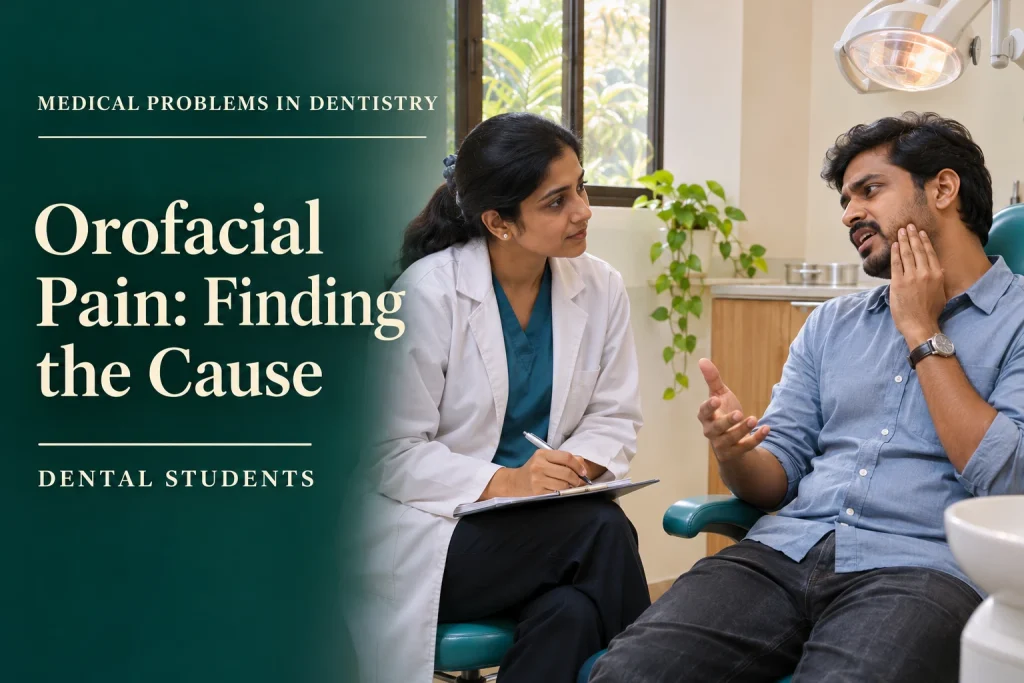
Fictional teaching case. A patient points to a restored lower molar and requests extraction for intermittent facial pain. Examination and initial dental tests do not explain the episodes. Some occur with jaw use; others are brief and electric. What additional history and examination are needed before the tooth is blamed?
Describe the pain in the patient’s own timeline
Ask when it began, whether onset followed dental treatment or injury, how long each episode lasts and whether there are pain-free intervals. Record quality, intensity, distribution, triggers, relieving factors, sleep effects and functional impact. Clarify whether “constant” means continuous pain or repeated frequent attacks.
Ask the patient to distinguish the current problem from previous toothache or headache. A diagram and a symptom diary can help describe distribution and timing, but neither establishes a diagnosis. Explore medicines already tried and the actual response without treating response alone as proof of a cause.
Look for a coherent dental explanation
Examine the teeth, periodontal tissues, mucosa and relevant adjacent structures. Choose pulp, percussion, palpation, periodontal and imaging assessments according to the suspected problem and compare findings where appropriate. Interpret results together rather than relying on a single tender tooth or an incidental radiographic finding.
A dental cause should plausibly explain the pain pattern. Conversely, an initially normal radiograph does not exclude every dental disorder. When the findings are inconclusive, document the uncertainty and reassess or seek appropriate help instead of extracting a tooth simply because the patient localises pain there.
Organise the wider differential
The first edition of the International Classification of Orofacial Pain groups pain related to dentoalveolar tissues, muscles, temporomandibular joints, cranial nerves and other patterns, including headache-like and idiopathic presentations. This is a framework for assessment, not a way to diagnose from one adjective.[ICOP]
Brief electric-shock-like attacks, altered sensation, jaw movement-related pain or a headache pattern each direct further questions. No single feature replaces the full diagnostic requirements. Examine relevant jaw function and neurological findings within competence, and refer when the pattern or examination requires specialist assessment.
Compare patterns without turning them into shortcuts
| Finding or question | Clinical implication | Student action |
|---|---|---|
| Pain with compatible local dental findings | An odontogenic cause may fit | Correlate history, examination and appropriate tests |
| Brief triggered electric-shock-like attacks | A neuralgic pattern is possible | Explore distribution and associated findings; assess or refer appropriately |
| Pain related to jaw function with familiar pain reproduced | A muscle or joint source may contribute | Perform a directed assessment; do not diagnose from clicking alone |
| No adequate local explanation | Further assessment is needed | Consider referred and other causes without labelling pain imaginary |
| New concerning systemic or neurological symptoms | Routine dental treatment may be unsafe | Prioritise urgent medical assessment |
Assess muscle and joint symptoms carefully
Ask about jaw function, restriction, locking and whether examination reproduces the patient’s familiar pain. An incidental painless click does not automatically explain facial pain or require treatment. NIDCR notes that TMD describes multiple conditions and that assessment depends on history and examination, with imaging selected when needed.[TMD]
Avoid irreversible bite alteration or repeated dental procedures as a diagnostic experiment. Explain uncertainty and discuss an appropriate conservative or specialist plan after assessment. This overview does not provide a splint prescription or a complete TMD treatment protocol.
Recognise medical urgency beyond toothache
Jaw or facial discomfort accompanied by chest discomfort, breathlessness, sweating or other concerning symptoms may indicate a cardiac emergency. Do not delay emergency assessment to complete a dental diagnosis. International public-health guidance includes jaw pain among possible heart-attack symptoms; use the local Indian emergency response pathway.[CARDIAC]
New headache with jaw pain on chewing, scalp symptoms or visual disturbance can raise concern for giant cell arteritis in an appropriate clinical setting. Suspected disease needs urgent medical assessment because vision can be threatened; visual symptoms require immediate escalation. These are warning patterns, not diagnoses made from jaw pain alone.[GCA]
Avoid premature idiopathic or psychological labels
Pain without an immediate dental explanation is still real. Persistent idiopathic facial pain has specific diagnostic requirements, including appropriate exclusion of dental causes; it is not a synonym for any normal radiograph. The ICHD-3 criteria should be applied through a proper assessment rather than used to close an uncertain case.[ICHD]
Ask about distress, sleep and the effect of pain on life as part of comprehensive care, without implying that those factors make the pain imaginary. Explain the referral question, give a clear review plan and advise what new symptoms should prompt urgent help. In a viva, a well-supported differential and safe next step are preferable to a confident but unsupported extraction diagnosis.
Viva and self-check
Does pointing to a tooth prove that tooth is the source? No. Location must be correlated with history, examination and appropriate tests.
Does a painless joint click require treatment? Not automatically. Establish whether there is a symptomatic disorder and a coherent relationship to the complaint.
Why avoid the label idiopathic too early? It has diagnostic requirements and appropriate exclusion steps; it should not replace investigation of an unexplained pain.
Continue through the series
- Previous: Hearing, Vision and Mobility Impairment: Practical Dental Access Adaptations
- Next: Migraine, Cluster Headache and Other Headache Disorders That Mimic Dental Pain
- Browse all 215 student guides by subject
More in Headache and orofacial pain: Migraine, Cluster Headache and Other Headache Disorders That Mimic Dental Pain · Burning Mouth Syndrome: Diagnostic Exclusion, Differentials and Referral · Persistent Dentoalveolar and Facial Pain: Avoiding Unnecessary Irreversible Treatment · Giant Cell Arteritis, Jaw Claudication and Other Urgent Facial-Pain Red Flags
Continue learning
- Dental pain pathways: a student refresher
- Trigeminal neuralgia and dental diagnosis
- Medical liaison and referral for complex dental patients
- Dental clinic medical emergency readiness
References and scope
Sources checked on 26 November 2026. This is an original student teaching guide. International clinical recommendations are identified by their issuing organisation. Use current local protocols, appropriate supervision and an individual clinical assessment.
- International Classification of Orofacial Pain, first edition (ICOP, 2020)
- NIDCR: Temporomandibular Disorders
- CDC: About Heart Attack Symptoms, Risk, and Recovery
- NHS: Temporal arteritis (giant cell arteritis)
- ICHD-3: Persistent idiopathic facial pain
Images are AI-generated educational illustrations of fictional people or equipment, not clinical records or diagnostic photographs.

Leave a Reply