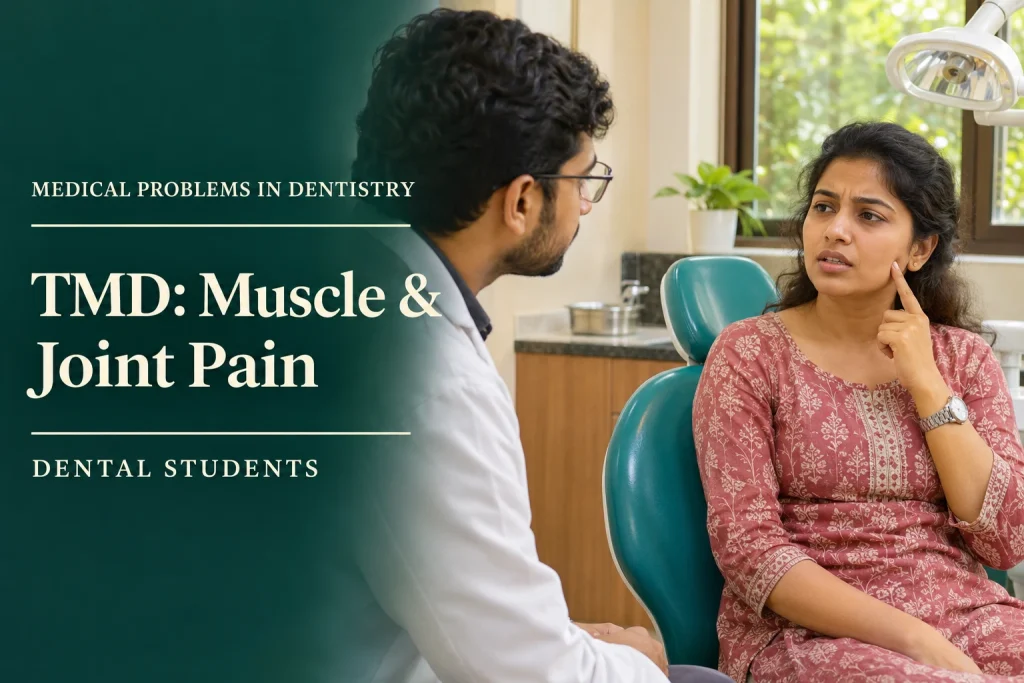
Medical Problems in Dentistry: Article 95 of 215 · Joint disorders · Complete student guide
Medical Problems in Dentistry · Student guide
TMJ names an anatomical joint; TMD names a group of disorders affecting jaw function and associated structures. Pain near the ear or a clicking joint does not establish a single diagnosis. A student should first identify the patient’s complaint, assess the relevant structures and explain uncertainty without offering a permanent bite alteration as a diagnostic experiment.
In this guide: Learning objectives · Start with this clinical case · Map the complaint and its impact · Examine competing explanations · Keep systemic and medicine context visible · Use findings to ask the next question · Explain conservative care and treatment limits · Refer when the story does not fit · Viva and self-check
Learning objectives
- Distinguish muscle, joint and other possible sources of pain.
- Take a focused history and choose investigations for a defined question.
- Explain reversible care, review and referral.
Start with this clinical case
Fictional teaching case. A student examines an adult with intermittent cheek pain during chewing and an occasional painless click. The patient asks whether all their crowns should be changed to “correct the joint”. Before considering treatment, the student must establish what hurts, whether the click is relevant and whether another cause explains the complaint.
Map the complaint and its impact
Ask the patient to indicate the pain location, then establish onset, duration, episodes, provoking activities, locking and changes in opening. Clarify whether joint sounds themselves are painful. Ask about headache, other pain, sleep, previous trauma, treatment and the effect on eating or work.
NIDCR describes TMD as a group that includes joint disorders, masticatory-muscle disorders and associated headache. Several can coexist. Painless clicking is common and usually does not require treatment. Record the patient’s main goal rather than letting an incidental sound become the reason for intervention.[TMD]
Examine competing explanations
Perform an appropriate dental, mucosal and facial examination. Tooth-related pain, infection, neuropathic pain and other head-and-neck disease can overlap with a jaw complaint. An examination should test a working hypothesis, not simply find any tender spot and declare it causal.
Under supervision, assess comfortable jaw movement and relevant muscle/joint tenderness, explaining each step and avoiding forced opening. Record what reproduces the familiar symptom and what does not. A symptom diary may help describe patterns, but it cannot replace reassessment when the course changes.
Keep systemic and medicine context visible
Known inflammatory arthritis, a recent medical change or reduced function may change the differential and the care setting. Ask about current systemic disease and medicines instead of assuming every jaw pain is isolated TMD. Rheumatoid arthritis can affect several aspects of treatment planning, while osteoarthritis assessment is guided by the person’s symptoms and function.[RA][OA]
Do not assume “stress” explains a symptom before completing assessment. Pain-related distress deserves validation and can be addressed alongside clinical investigation. A normal initial dental radiograph does not establish that pain is imagined.
Use findings to ask the next question
| Finding or question | Clinical implication | Student action |
|---|---|---|
| Chewing-related muscle-area pain | A masticatory-muscle source is possible | Assess the familiar pain pattern and other causes. |
| Pain localised near the joint with movement | A joint source is possible | Assess function, history and need for further investigation. |
| Painless clicking without functional difficulty | May be incidental | Explain and observe rather than treat the sound alone. |
| New progressive limitation, swelling or neurological change | A simple TMD label may be inadequate | Arrange timely investigation or specialist referral. |
Explain conservative care and treatment limits
NIDCR recommends starting with conservative approaches and cautions against treatments that permanently change the teeth, bite or jaw joints without a sound indication. Occlusal grinding or replacing crowns should not be offered simply because pain is present. Any appliance or exercise programme needs a diagnosis-informed plan, tolerability checks and review.[TMD]
Discuss the agreed aim: improved comfort and function, a way to monitor symptoms and a clear review point. Medicine choice needs assessment of renal, gastrointestinal and other risks, existing analgesics and interactions. “Try an NSAID” is not an adequate prescription for every patient.
Refer when the story does not fit
Persistent or worsening symptoms, marked functional limitation, atypical findings or uncertainty may require oral medicine, orofacial pain, OMFS or medical assessment. Rapid swelling, severe systemic illness or a threat to breathing/swallowing requires urgent care. Investigation should answer a specific question rather than serve as automatic imaging for every click.
For the case, address the painful complaint and explain why an incidental painless click does not justify replacing crowns. Document the differential, agreed reversible plan and what should trigger earlier review. A follow-up that measures the patient’s eating and function is more useful than recording only whether the joint still makes a sound.
Viva and self-check
Is every clicking TMJ a disorder needing treatment? No. Painless clicking without dysfunction is often incidental.
Does temporary pain improvement prove that the bite caused TMD? No. Improvement after an intervention does not establish causality or justify irreversible treatment.
What should an investigation answer? A specific diagnostic or treatment-planning question arising from the history and examination.
Continue through the series
- Previous: Rheumatoid Arthritis and Dentistry: TMJ, Function, Medicines and Shared Care
- Next: Osteoarthritis and Limited Mobility: Adapting Dental Positioning and Appointments
- Browse all 215 student guides by subject
More in Joint disorders: Rheumatoid Arthritis and Dentistry: TMJ, Function, Medicines and Shared Care · Osteoarthritis and Limited Mobility: Adapting Dental Positioning and Appointments · Prosthetic Joint Replacements: Dental Care and Antibiotic Prophylaxis Decisions · Inflammatory Arthritis and Biologic Treatment: Dental Infection and Procedure Planning
Continue learning
References and scope
Sources checked on 26 November 2026. This is an original student teaching guide. International clinical recommendations are identified by their issuing organisation. Emergency contact information is specific to India. Use current local protocols, appropriate supervision and an individual clinical assessment.
- NIDCR: Temporomandibular Disorders
- NIAMS: Rheumatoid Arthritis—Diagnosis and Treatment
- NIAMS: Osteoarthritis—Diagnosis and Treatment
Images are AI-generated educational illustrations of fictional people or equipment, not clinical records or diagnostic photographs.

Leave a Reply