Medical Problems in Dentistry: Article 203 of 215 · Medical emergencies · Complete student guide
Medical Problems in Dentistry · Student guide
A seizure may involve jerking movements, altered awareness or a less obvious change in responsiveness. The dental team’s immediate task is to keep the person safe, call appropriate help and monitor recovery. A history of epilepsy does not remove the need to assess an unusual or prolonged event. Observation and timing are more useful than trying to force a diagnosis during the episode.
In this guide: Learning objectives · Start with this clinical case · Observe the event and start timing · Protect without restraint · Know when the episode is an emergency · Recovery is an active assessment period · Handover and future dental planning · Viva and self-check
Learning objectives
- Describe a seizure without assuming every collapse is epilepsy.
- Identify actions that prevent injury and actions that can cause harm.
- Recognise prolonged or recurrent seizures and organise emergency handover.
Start with this clinical case
Fictional teaching case. An adult develops convulsive movements during a dental visit. A colleague reaches for a mouth prop to prevent tongue biting, while another estimates that the seizure has lasted “a while.” Do not insert an object or restrain the person. Clear immediate hazards, summon trained help and record timing; uncertainty about duration should be communicated rather than concealed.
Observe the event and start timing
Note when the episode began, the change in awareness, movement pattern and any preceding symptoms. Seizures do not all look the same: CDC describes presentations including staring, confusion and loss of awareness as well as generalised convulsions. Record what was seen instead of writing a diagnosis unsupported by the observations.[CDCSEIZURE]
Stop treatment and call for help. Dental instruments and nearby equipment can become hazards. Remove items only when this can be done safely; do not reach between clenched teeth. Ask another team member to time the event and document major changes while care proceeds. A reliable timeline helps determine urgency and informs the receiving team.
Protect without restraint
Do not hold the person down or attempt to stop the movements. Do not put a spoon, mouth prop, fingers or another object into the mouth. CDC advises against food, water or oral intake until the person is fully alert. These actions can injure the patient or rescuer and create aspiration risk.[CDCSEIZURE]
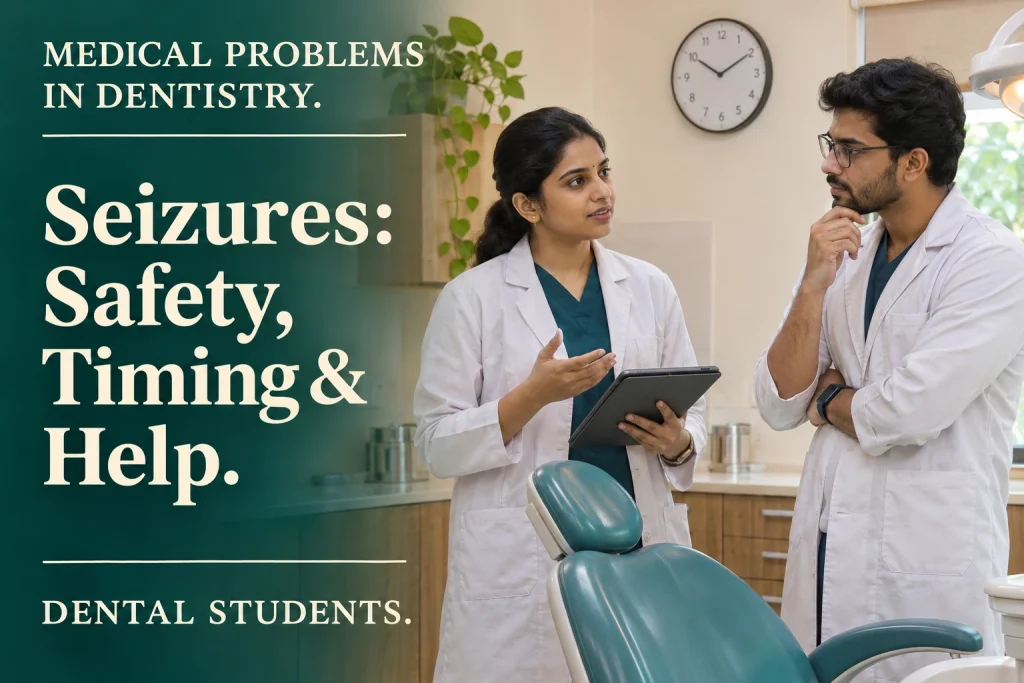
Reduce surrounding hazards and protect from avoidable injury using the trained team’s approach. Do not attempt a complex transfer during uncontrolled movements without appropriate help. The image for this article is a preparation scene, not a demonstration of seizure positioning. Practical skills must be learned in supervised training with the actual clinical environment.
Know when the episode is an emergency
A convulsive seizure reaching five minutes, or recurrent seizures without adequate recovery, requires urgent emergency response. SDCEP also advises ambulance help for a first episode, an atypical convulsion, injury or difficulty monitoring the patient. Do not wait for a longer event simply because the person has a previous epilepsy diagnosis.[SEIZURE]
An individual rescue plan may exist. Retrieve it and involve a clinician trained and authorised to implement it, while activating emergency services when indicated. Rescue medicines have specific indications, products, routes and monitoring requirements. This guide does not teach buccal midazolam administration or provide a dose; students should not improvise from a remembered number.
In India, use 112 or the clinic’s verified emergency ambulance arrangements. Describe the active seizure, duration or uncertainty about onset, recurrence, injuries and breathing concerns. Make clear if the patient has not regained their usual level of responsiveness. Do not spend the emergency call describing the planned dental procedure before stating the immediate problem.[INDIA]
Recovery is an active assessment period
| Finding or question | Clinical implication | Student action |
|---|---|---|
| Ongoing convulsions with uncertain onset | Duration may already be prolonged | Escalate promptly and communicate the uncertainty |
| Another seizure before recovery | A continuing emergency is possible | Activate emergency care rather than restarting the clock casually |
| Movements stop but breathing is abnormal | The event may not be simple post-seizure recovery | Assess immediately and use the appropriate resuscitation pathway |
| Confusion persists after the event | Recovery and safety are unresolved | Continue observation and obtain appropriate medical advice |
After movements stop, reassess responsiveness and breathing. Cardiac arrest can begin with seizure-like activity, so abnormal breathing in an unresponsive person must not be dismissed as a normal postictal state. Use CPR and AED pathways when indicated. For a person breathing normally, the trained team should protect the airway and continue monitoring using its current protocol.[BLS]
Handover and future dental planning
Give responders the observed start time, movement and awareness changes, recurrence, breathing findings, injuries, relevant medicines and interventions. Include whether the event differs from the patient’s usual pattern, if that information is available. Separate a witness account from your own observations in the record.
After appropriate recovery or transfer decisions, review the medical history and any existing seizure plan before future treatment. Ask about seizure control, missed medicines, triggers and treating-team advice without independently changing anticonvulsants. Appointment planning should reflect the individual rather than an automatic refusal to provide care.
In the teaching case, the mouth-prop impulse and uncertain timing are useful simulation learning points. Rehearse roles for clearing hazards, calling help, timing and handover. The goal is a team that acts safely while acknowledging uncertainty. This recognition guide does not substitute for emergency training, an individual rescue plan or specialist management of status epilepticus.
Viva and self-check
Should something be placed between the teeth? No. Objects and fingers in the mouth can cause injury and aspiration risk.
Does a known epilepsy diagnosis make a prolonged seizure routine? No. Prolonged, recurrent or atypical events still need emergency assessment.
What must be checked once jerking stops? Responsiveness and breathing, with immediate escalation if abnormal.
Continue through the series
- Previous: Hypoglycaemia in Dental Practice: Consciousness, Recognition and Escalation
- Next: Severe Asthma in the Dental Chair: Recognition and Emergency Escalation
- Browse all 215 student guides by subject
More in Medical emergencies: A Collapsed Patient in the Dental Chair: ABCDE, Calling for Help and BLS/AED · Hypoglycaemia in Dental Practice: Consciousness, Recognition and Escalation · Severe Asthma in the Dental Chair: Recognition and Emergency Escalation · Suspected Stroke During a Dental Visit: Recognising Signs and Activating Emergency Care · Choking and Suspected Aspiration in Dentistry: Recognition, Prevention and Emergency Response
Continue learning
- Dental clinic medical emergency readiness
- Structured medical history and examination
- Medical liaison and referral for complex dental patients
References and scope
Sources checked on 26 November 2026. This is an original student teaching guide. International clinical recommendations are identified by their issuing organisation. Use current local protocols, appropriate supervision and an individual clinical assessment.
- CDC: First Aid for Seizures
- SDCEP: Epilepsy
- RCUK: Adult Basic Life Support Guidelines (2025)
- National Portal of India: Emergency Helpline
Images are AI-generated educational illustrations of fictional people or equipment, not clinical records or diagnostic photographs.

Leave a Reply