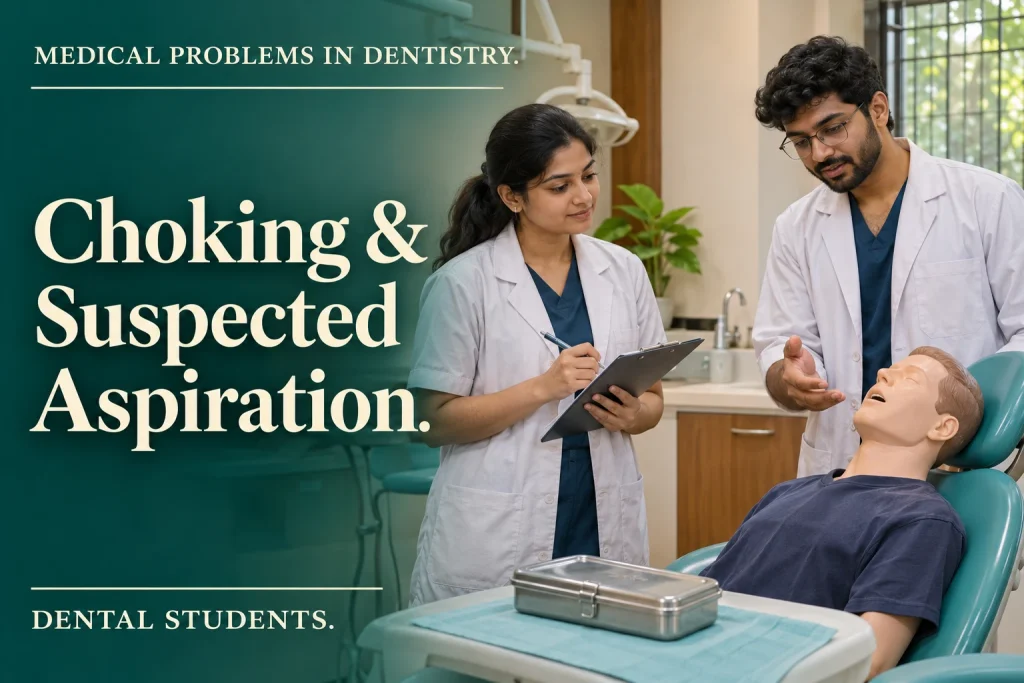
Medical Problems in Dentistry: Article 206 of 215 · Medical emergencies · Complete student guide
Medical Problems in Dentistry · Student guide
A missing dental object raises two immediate questions: is the patient’s airway compromised, and where might the object have gone? Choking, aspiration and swallowing are related possibilities with different implications. Lack of dramatic symptoms does not prove safe passage into the stomach. Assess the patient first and organise appropriate help.
In this guide: Learning objectives · Start with this clinical case · Assess the person before searching the room · Effective cough and severe obstruction are different · Symptoms settling does not resolve the missing-object problem · Record what responders need to know · Prevention and follow-up after the event · Viva and self-check
Learning objectives
- Recognise effective cough versus severe airway obstruction.
- Understand why suspected aspiration needs assessment even after symptoms settle.
- Communicate object details and review prevention without blind retrieval.
Start with this clinical case
Fictional teaching case. A small component is no longer visible during treatment. The adult patient coughs briefly, then says they feel fine. Another team member suggests continuing because the cough stopped. First assess breathing, account for the component and seek appropriate advice about its possible location. A symptom-free interval does not confirm that it was swallowed safely.
Assess the person before searching the room
Stop treatment and call for nearby trained help. Determine whether the person can speak, breathe and cough effectively. Note sudden respiratory difficulty, noisy breathing, altered responsiveness or deterioration. SDCEP describes coughing, breathing difficulty and other respiratory signs in dental aspiration and choking emergencies.[ASPIRATION][CHOKING]
Avoid several people concentrating on the lost item while nobody monitors the patient. Assign object accounting and surrounding checks to another team member when possible. The clinical response depends on the patient’s condition, not whether the component was expensive or a replacement is available.
Effective cough and severe obstruction are different
For an adult who can cough effectively, encourage coughing and monitor for deterioration. If the cough is ineffective or the person cannot cough, use the trained adult choking response and activate emergency help. RCUK’s 2025 approach progresses from back blows to abdominal thrusts if needed; if the person becomes unresponsive, begin CPR and ensure emergency services have been called.[CHOKE2025]
Do not perform blind finger sweeps or probe the airway with instruments. Visible material should only be removed when it can be retrieved safely by a competent person. An uncertain location is not permission to search behind the tongue or between clenched teeth. This article does not teach invasive airway retrieval or substitute for supervised choking training.[CHOKING]
Adult techniques must not be transferred unchanged to infants or children. Pregnancy and other circumstances may also require adaptations taught in recognised training. The clinic should rehearse its approved protocols for the population it treats. Do not improvise because the emergency happens inside a dental surgery.
Symptoms settling does not resolve the missing-object problem
Aspiration means material entering the airway; swallowing involves the digestive tract. These cannot always be distinguished by the patient’s sensation or a brief cough. SDCEP advises hospital assessment when a large fragment is suspected to have been inhaled or swallowed even without signs or symptoms, and emergency referral for symptomatic aspiration.[ASPIRATION]
Do not turn that wording into reassurance that a smaller missing object is automatically harmless. Shape, size, material, sharp edges and the circumstances matter. Obtain prompt appropriate medical advice for a suspected inhaled or swallowed dental item and follow the relevant referral pathway. The receiving clinicians decide investigations and removal needs.
Do not offer food or drink to “push it down,” induce vomiting or assume that waiting for stool passage is the correct plan. Investigation should address the actual suspected object and the patient’s condition. If breathing symptoms or deterioration develop, activate emergency care immediately rather than waiting for a routine imaging appointment.
Record what responders need to know
| Finding or question | Clinical implication | Student action |
|---|---|---|
| Can the person speak and cough effectively? | Distinguishes the immediate airway response | Monitor and escalate if the cough becomes ineffective |
| Are respiratory symptoms present? | Symptomatic aspiration may require emergency care | Activate the appropriate response and transfer |
| What exactly is missing? | Material, size and shape influence assessment | Provide a matching item, photograph or product details if available |
| Symptoms have settled but location is unknown | Safe swallowing has not been established | Seek prompt medical assessment rather than reassurance |
For an emergency in India, 112 is the integrated response number; use the clinic’s verified local ambulance arrangements. State the current airway condition and suspected object, not only that a dental complication occurred. Give access details and arrange someone to meet the responders.[INDIA]
Prevention and follow-up after the event
Review procedure-specific measures such as appropriate isolation, secure handling, item accounting and the use of protective or retrieval arrangements suited to the procedure. These require training and individual judgement. A generic photograph or a single device cannot prove that a procedure is aspiration-proof. Do not allow prevention equipment to create false reassurance if an item is actually missing.
Document the event, symptoms, object description, assessment, advice sought, treatment and destination of referral. Ensure the receiving team has useful details without delaying care. After the immediate event, confirm the outcome and communicate it appropriately to the patient and dental team.
In the teaching case, the settled cough does not close the investigation. A useful simulation separates airway assessment, emergency calling, object identification and documentation. Review the system rather than blaming the patient’s movement. The purpose of this guide is recognition, escalation and clear handover, with practical emergency manoeuvres learned through current supervised training.
Viva and self-check
Does a stopped cough prove the object reached the stomach? No. Its location may still be uncertain.
Should an unseen object be searched for with a finger? No. Blind sweeps and probing can cause harm.
What object information helps the receiving team? Its identity, material, dimensions, shape and any sharp features, together with the event and symptoms.
Continue through the series
- Previous: Suspected Stroke During a Dental Visit: Recognising Signs and Activating Emergency Care
- Next: Recurrent Oral Ulceration: Local, Nutritional, Gastrointestinal, Immune and Malignant Causes
- Browse all 215 student guides by subject
More in Medical emergencies: A Collapsed Patient in the Dental Chair: ABCDE, Calling for Help and BLS/AED · Hypoglycaemia in Dental Practice: Consciousness, Recognition and Escalation · Seizures and Status Epilepticus in Dental Practice: Recognition and Emergency Response · Severe Asthma in the Dental Chair: Recognition and Emergency Escalation · Suspected Stroke During a Dental Visit: Recognising Signs and Activating Emergency Care
Continue learning
- Dental clinic medical emergency readiness
- Informed consent in an Indian dental practice
- Structured medical history and examination
References and scope
Sources checked on 26 November 2026. This is an original student teaching guide. International clinical recommendations are identified by their issuing organisation. Use current local protocols, appropriate supervision and an individual clinical assessment.
- SDCEP: Aspiration
- SDCEP: Choking
- RCUK: Adult Choking Algorithm (2025)
- RCUK: First Aid Guidelines (2025)
- National Portal of India: Emergency Helpline
Images are AI-generated educational illustrations of fictional people or equipment, not clinical records or diagnostic photographs.

Leave a Reply