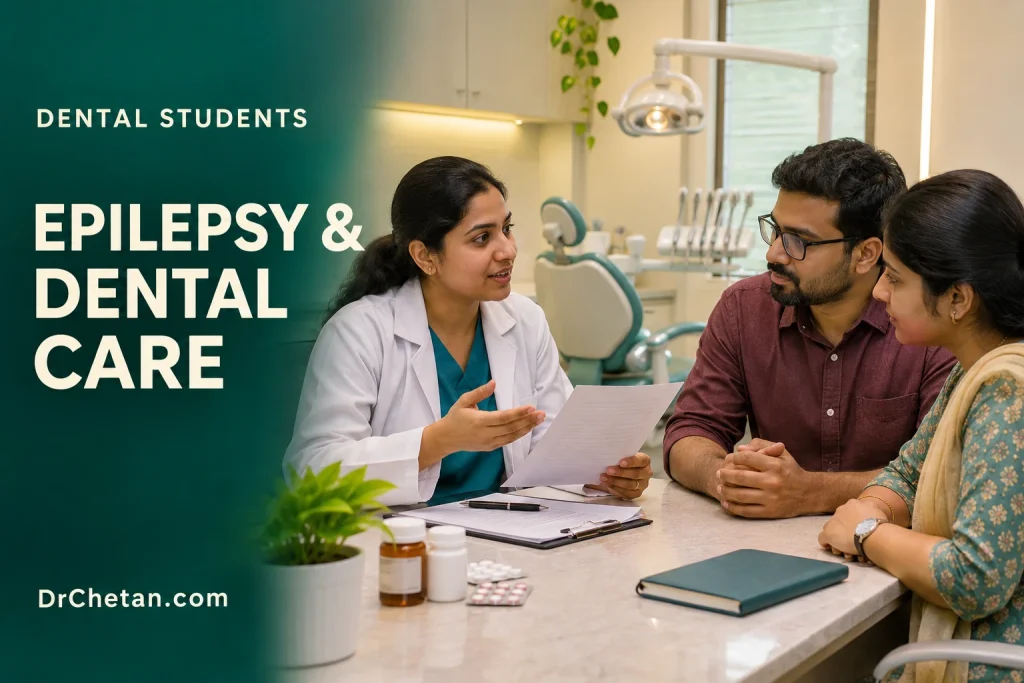
Medical Problems in Dentistry: Article 108 of 215 · Epilepsy, stroke and cranial neuropathy · Complete student guide
Medical Problems in Dentistry · Student guide
Epilepsy is not one uniform seizure pattern. Dental planning depends on what happens to this patient, how often, what has changed, which medicines they take and what the team should do if a seizure occurs during care.
In this guide: Learning objectives · Ask what the patient experiences · The pre-appointment history · Medicines and oral examination · Prepare a predictable visit · If a seizure occurs during dentistry · When is it an emergency? · After the event · Original cases and viva
Learning objectives
- Describe a seizure history in terms useful for dental planning.
- Identify medicine and oral-care issues without assuming that every episode of collapse is epilepsy.
- Apply first-aid principles and recognise when emergency treatment is required.
Ask what the patient experiences
Some seizures involve brief changes in awareness or focal symptoms; others involve loss of consciousness and bilateral convulsions. Ask the patient or an appropriate witness to describe the usual event in everyday language. Record any warning, movements, duration, recovery and injury history rather than relying only on a diagnostic label.
A seizure can have causes other than established epilepsy, including an acute metabolic or medical problem. A new event or changed pattern needs medical assessment. Syncope, hypoglycaemia and other causes may enter the differential during a dental visit; avoid premature certainty.
The pre-appointment history
| Question | Why it changes the plan |
|---|---|
| When was the last event and how frequent are events? | Establishes recent control and change |
| What is the usual duration and recovery? | Provides a baseline for recognising a prolonged or unusual episode |
| Any recent missed medicines, illness or sleep disruption? | Identifies potentially relevant circumstances |
| What triggers are known for this person? | Allows practical appointment adjustments |
| Is there a written emergency plan or prescribed rescue medicine? | Clarifies instructions, training and access |
| What dental injuries or oral problems have occurred? | Guides prevention and examination |
Medicines and oral examination
Reconcile drug names, doses, schedules, adherence concerns and recent changes. Do not advise a patient to omit antiseizure medication for routine local-anaesthetic dentistry. If fasting, sedation or inability to swallow is expected, the responsible team needs an explicit plan for the medicine schedule.
Examine for trauma to teeth or mucosa, gingival enlargement, hygiene difficulties and other oral findings. Some medicines can contribute to gingival changes, dryness or other adverse effects. Describe the finding and discuss it with the prescriber rather than independently changing a successful antiseizure regimen.
Before prescribing an analgesic, antibiotic or sedative, check the current interaction resource and the actual antiseizure medicine. “Antiepileptic” is not one interchangeable drug class for prescribing purposes. Consider the patient’s wider medical and pregnancy history where relevant.
Prepare a predictable visit
Discuss anxiety, known triggers, preferred appointment timing and the patient’s usual meals and medicines. A calm, well-explained visit and adequate pain control can help avoid preventable disruption. A universal rule about flashing lights or one appointment time is less useful than an individual history.
Ensure the team knows the emergency plan, how to call for help, where appropriate equipment is stored and who is trained to administer any rescue treatment. A medicine in a cupboard is not a complete response system. Choose a care setting suited to control, procedure and support needs.
If a seizure occurs during dentistry
- Stop treatment, call for assistance and start timing the event.
- Remove instruments and materials from the mouth if this can be done safely; move equipment away and protect the person from injury.
- Do not restrain movements, force open the jaws or put fingers or objects into the mouth.
- Follow trained first-aid care and the individual emergency plan. Position safely and assess breathing as the event resolves.
- Do not offer food, drink or oral medication until alertness and safe swallowing have returned.
Be aware that brief seizure-like movements can occur at the start of cardiac arrest. After movements cease, assess responsiveness and breathing promptly. If unresponsive and not breathing normally, activate the emergency response and begin CPR/AED care according to current training rather than waiting for an assumed postictal phase.[3]
When is it an emergency?
NICE treats convulsive seizures lasting five minutes or more as status epilepticus requiring immediate resuscitation and emergency treatment. A convulsive event continuing more than two minutes beyond the person’s usual duration is also a prolonged-seizure emergency in that framework. Do not wait for five minutes if breathing is impaired, serious injury occurs, recovery is poor or another emergency concern is present.
A first seizure, repeated events without recovery, pregnancy or a markedly different presentation also warrants urgent medical assessment. Rescue medication must follow the individual plan or the clinic’s authorised protocol, with trained administration and emergency support. This guide does not provide an unsupervised rescue-dose chart.[2]
After the event
Reassess, document timings and observations, check for injury and explain what happened when the patient can understand. Record any treatment and handover. Do not resume an elective procedure simply because the movements stopped. Consider the patient’s return to baseline, cause, supervision and appropriate medical advice.
Review the visit with the patient and team later: did a known plan work, were medicines accessible and does the proposed dental treatment need another setting? Support dignified care and confidentiality throughout.
Original cases and viva
Case A: A patient whose usual event lasts under a minute continues convulsing well beyond the usual pattern. Treat this as a changed/prolonged event; a stopwatch threshold must not delay help.
Case B: A patient collapses before an injection and recovers quickly. The differential includes syncope; do not label the event epilepsy from collapse alone.
MCQ: During convulsions, the team should A, place a bite block into the jaws; B, protect from injury, time the event and follow the emergency plan; C, give water. Answer: B.
Continue through the series
- Previous: Muscle Weakness, Dysphagia and Breathlessness: Recognising a Patient Who Needs Medical Assessment
- Next: Stroke and Dental Care: Disability, Dysphagia, Antithrombotics and Prevention
- Browse all 215 student guides by subject
More in Epilepsy, stroke and cranial neuropathy: Stroke and Dental Care: Disability, Dysphagia, Antithrombotics and Prevention · Facial Weakness: Bell Palsy, Stroke Red Flags and Dental Differentials · Cranial Nerve Examination for Dental Students: A Focused Clinical Guide
Continue learning
- taking a structured medical history
- assessment and medical liaison for complex patients
- medical emergency readiness in a dental clinic
References and scope
Sources checked on 25 November 2026. This is an original student teaching guide. International clinical guidance is identified by its issuing organisation; it is not presented as an Indian statutory rule. Apply the treating team’s current protocol and supervision to individual patients.
- CDC: First Aid for Seizures, May 2024
- NICE NG217: Status Epilepticus, Cluster and Prolonged Seizures, updated January 2025
- Resuscitation Council UK: The ABCDE Approach, updated July 2024
Images are AI-generated educational illustrations of fictional people or equipment, not clinical records or diagnostic photographs.

Leave a Reply