Medical Problems in Dentistry: Article 109 of 215 · Epilepsy, stroke and cranial neuropathy · Complete student guide
Medical Problems in Dentistry · Student guide
After a stroke, dental care should support the person’s health, independence and comfort. The important questions include current medical stability, swallowing and communication, ability to clean the mouth, medicines and the procedure being considered.
In this guide: Learning objectives · Understand the medical history · Recognise a possible new stroke · Communication and supported decision-making · Swallowing changes the procedure · A dental adaptation table · Practical oral care · Antithrombotics and other medicines · Timing and setting of dental treatment · Two original cases · Viva and MCQ
Learning objectives
- Distinguish long-term consequences of a previous stroke from new emergency symptoms.
- Assess communication, dexterity and swallowing needs respectfully.
- Coordinate dental treatment and prevention without unsafe medicine interruption.
Understand the medical history
A stroke may result from interrupted blood supply or intracranial bleeding. Secondary prevention and treatment therefore differ between patients. Record the type and date, residual problems, recent events, current follow-up and medicines rather than simply writing “CVA”. A transient ischaemic attack is also a significant medical history.
Ask what the person can do now: communicate, transfer, tolerate positioning, manage saliva, swallow medicines, eat and clean the mouth. A diagnosis does not describe these functions reliably. New symptoms must not be dismissed as part of an old disability.
Recognise a possible new stroke
Sudden facial asymmetry, arm weakness, speech difficulty, loss of balance or a visual change can indicate stroke. Note the onset or last-known-well time, stop dental care and activate emergency services. Symptoms that resolve still need urgent assessment. Do not attempt to distinguish ischaemic from haemorrhagic stroke in the dental chair by appearance.
Do not give oral food, drink or tablets if swallowing may be unsafe, and do not independently give aspirin for an undiagnosed suspected stroke. Support emergency assessment and handover. The American Stroke Association’s warning-sign resource is useful for recognition; use the local emergency pathway in India.[1]
Communication and supported decision-making
Aphasia or dysarthria does not automatically mean impaired understanding or inability to consent. Speak to the patient directly, allow time and use short, clear questions. Offer pictures, writing or other communication aids suited to the person. Involve a companion with the patient’s agreement.
Check understanding rather than assuming that a nod or a family member’s answer resolves consent. Assess decision-making ability for the particular decision and follow the applicable consent framework. Communication support and a genuine loss of decision-making ability are different issues.
Swallowing changes the procedure
Dysphagia can increase aspiration risk and complicate medicines and oral care. Ask whether a swallowing assessment has been done, what texture or fluid instructions apply and who manages the plan. Do not perform an informal “drink some water” challenge to certify safety.
NICE emphasises assessed mouth care and appropriate support after stroke, including for people with dysphagia. The swallowing team should guide relevant positioning and intake modifications; dental care should work within that individual plan.[2]
A dental adaptation table
| Need | Assessment question | Possible adaptation to individualise |
|---|---|---|
| Reduced hand function | Can the patient grip and use a brush effectively? | Larger handle, suitable powered brush or trained assistance |
| Communication difficulty | Which method helps the person understand and respond? | Extra time, visual aids and confirmation of understanding |
| Dysphagia / saliva control | What assessed swallowing and positioning plan applies? | Appropriate positioning, suction and carefully controlled materials |
| Fatigue / mobility | Can the patient transfer and tolerate the appointment? | Accessible arrangements, shorter visits and planned breaks |
| Medicines affecting bleeding | Which exact antithrombotic is prescribed and why? | Drug- and procedure-specific haemostatic plan |
Practical oral care
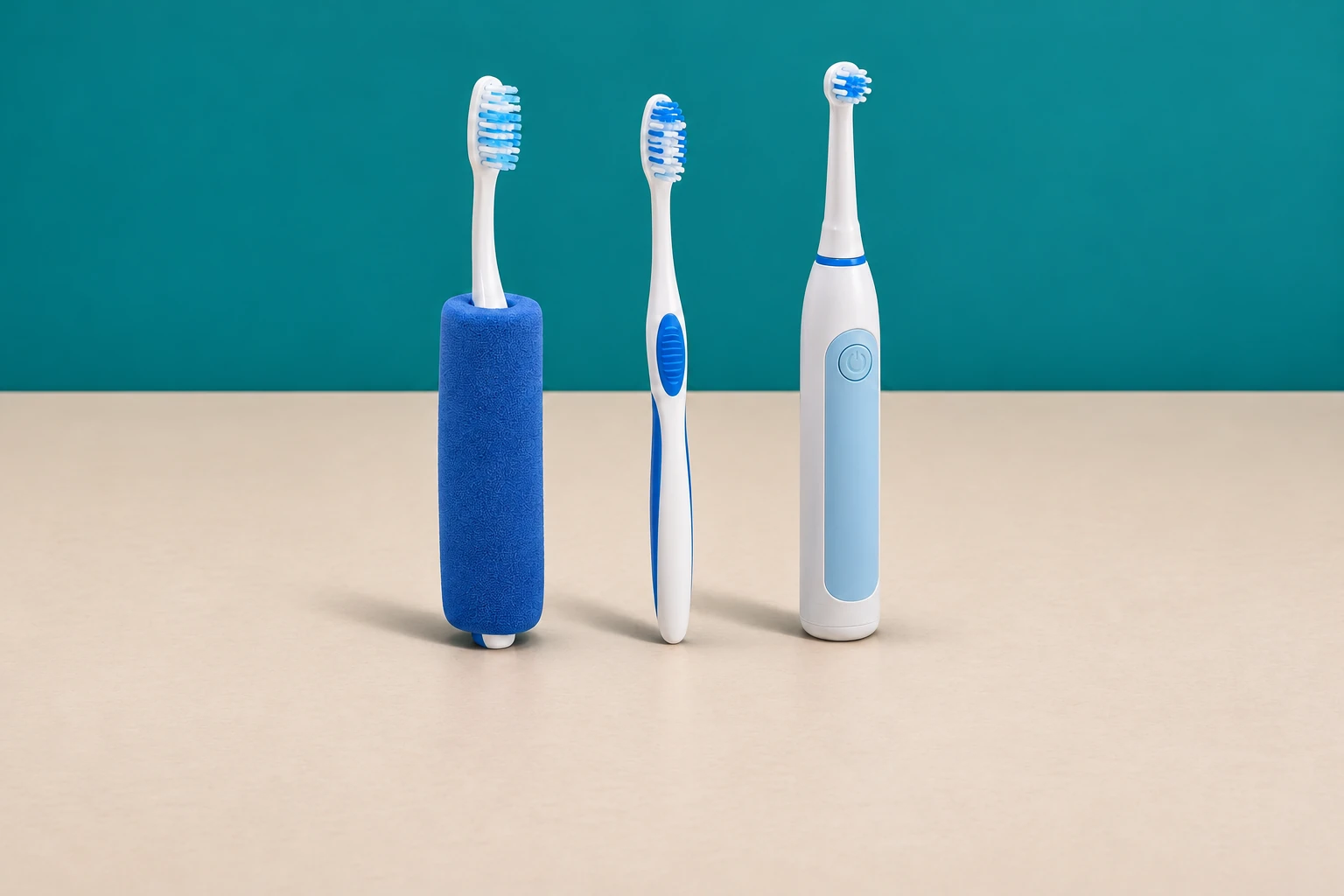
Inspect teeth, gingivae, tongue, dentures and mucosa. Check whether food or debris collects unnoticed and whether the person can recognise and report discomfort. Ask how cleaning happens at home rather than assuming a companion provides it.
Demonstrate an achievable routine and arrange trained assistance where needed. A powered brush or larger grip can help selected patients, but suitability depends on dexterity, tolerance and swallowing. Review cleaning technique, denture care, fluoride exposure, dryness and recall. Do not recommend a free-flowing rinse to someone who cannot safely manage it.
Antithrombotics and other medicines
Identify whether the person takes an antiplatelet, an anticoagulant, a combination or neither. The stroke label alone does not tell you. Do not stop preventive treatment reflexively before dental care. A normal INR cannot establish the absence of an antiplatelet or DOAC effect.
Balance the exact procedure and local haemostatic plan with the medical indication. The ADA discussion supports avoiding unnecessary alteration for many dental procedures and coordinating any higher-risk change with the prescriber. Check analgesic and antibiotic interactions as well.[3]
Timing and setting of dental treatment
A recent event, unstable symptoms or ongoing acute rehabilitation may require liaison before elective invasive treatment. There is no one waiting interval in this guide that applies to every stroke and every dental procedure. Establish stability, urgency, planned anaesthesia and available support with the treating team.
Pain or infection still needs a safe pathway. Avoid allowing a vague postponement instruction to leave the person without assessment. Record the purpose of medical advice and the practical treatment options.
Two original cases
Case A: A patient communicates slowly but clearly understands the choices when allowed time. Support the conversation; do not transfer all decision-making to the daughter because she speaks faster.
Case B: A patient with known mild residual weakness develops sudden new slurred speech during an appointment. Treat the change as possible acute stroke, note timing and arrange emergency care. Do not attribute the deterioration to the old diagnosis.
Viva and MCQ
Why ask about swallowing before dental treatment? It affects aspiration risk, positioning, materials, oral care and medicine administration.
Does a powered toothbrush replace assessment? No. It is one possible aid within an individual plan.
MCQ: Aphasia automatically proves inability to consent: true or false? False. Provide communication support and assess the particular decision appropriately.
Continue through the series
- Previous: Epilepsy and Dental Treatment: Seizure History, Triggers and Medicines
- Next: Facial Weakness: Bell Palsy, Stroke Red Flags and Dental Differentials
- Browse all 215 student guides by subject
More in Epilepsy, stroke and cranial neuropathy: Epilepsy and Dental Treatment: Seizure History, Triggers and Medicines · Facial Weakness: Bell Palsy, Stroke Red Flags and Dental Differentials · Cranial Nerve Examination for Dental Students: A Focused Clinical Guide
Continue learning
- taking a structured medical history
- assessment and medical liaison for complex patients
- medical emergency readiness in a dental clinic
References and scope
Sources checked on 25 November 2026. This is an original student teaching guide. International clinical guidance is identified by its issuing organisation; it is not presented as an Indian statutory rule. Apply the treating team’s current protocol and supervision to individual patients.
- American Stroke Association: Stroke Symptoms and Warning Signs
- NICE NG236: Stroke Rehabilitation in Adults, 2023
- American Dental Association: Anticoagulants, Antiplatelets and Dental Procedures
Images are AI-generated educational illustrations of fictional people or equipment, not clinical records or diagnostic photographs.

Leave a Reply