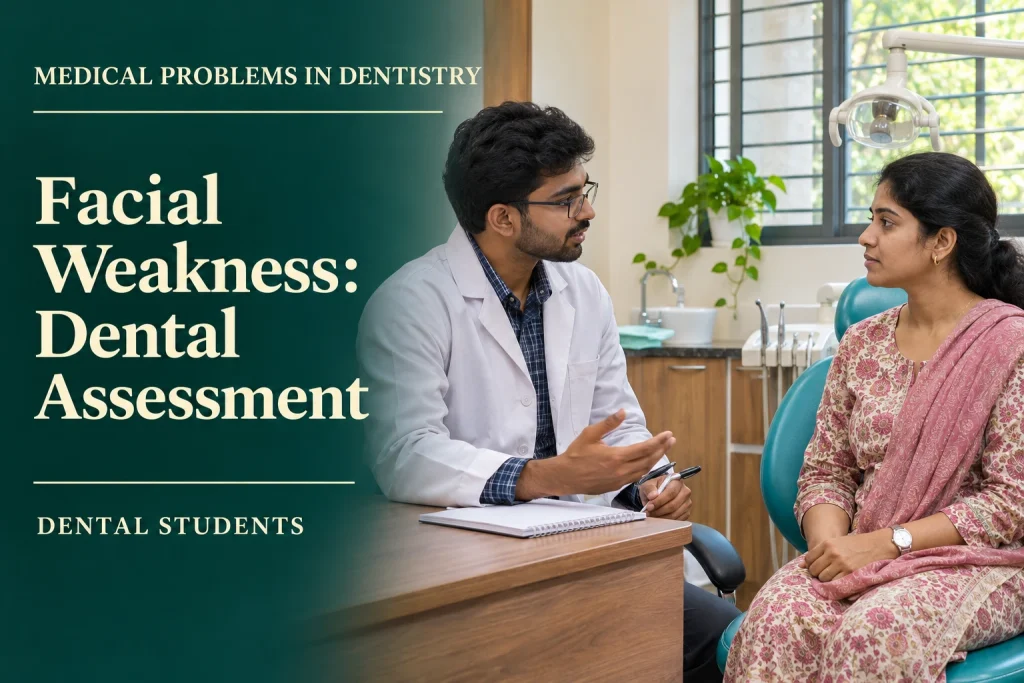
Medical Problems in Dentistry: Article 110 of 215 · Epilepsy, stroke and cranial neuropathy · Complete student guide
Medical Problems in Dentistry · Student guide
Facial weakness is a finding, not a final diagnosis. The dental setting adds possible procedural and local explanations, but these must not distract from stroke or other medical causes. Establish onset and associated symptoms first; a detailed examination is useful only when it does not delay necessary emergency care.
In this guide: Learning objectives · Start with this clinical case · Start with onset and associated symptoms · Describe movement and function · Do not use the forehead as a stroke exclusion test · Keep the differential and priority visible · Understand Bell palsy and the dental context · Communicate and review the outcome · Viva and self-check
Learning objectives
- Identify acute neurological warning features and appropriate urgency.
- Document facial movement and eye closure without relying on one localisation rule.
- Consider dental context while retaining a wider differential.
Start with this clinical case
Fictional teaching case. A person in the waiting room develops new facial droop and slurred speech. A second patient notices facial weakness after a recent dental visit and cannot close one eye properly. Both need assessment; neither should be reassured from the dental context or forehead appearance alone.
Start with onset and associated symptoms
Determine whether weakness was sudden, when the person was last known to be well, and whether speech, arm or leg function, vision, balance, headache or consciousness has changed. Use the history available immediately; do not delay emergency assistance while trying to obtain a perfect timeline.
NHS stroke guidance highlights sudden face, arm and speech changes and other neurological symptoms. Possible stroke requires immediate emergency assessment even if symptoms resolve. In India, activate the clinic response and call 112 as appropriate; do not ask the person to drive themselves.[STROKE][INDIA]
Describe movement and function
When safe to examine, observe the face at rest and during conversation, then assess forehead movement, eye closure and a smile or lip movement under supervision. Compare sides and document what was actually tested. Ask about drooling, oral function, taste changes, ear symptoms, pain and prior episodes.
Weakness affecting facial expression and numbness of facial skin are different findings; they may coexist, but one does not establish the other. Record each separately. A report of “the face feels numb” needs clarification rather than automatic translation into facial nerve paralysis.[CN]
Do not use the forehead as a stroke exclusion test
The familiar teaching distinction between central and peripheral facial weakness is useful background, but real presentations are not always a perfect textbook pattern. A 2025 single-centre observational study documented upper facial involvement in some patients with acute ischaemic stroke. It does not provide a stand-alone diagnostic rule or a prevalence estimate for all dental patients.[FACEPAPER]
Forehead involvement, preserved movement or an apparently isolated facial deficit cannot independently settle the diagnosis. Base urgency on onset and the whole presentation. Do not finish a long cranial nerve examination before calling for help when an acute event is suspected.
Keep the differential and priority visible
| Finding or question | Clinical implication | Student action |
|---|---|---|
| Sudden facial weakness with speech, limb or other neurological change | Possible stroke or another acute event | Arrange emergency assessment immediately. |
| New facial weakness without an established diagnosis | Bell palsy and other causes require medical assessment | Seek prompt assessment rather than reassure from one sign. |
| Incomplete eye closure | Corneal exposure and injury may occur | Arrange timely eye-protection advice and medical review. |
| Onset around a dental procedure | A procedural explanation is possible, not proven | Record timing and agents while assessing urgent alternative causes. |
Understand Bell palsy and the dental context
Bell palsy usually affects one side and can impair eye closure, eating, drinking or facial expression. NHS guidance recommends early medical assessment because treatment is most useful when started promptly, generally within 72 hours. That window is not permission to wait three days before referral. Eye protection needs attention when closure is incomplete.[BELL]
After a dental procedure, record the injection or intervention, site, agents, timing and observed changes. Do not assume all delayed weakness is a transient injection effect or promise recovery at a specific time without a diagnosis. Persistent, recurrent, progressive or atypical findings need appropriate medical/oral-maxillofacial assessment.
Communicate and review the outcome
Send the onset, associated features, examination findings, medicines and procedural information with the referral. Distinguish reported symptoms from observed deficits and state whether the eye closes fully. Record who accepted the handover and what the patient was told.
The waiting-room case requires emergency action. The second case needs prompt assessment of the new weakness and eye closure, including consideration of other causes despite the recent dental visit. At follow-up, confirm the established diagnosis, care team and functional needs before elective dentistry continues. Provide understandable instructions and a route to help if symptoms worsen.
Viva and self-check
Does forehead involvement rule out stroke? No. It cannot be used as an isolated exclusion test.
Is a new facial droop automatically Bell palsy? No. Assess onset and associated findings and arrange the appropriate medical assessment.
Why document eye closure? Incomplete closure can expose the cornea and requires timely protection and review.
Continue through the series
- Previous: Stroke and Dental Care: Disability, Dysphagia, Antithrombotics and Prevention
- Next: Cranial Nerve Examination for Dental Students: A Focused Clinical Guide
- Browse all 215 student guides by subject
More in Epilepsy, stroke and cranial neuropathy: Epilepsy and Dental Treatment: Seizure History, Triggers and Medicines · Stroke and Dental Care: Disability, Dysphagia, Antithrombotics and Prevention · Cranial Nerve Examination for Dental Students: A Focused Clinical Guide
Continue learning
- Structured medical history and examination
- Medical liaison and referral for complex dental patients
- Dental clinic medical emergency readiness
References and scope
Sources checked on 26 November 2026. This is an original student teaching guide. International clinical recommendations are identified by their issuing organisation. Emergency contact information is specific to India. Use current local protocols, appropriate supervision and an individual clinical assessment.
- NHS: Stroke Symptoms
- Ministry of Home Affairs: Emergency Response Support System
- University of Utah: NeuroLogic Examination—Normal Cranial Nerve Examination
- Wongwandee and Hongdusit: Upper Facial Weakness After Acute Ischaemic Stroke (2025)
- NHS: Bell Palsy
Images are AI-generated educational illustrations of fictional people or equipment, not clinical records or diagnostic photographs.

Leave a Reply