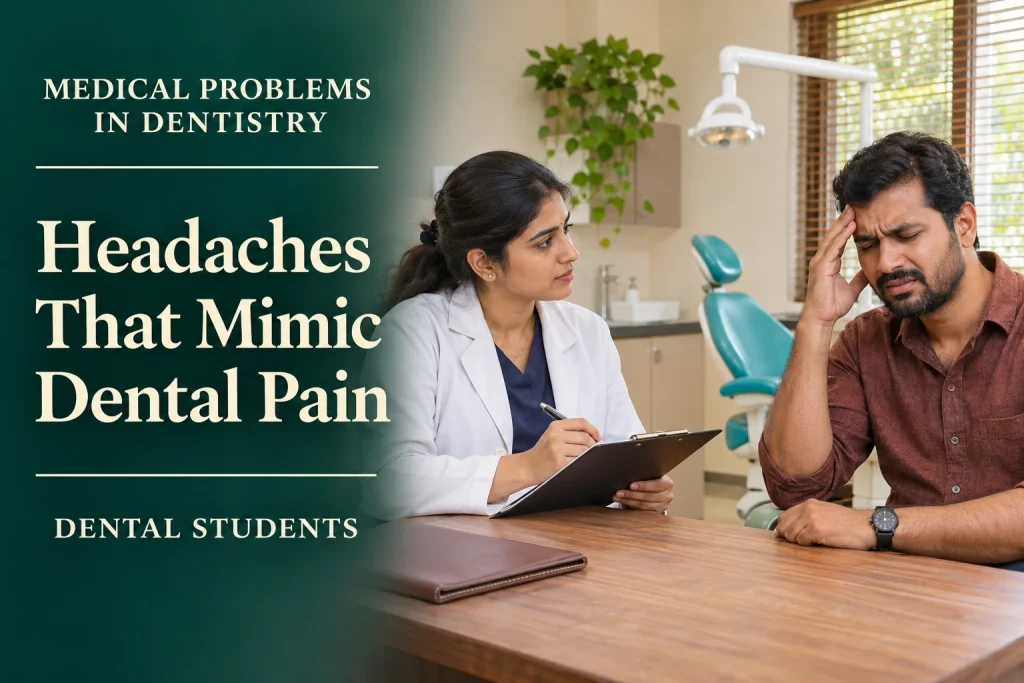
Medical Problems in Dentistry: Article 154 of 215 · Headache and orofacial pain · Complete student guide
Medical Problems in Dentistry · Student guide
A patient may describe a headache disorder as tooth, jaw or facial pain. The challenge is to test whether a dental explanation fits while asking enough about the wider attack. Recognising a headache pattern can prevent unnecessary treatment, but it should not replace assessment for secondary causes or urgent symptoms.
In this guide: Learning objectives · Start with this clinical case · Ask what happens before, during and after an attack · Migraine can include facial pain · Recognise a cluster-like pattern without self-diagnosing · Use pattern comparison carefully · Keep a proper dental assessment · Do not miss an urgent medical pattern · Refer with information that another clinician can use · Viva and self-check
Learning objectives
- Describe the entire attack rather than the tooth location alone.
- Compare migraine-like and cluster-like patterns using associated features.
- Avoid irreversible dental treatment without a coherent dental diagnosis.
Start with this clinical case
Fictional teaching case. A patient reports repeated upper-jaw pain with a severe one-sided head pain. During some episodes the eye waters and the patient cannot sit still. A small old restoration is present, but the dental findings do not explain the attacks. Which features should be recorded for an appropriate medical referral?
Ask what happens before, during and after an attack
Record onset, duration, frequency, pain-free intervals and whether attacks occur in a recognisable sequence. Ask where the pain begins and how it spreads, not simply where the patient points today. Explore nausea, light or sound sensitivity, eye or nasal symptoms, restlessness and any neurological or visual symptoms.
A symptom diary may help establish timing and associated features. Ask whether the patient has a previous medical diagnosis and whether the current episodes match that established pattern. A new or substantially changed presentation needs reassessment rather than automatic reuse of the old label.
Migraine can include facial pain
The ICHD-3 description of migraine without aura emphasises recurrent attacks with characteristic pain and associated symptoms. Its comments recognise that some otherwise typical attacks have facial localisation. This helps explain why a person can seek dental care for a headache-related problem.[MIGRAINE]
Ask about the broader episode and the effect of ordinary activity. Do not diagnose migraine because the patient uses the word “throbbing”, and do not exclude it solely because the pain is felt in the face. Full diagnostic requirements and exclusion of another cause belong to the appropriate clinical assessment.
Recognise a cluster-like pattern without self-diagnosing
Cluster headache involves severe one-sided attacks, often around the eye or temple, with same-sided autonomic features or restlessness. The timing and repeated attack pattern matter as much as the site. A watery eye alone is not a diagnostic test.[CLUSTER]
When the history suggests a trigeminal autonomic headache disorder, document the attack details and arrange appropriate medical assessment. Other conditions can produce overlapping symptoms. Do not turn a dental consultation into an unsupervised trial of headache medication, and do not assume that a nasal symptom proves sinus disease.
Use pattern comparison carefully
| Finding or question | Clinical implication | Student action |
|---|---|---|
| How long is each attack? | Timing helps organise the differential | Record the patient’s actual timeline rather than forcing a label |
| What happens to the eye, nose or behaviour? | Associated features may suggest a headache pattern | Record side, timing and relation to pain |
| Is there a compatible dental abnormality? | An incidental restoration may not be causal | Correlate dental tests with the complaint |
| Is this a new or changed presentation? | An established label may no longer explain it | Reassess urgency and seek medical review |
| Are there visual or other concerning symptoms? | A secondary cause may need urgent care | Escalate from the clinical findings |
Keep a proper dental assessment
Examine relevant teeth, periodontal tissues and oral structures and select tests for the clinical question. A headache disorder and dental disease can coexist. The aim is not to declare all normal-looking teeth innocent without examination; it is to avoid attributing the full complaint to an incidental finding.
If dental findings are inconclusive, record what was tested and why they do not yet establish the pain source. A request for extraction does not create a clinical indication. Explain why obtaining a clearer diagnosis is a positive next step and arrange a review or referral.
Do not miss an urgent medical pattern
Jaw pain on chewing with a new headache or visual symptoms can raise concern for giant cell arteritis in an appropriate patient. Suspected disease needs urgent assessment, with immediate escalation for visual symptoms because of threatened sight. Do not simply relabel this as a familiar headache or jaw-joint disorder.[GCA]
Pain accompanied by chest symptoms, breathlessness or systemic deterioration also changes the priority. Acute neurological or visual changes require prompt appropriate assessment. The student should state the warning finding and action rather than attempt to prove a rare diagnosis before referring.
Refer with information that another clinician can use
Include duration and frequency, distribution, associated symptoms, previous diagnoses and medicines, examination findings and the dental investigations already performed. State whether the presentation is stable, new or changing. A letter saying only “non-dental pain” gives the next clinician little to work with.
Avoid repeated irreversible dental interventions when the cause remains unsupported. Continue to address established dental disease on its own merits and keep communication open while the headache assessment proceeds. The best outcome is a coherent shared explanation and a clear route for continuing care.
Viva and self-check
Can headache pain be felt in the face? Yes. Facial localisation is recognised in migraine descriptions, but the complete attack and differential still need assessment.
Does tearing prove cluster headache? No. The full attack pattern, associated features and exclusion of another cause matter.
Why document dental tests in the referral? They show what local causes were assessed and help avoid repeated or unnecessary interventions.
Continue through the series
- Previous: Orofacial Pain Assessment: Odontogenic, Neuropathic, Musculoskeletal and Referred Causes
- Next: Burning Mouth Syndrome: Diagnostic Exclusion, Differentials and Referral
- Browse all 215 student guides by subject
More in Headache and orofacial pain: Orofacial Pain Assessment: Odontogenic, Neuropathic, Musculoskeletal and Referred Causes · Burning Mouth Syndrome: Diagnostic Exclusion, Differentials and Referral · Persistent Dentoalveolar and Facial Pain: Avoiding Unnecessary Irreversible Treatment · Giant Cell Arteritis, Jaw Claudication and Other Urgent Facial-Pain Red Flags
Continue learning
- Dental pain pathways: a student refresher
- Trigeminal neuralgia and dental diagnosis
- Medical liaison and referral for complex dental patients
References and scope
Sources checked on 26 November 2026. This is an original student teaching guide. International clinical recommendations are identified by their issuing organisation. Use current local protocols, appropriate supervision and an individual clinical assessment.
Images are AI-generated educational illustrations of fictional people or equipment, not clinical records or diagnostic photographs.

Leave a Reply