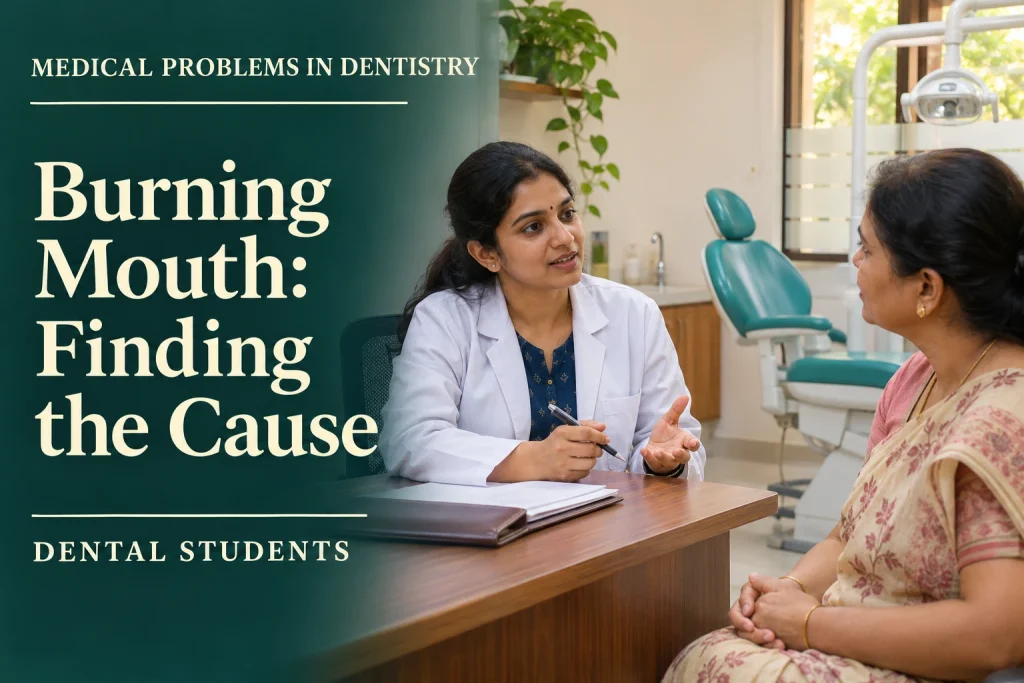
Medical Problems in Dentistry: Article 155 of 215 · Headache and orofacial pain · Complete student guide
Medical Problems in Dentistry · Student guide
Burning is a symptom, not a diagnosis. A person with oral burning needs a careful history and examination before burning mouth syndrome is considered. A normal-looking tongue does not make the pain imaginary, and it does not automatically establish an idiopathic pain condition.
In this guide: Learning objectives · Start with this clinical case · Describe the symptom precisely · Examine before applying a syndrome label · Review plausible contributing conditions · Choose targeted investigations · Understand diagnostic exclusion · Avoid treatment by assumption · Take pain seriously and follow through · Viva and self-check
Learning objectives
- Separate oral burning from a confirmed burning mouth syndrome diagnosis.
- Identify relevant local, medicine-related and systemic possibilities.
- Choose targeted investigation and avoid blanket empirical treatments.
Start with this clinical case
Fictional teaching case. A middle-aged patient reports several months of tongue burning, altered taste and a dry feeling. The mucosa appears broadly normal on initial inspection. The patient has already tried vitamins and an antifungal without a clear diagnosis. What would make the next assessment more useful?
Describe the symptom precisely
Ask where the burning occurs, whether it is continuous or intermittent, how it changes during the day and what affects it. Record dryness, taste changes, numbness, swallowing difficulty and the impact on eating, sleep and daily life. Clarify whether the present symptom followed a new medicine, product, dental procedure or illness.
NIDCR describes persistent oral burning that can occur with an apparently healthy mouth and can accompany altered taste or a dry sensation. Those features support a structured assessment; they do not identify the cause in an individual patient.[BMS]
Examine before applying a syndrome label
Inspect the entire relevant mucosa, tongue, lips and denture-bearing areas, not only the site the patient points to. Look for a visible lesion, trauma, irritant exposure and evidence of another oral disorder. Examine teeth and periodontal tissues where the history suggests a local contribution.
A persistent focal lesion requires its own diagnostic pathway. Do not explain an ulcer, induration or progressive mucosal change away as burning mouth syndrome. Conversely, the absence of a visible lesion is a finding to document, not a reason to dismiss the patient.
Review plausible contributing conditions
Dry mouth, infection, local irritation, relevant nutritional or medical problems and medicine effects may need consideration according to the history. NIDCR lists several oral and systemic possibilities that can cause burning symptoms; the task is to investigate those that fit this patient rather than assume all are present.[BMS]
Ask about prescribed and non-prescribed products, recent changes and previous treatment responses. Do not tell the patient to stop an important medicine independently. If a medicine contribution is plausible, communicate a focused question to the prescriber and agree an appropriate plan.
Choose targeted investigations
| Finding or question | Clinical implication | Student action |
|---|---|---|
| Visible local abnormality | A separate oral diagnosis may explain symptoms | Investigate or refer according to the finding |
| Dry feeling or reduced saliva concern | Subjective and objective findings may differ | Assess history and consider appropriate salivary evaluation |
| Relevant medical or nutritional clues | A targeted systemic question exists | Select investigations with the treating clinician |
| No local explanation after appropriate assessment | A pain syndrome may be considered | Seek oral medicine or appropriate specialist assessment |
| Several empirical treatments have failed | The original diagnosis may be unsupported | Review evidence rather than repeat prescriptions |
Understand diagnostic exclusion
ICOP places burning mouth syndrome within a defined classification framework. A syndrome diagnosis requires more than one normal inspection or one normal blood result. Appropriate assessment must consider other explanations and the symptom pattern; the classification should not be reduced to “burning plus normal tongue”.[ICOP]
The classification is a reference for trained assessment, not a checklist reproduced here in full. Do not delay referral simply to wait for a duration threshold if another concerning finding exists. A patient may need help and diagnostic review before a definitive label is available.
Avoid treatment by assumption
Repeated antifungals, supplements or changes to dental restorations without a supported indication can add cost and confusion. An abnormal result should be interpreted in context rather than automatically declared the complete cause of pain. Review what improved, what did not and whether the original treatment was indicated.
Explain that management depends on the assessment and may require specialist help. This student overview does not provide neuropathic-pain drug doses or a universal treatment sequence. Provide a clear route for review and discuss any avoidable irritant identified in this person’s routine.
Take pain seriously and follow through
Ask about the effect on life and the patient’s worries. Supportive discussion is compatible with thorough investigation; it should not become a suggestion that unexplained symptoms are invented. If distress needs additional help, discuss that sensitively while continuing the oral assessment.
A useful referral includes the symptom timeline, distribution, visible findings, medicine history, investigations and previous treatments with their outcomes. Tell the patient who will review results and when to return. The student’s objective is a defensible diagnostic pathway and continuing support, not a quick label for a normal-looking mouth.
Viva and self-check
Is burning mouth syndrome diagnosed from appearance alone? No. The symptom pattern and appropriate exclusion of other causes are necessary.
Does a normal-looking tongue make the symptom insignificant? No. Pain can be substantial without a visible lesion and deserves assessment.
Why avoid another empirical antifungal course? Without a supported indication it can delay a more useful diagnostic review and add unnecessary treatment.
Continue through the series
- Previous: Migraine, Cluster Headache and Other Headache Disorders That Mimic Dental Pain
- Next: Persistent Dentoalveolar and Facial Pain: Avoiding Unnecessary Irreversible Treatment
- Browse all 215 student guides by subject
More in Headache and orofacial pain: Orofacial Pain Assessment: Odontogenic, Neuropathic, Musculoskeletal and Referred Causes · Migraine, Cluster Headache and Other Headache Disorders That Mimic Dental Pain · Persistent Dentoalveolar and Facial Pain: Avoiding Unnecessary Irreversible Treatment · Giant Cell Arteritis, Jaw Claudication and Other Urgent Facial-Pain Red Flags
Continue learning
- Structured medical history and examination
- Explain Sjögren disease and dry mouth to a patient
- Medical liaison and referral for complex dental patients
References and scope
Sources checked on 26 November 2026. This is an original student teaching guide. International clinical recommendations are identified by their issuing organisation. Use current local protocols, appropriate supervision and an individual clinical assessment.
- NIDCR: Burning Mouth Syndrome
- International Classification of Orofacial Pain, first edition (ICOP, 2020)
Images are AI-generated educational illustrations of fictional people or equipment, not clinical records or diagnostic photographs.

Leave a Reply