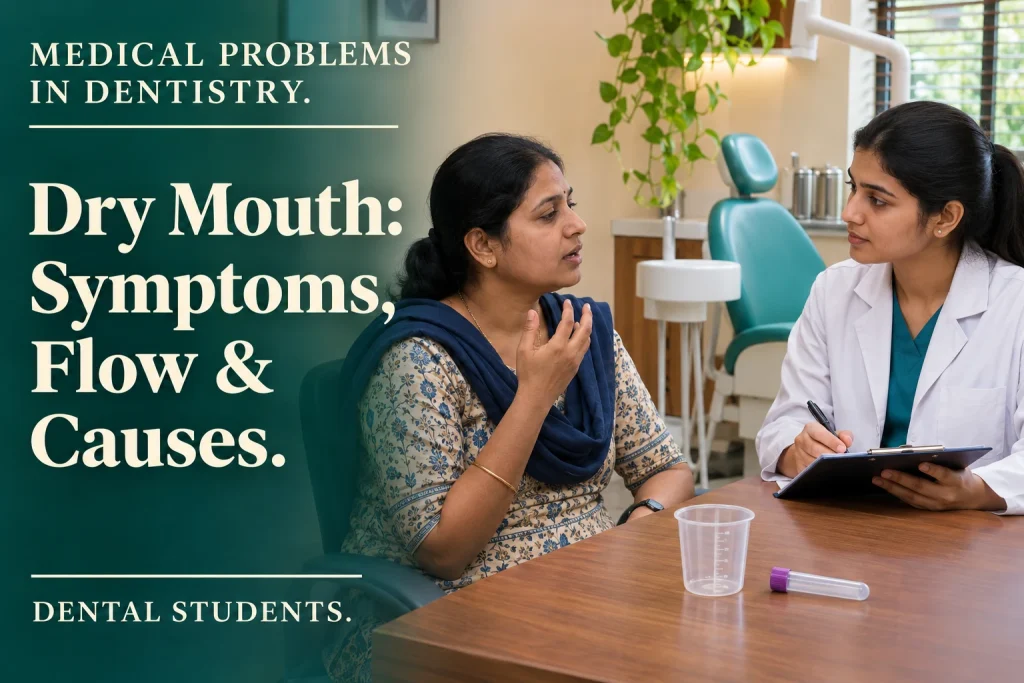
Medical Problems in Dentistry: Article 208 of 215 · Signs and symptoms · Complete student guide
Medical Problems in Dentistry · Student guide
Xerostomia is the subjective feeling of a dry mouth. Salivary hypofunction describes reduced measured secretion. These can overlap, but a symptom and a measurement are not interchangeable. The student should investigate the patient’s experience, oral consequences and possible causes rather than diagnose the problem from a single glance or flow result.
In this guide: Learning objectives · Start with this clinical case · Ask what dryness means to this patient · Examination adds evidence without replacing the history · Measure flow in a reproducible way · Organise the differential and next question · Manage consequences while investigating the cause · Viva and self-check
Learning objectives
- Separate symptoms, examination findings and measured salivary flow.
- Identify medicine, systemic and gland-related questions.
- Plan prevention and directed referral without a universal test or treatment.
Start with this clinical case
Fictional teaching case. An adult reports waking with a dry mouth and difficulty eating dry foods. At the appointment saliva is visible, so a trainee suggests there is no problem. The patient also uses several medicines and has intermittent gland swelling. Their symptoms still need assessment; visible saliva neither explains the complaint nor excludes a gland or systemic issue.
Ask what dryness means to this patient
Clarify onset, persistence, daily variation, night-time symptoms and effects on eating, speech, sleep and denture comfort. Ask what the person does for relief and whether this includes frequent sweet or acidic products. Record the burden in their own words. A mild appearance at one appointment may not reflect the experience during the rest of the day.
NIDCR notes that medicines can contribute to dry mouth and that dryness is not simply normal ageing. Compare symptom onset with current and recent treatment, illness and hydration circumstances. Obtain an actual medicine list rather than asking only whether the patient takes “anything that dries the mouth.” Do not independently stop a suspected medicine.[OLDERDRY]
Examination adds evidence without replacing the history
Assess teeth, mucosa, saliva pooling and the major glands as appropriate. Look for dental disease, discomfort, mucosal changes, swelling or tenderness. ADA’s professional resource describes examination and salivary flow measurement as parts of a directed assessment, with further tests selected for the clinical question. Normal-looking tissue does not invalidate a persistent symptom.[XERO]
Pain or swelling associated with a gland, a mass, facial symptoms or other concerning findings deserves its own assessment. NIDCR describes obstruction, infection and other gland disorders as possible causes of salivary problems. Do not assume all swelling is Sjögren disease or all dryness is caused by ageing. A focal finding may require a different referral from a general dry-mouth complaint.[GLANDS]
Measure flow in a reproducible way
Salivary flow assessment should follow the supervised service’s standard method. Document whether the sample is unstimulated or stimulated, collection duration and relevant circumstances, including recent intake, medicines and difficulties with collection. Report a rate with units rather than simply writing “low saliva.” A sample collected inconsistently may be difficult to interpret.
The ADA resource describes reduced-flow criteria, but a cut-off alone does not diagnose the cause. Stimulation method and collection conditions matter, and a symptom score answers a different question from measured output. Review an unexpected result in context. Do not diagnose or exclude Sjögren disease from one salivary measurement or a single dry-mouth symptom.[XERO]
Explain testing before collection and ask the patient to describe what they understand. Collection equipment in a teaching image does not establish a valid method or laboratory protocol. Students should learn the actual collection process, infection prevention and interpretation with supervision instead of copying a photograph.
Organise the differential and next question
| Finding or question | Clinical implication | Student action |
|---|---|---|
| Symptoms with apparently normal pooling | Subjective dryness remains a real complaint | Assess timing, exposures and functional impact |
| Reduced measured secretion | Hypofunction may be present | Check method and investigate likely causes |
| Medicine change before symptom onset | A contribution is possible, not proven | Coordinate a focused prescriber review |
| Gland swelling, tenderness or a mass | A focal gland disorder may need assessment | Arrange appropriate directed investigation or referral |
Ask about relevant systemic symptoms and previous head-and-neck treatment. Tests such as blood investigations, imaging or biopsy should be selected by the appropriate clinician for the suspected problem. A universal panel for every patient is not a substitute for reasoning, and no one test resolves every cause of salivary dysfunction.
Manage consequences while investigating the cause
Agree a risk-based oral prevention plan and address established disease. ADA discusses fluoride, saliva substitutes and selected salivary stimulation approaches among management options. Product selection should account for the individual’s medical conditions and ability to use it safely. Systemic sialogogues require appropriate assessment; this guide does not supply a prescription.[XERO]
NIDCR’s oral hygiene resource supports fluoride brushing and professional advice for increased caries risk. Discuss the patient’s relief habits, because frequent sweet products can add a separate caries concern. Fluid, gum or candy advice must account for swallowing ability, choking risk and any medical fluid restriction. Necessary treatment and nutrition should be preserved while the wider team reviews contributing factors.[HYGIENE]
Arrange follow-up for symptoms, disease control, test results and referrals. In the teaching case, the visible saliva does not close the consultation, and intermittent gland swelling needs further enquiry. Keep the patient’s complaint, clinical findings and measurements separate in the record, then explain how they support the working diagnosis and next step.
Viva and self-check
Are xerostomia and salivary hypofunction identical? No. One is a symptom and the other is reduced measured secretion.
Does visible saliva exclude significant dry-mouth symptoms? No. Assess timing and impact, then investigate appropriately.
Can one low flow result diagnose Sjögren disease? No. The cause requires the appropriate clinical assessment and directed testing.
Continue through the series
- Previous: Recurrent Oral Ulceration: Local, Nutritional, Gastrointestinal, Immune and Malignant Causes
- Next: Generalised Gingival Enlargement: Plaque, Drugs and Haematological Disease
- Browse all 215 student guides by subject
More in Signs and symptoms: Recurrent Oral Ulceration: Local, Nutritional, Gastrointestinal, Immune and Malignant Causes · Generalised Gingival Enlargement: Plaque, Drugs and Haematological Disease · Oral Pigmentation and Systemic Disease: Physiological Change, Drugs and Red Flags
Continue learning
- Explain Sjögren disease and dry mouth to a patient
- Structured medical history and examination
- Medical liaison and referral for complex dental patients
References and scope
Sources checked on 26 November 2026. This is an original student teaching guide. International clinical recommendations are identified by their issuing organisation. Use current local protocols, appropriate supervision and an individual clinical assessment.
- NIDCR: Dry Mouth and Older Adults — Caregiver Information
- ADA: Xerostomia
- NIDCR: Saliva and Salivary Gland Disorders
- NIDCR: Oral Hygiene
Images are AI-generated educational illustrations of fictional people or equipment, not clinical records or diagnostic photographs.

Leave a Reply