Medical Problems in Dentistry: Article 68 of 215 · Immune-mediated disease · Complete student guide
Medical Problems in Dentistry · Student guide
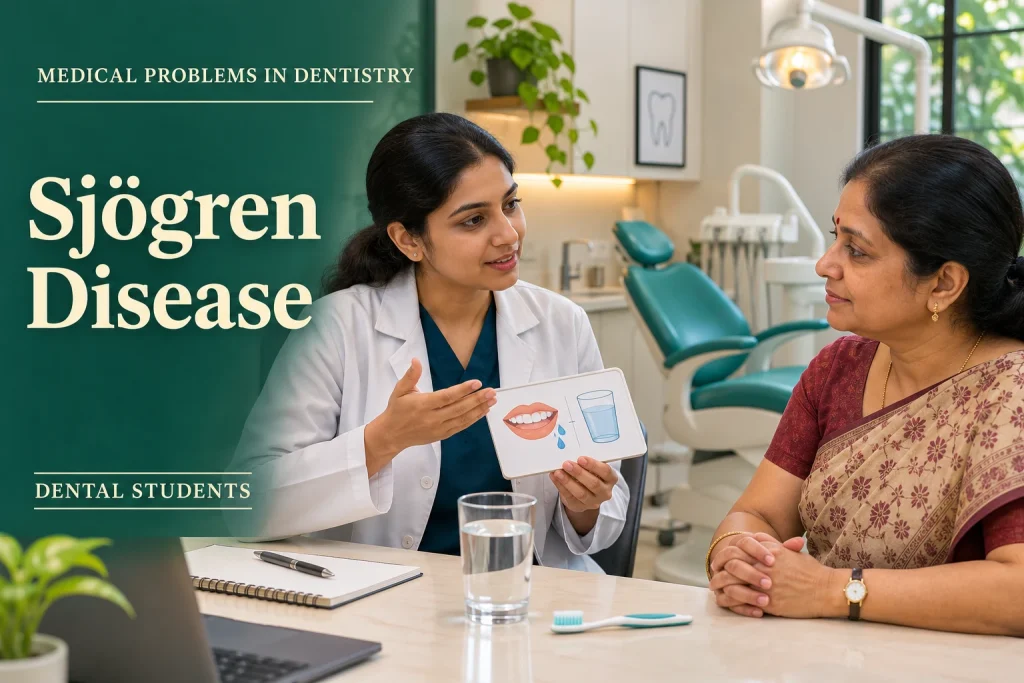
Sjögren disease brings together systemic autoimmunity and a practical oral-health problem: the mouth may lose the protection and comfort normally provided by saliva. Students should connect diagnosis, function and prevention rather than learning dryness as an isolated symptom.
In this guide: Learning objectives · Start with this clinical case · Understand the mechanism and impact · History, examination and differential diagnosis · Tests support a combined diagnosis · Build a practical prevention plan · Follow-up and referral exercise · Viva and self-check
Learning objectives
- Take a focused sicca and medicine history.
- Distinguish subjective dryness from measured gland function.
- Plan prevention and recognise findings requiring further investigation.
Start with this clinical case
Fictional teaching case. A 52-year-old woman needs water to swallow dry food, has gritty eyes and several recent cervical carious lesions. She takes medicines that can also cause dryness. She asks whether a positive blood test alone would prove Sjögren disease. Plan an assessment without prematurely attributing every symptom to one cause.
Understand the mechanism and impact
Sjögren disease is an autoimmune disorder affecting tear and salivary glands and sometimes other organs. Dryness may interfere with speech, eating, sleep and prosthesis comfort. Reduced oral protection increases the importance of preventing caries and oral infection. Ask about daily function as well as the disease label: a person may describe difficulty completing a meal more clearly than “xerostomia”.
[SJ]History, examination and differential diagnosis
Record onset, persistence, meal-time difficulty, night-time symptoms, eye discomfort and gland swelling. Review medicines, radiation history, hydration and other medical conditions. Inspect moisture, mucosa, dentures, plaque and the pattern of caries; assess salivary glands as indicated. Do not dismiss dryness as normal ageing or diagnose autoimmunity from dry lips alone.
[DRY]| Finding or question | Clinical implication | Student action |
|---|---|---|
| Dry-mouth symptoms | Patient experience and functional burden | Record frequency, severity and effects on eating or sleep |
| Observed reduced moisture or measured low flow | Possible salivary dysfunction | Document examination and test conditions |
| Dry eyes or systemic symptoms | Broader disease question | Coordinate appropriate medical assessment |
| Persistent focal gland lump or unilateral swelling | Needs a separate differential | Arrange investigation rather than attributing it automatically to Sjögren disease |
Tests support a combined diagnosis
NIAMS explains that no single test establishes Sjögren disease. Assessment may combine eye testing, salivary testing, relevant autoantibodies and, in selected cases, imaging or biopsy. Antibodies alone cannot diagnose it. A dental student should understand why a test is requested and how it will change management, rather than ordering a panel without a clinical question.
[SJDX]If salivary flow is measured, record whether stimulation was used and the collection method and duration. A subjective report and an objective measurement are related but not identical. Interpret results using the chosen validated protocol and the clinical setting; this guide does not supply a stand-alone diagnostic cutoff.
Build a practical prevention plan
Protect teeth with fluoride-based prevention appropriate to caries risk, effective cleaning and a review interval matched to current disease. Discuss the frequency of sugar exposure and symptom-relief products. Saliva substitutes may improve comfort; prescribed stimulants require individual assessment. Diagnose suspected candidiasis rather than using an antifungal for every burning symptom.
[SJ] [SJDX]For water, sugar-free gum or other measures, check swallowing safety and relevant medical restrictions. Avoid telling a fluid-restricted patient simply to drink unlimited water. Ask what the person can sustain at work and overnight. Relief of dryness and prevention of caries are complementary goals.
Follow-up and referral exercise
Arrange further assessment for a new focal swelling, persistent ulcer or other unexplained lesion rather than assuming it is part of the known autoimmune disease. NIDCR describes separate investigations for salivary masses and obstruction. Review symptoms that impair nutrition or suggest systemic involvement with the responsible medical team.
[SALIVA]For the case, write a problem list covering dryness, caries activity, medicines and possible systemic disease. At follow-up, record new lesions, comfort, diet, cleaning and whether the referral happened. A useful outcome is a workable prevention routine and an explained diagnostic pathway, not simply a completed blood-test form.
Viva and self-check
Does a positive antibody result alone establish Sjögren disease? No. Diagnosis combines clinical and relevant objective findings.
MCQ: Symptom relief from a saliva substitute proves caries risk is controlled. False. Prevention and disease monitoring remain necessary.
What should be recorded with a saliva-flow result? The method, stimulation status, collection conditions and interpretation in context.
Continue through the series
- Previous: Vaccination History and Dental Care in Immunocompromised Patients: Practical Boundaries
- Next: Systemic Sclerosis: Microstomia, Xerostomia and Dental Treatment Adaptation
- Browse all 215 student guides by subject
More in Immune-mediated disease: Systemic Sclerosis: Microstomia, Xerostomia and Dental Treatment Adaptation · Allergy, Hypersensitivity and Autoimmunity: Mechanisms Dental Students Should Distinguish · Autoimmune Disease and Dentistry: Medicines, Infection Risk and Shared Care
Continue learning
- Explain Sjögren disease and dry mouth to a patient
- Structured medical history and examination
- Medical liaison and referral for complex dental patients
References and scope
Sources checked on 25 November 2026. This is an original student teaching guide. International clinical recommendations are identified by their issuing organisation; Indian legal provisions are identified separately. Use current local protocols, appropriate supervision and an individual clinical assessment.
- NIDCR: Sjögren Disease
- NIAMS: Sjögren Disease, Diagnosis and Treatment
- NIDCR: Dry Mouth, reviewed October 2024
- NIDCR: Saliva and Salivary Gland Disorders
Images are AI-generated educational illustrations of fictional people or equipment, not clinical records or diagnostic photographs.

Leave a Reply