Medical Problems in Dentistry: Article 69 of 215 · Immune-mediated disease · Complete student guide
Medical Problems in Dentistry · Student guide
Systemic sclerosis can make an ordinary dental task difficult through restricted opening, dryness, hand limitations and internal-organ disease. A useful student plan connects these problems to the actual appointment and home-care routine.
In this guide: Learning objectives · Start with this clinical case · A systemic condition with oral consequences · Assess function before choosing equipment · Ask about internal-organ disease · Prevent disease and reduce avoidable strain · An original practical station · Do not overlook a separate lesion · Viva and self-check
Learning objectives
- Recognise functional oral limitations without relying on appearance.
- Ask about systemic involvement and positioning tolerance.
- Select adaptations and seek specialist help when access or safety is limited.
Start with this clinical case
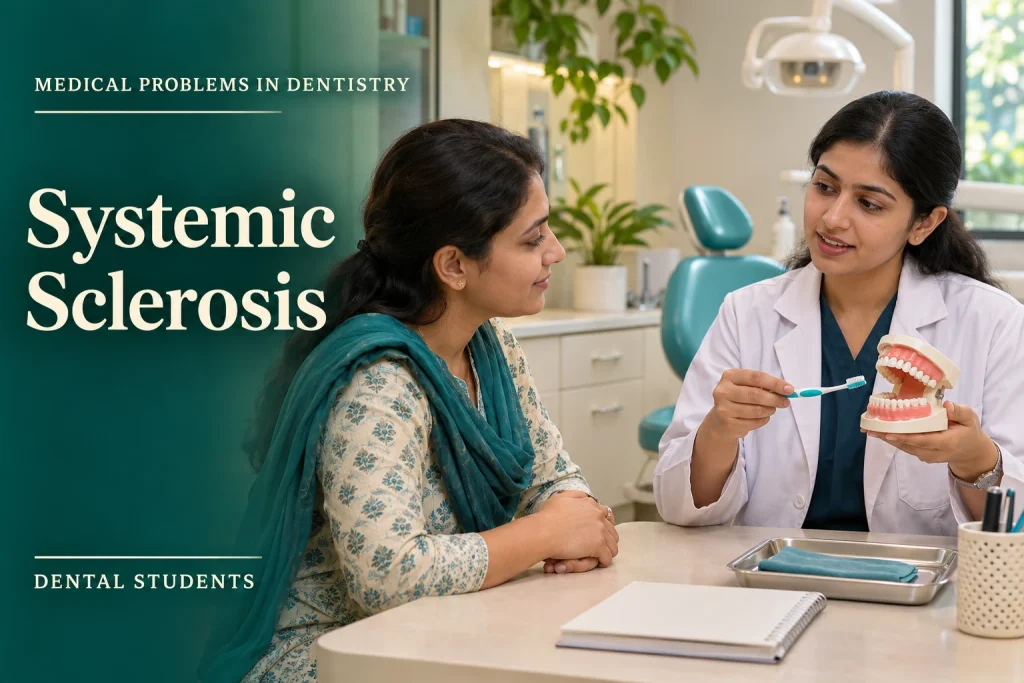
Fictional teaching case. A woman with systemic sclerosis reports that a large toothbrush no longer fits comfortably behind her last molars. Her fingers are stiff and she cannot tolerate a long appointment lying flat. A student focuses only on measuring the mouth opening. Explain which important parts of care would be missed.
A systemic condition with oral consequences
NIAMS describes fibrosis and vascular involvement in scleroderma. Localised scleroderma and systemic sclerosis are not interchangeable diagnoses. In systemic disease, lung, heart, gastrointestinal and kidney involvement may affect care. Tightening around the mouth can restrict opening, while dryness and difficulty cleaning may increase oral disease burden. Ask what the patient can comfortably do today.
[SSC]Assess function before choosing equipment
Record comfortable opening, access to each area, pain, lip flexibility and the patient’s account of change. Assess whether the person can hold and move their usual toothbrush. Examine mucosal, periodontal and dental health. Do not use forceful stretching as an examination shortcut. A small opening may require specialist restorative or surgical planning, but the adaptation should follow an assessment rather than an arbitrary measurement alone.
| Finding or question | Clinical implication | Student action |
|---|---|---|
| Restricted opening | Reduced working space | Trial suitable instruments gently and assess feasibility |
| Hand stiffness | Cleaning technique may be difficult | Demonstrate an aid and ask the patient to try it |
| Reflux or breathing discomfort | Position and duration may need adjustment | Agree a tolerable position and seek medical advice when indicated |
| Dryness and active caries | Greater preventive need | Create and review a practical prevention plan |
Ask about internal-organ disease
Clarify breathlessness, exercise tolerance, reflux or swallowing problems, blood-pressure history and relevant specialist follow-up. NIAMS identifies potentially important cardiopulmonary and renal complications. New severe symptoms should not be explained away as anxiety in the chair. Obtain medical assessment when the history suggests instability, and use an appropriate emergency pathway for acute illness.
[SSC]Record exact medicines and any current steroid or immunosuppressive treatment. The disease name does not provide a safe analgesic, antibiotic or sedation plan. If a procedure cannot be completed comfortably in the available setting, discuss a more suitable service before repeatedly attempting it.
Prevent disease and reduce avoidable strain
Dry-mouth management needs both symptom relief and protection against new caries. Review contributing medicines with the prescriber where appropriate; do not stop them independently. Consider suitable fluoride prevention, food and drink habits, and salivary support. Individual tolerability matters: products that sting or a device that cannot reach the relevant surfaces will not become effective merely because they were prescribed.
[DRY]Practical adaptations can include a smaller brush head, an altered grip, short treatment stages and breaks. These are options to test with the patient, not an established exercise prescription. Jaw stretching or physiotherapy should follow appropriate advice; avoid teaching an unsourced force or repetition regimen.
An original practical station
Set out the patient’s current brush and one alternative. Ask them to demonstrate how they reach the back teeth on a model or describe the difficulty. Identify whether the main obstacle is head size, grip, fatigue, pain or access. Change one feature and reassess. This produces a more useful record than writing “oral hygiene instructions given”.
For the case, divide the plan into prevention, access and medical stability. Establish tolerable chair position and session length, clarify the reason for lying-flat intolerance, and choose the referral question if necessary. At review, ask which adaptation helped and whether opening or function has changed.
Do not overlook a separate lesion
A patient with an established systemic condition can still develop unrelated dental infection, trauma or suspicious mucosal disease. Persistent focal pain, swelling or a new ulcer needs its own assessment. When gland swelling is present, distinguish diffuse dryness from a local obstructive or mass lesion; NIDCR outlines investigation pathways for salivary disorders.
[SALIVA]Viva and self-check
Does systemic sclerosis affect only the skin around the mouth? No. Ask about organ involvement and the patient’s current medical care.
MCQ: A mouth-opening measurement alone establishes that treatment will be feasible. False. Site, instruments, tolerance, positioning and the planned procedure also matter.
What makes an adaptation useful? It addresses a demonstrated problem and the patient can use it comfortably.
Continue through the series
- Previous: Sjögren Disease: Salivary Assessment, Systemic Clues and Dental Prevention
- Next: Allergy, Hypersensitivity and Autoimmunity: Mechanisms Dental Students Should Distinguish
- Browse all 215 student guides by subject
More in Immune-mediated disease: Sjögren Disease: Salivary Assessment, Systemic Clues and Dental Prevention · Allergy, Hypersensitivity and Autoimmunity: Mechanisms Dental Students Should Distinguish · Autoimmune Disease and Dentistry: Medicines, Infection Risk and Shared Care
Continue learning
- Medical liaison and referral for complex dental patients
- Structured medical history and examination
- Explain Sjögren disease and dry mouth to a patient
References and scope
Sources checked on 25 November 2026. This is an original student teaching guide. International clinical recommendations are identified by their issuing organisation; Indian legal provisions are identified separately. Use current local protocols, appropriate supervision and an individual clinical assessment.
- NIAMS: Scleroderma, Diagnosis, Treatment and Steps to Take
- NIDCR: Dry Mouth, reviewed October 2024
- NIDCR: Saliva and Salivary Gland Disorders
Images are AI-generated educational illustrations of fictional people or equipment, not clinical records or diagnostic photographs.

Leave a Reply