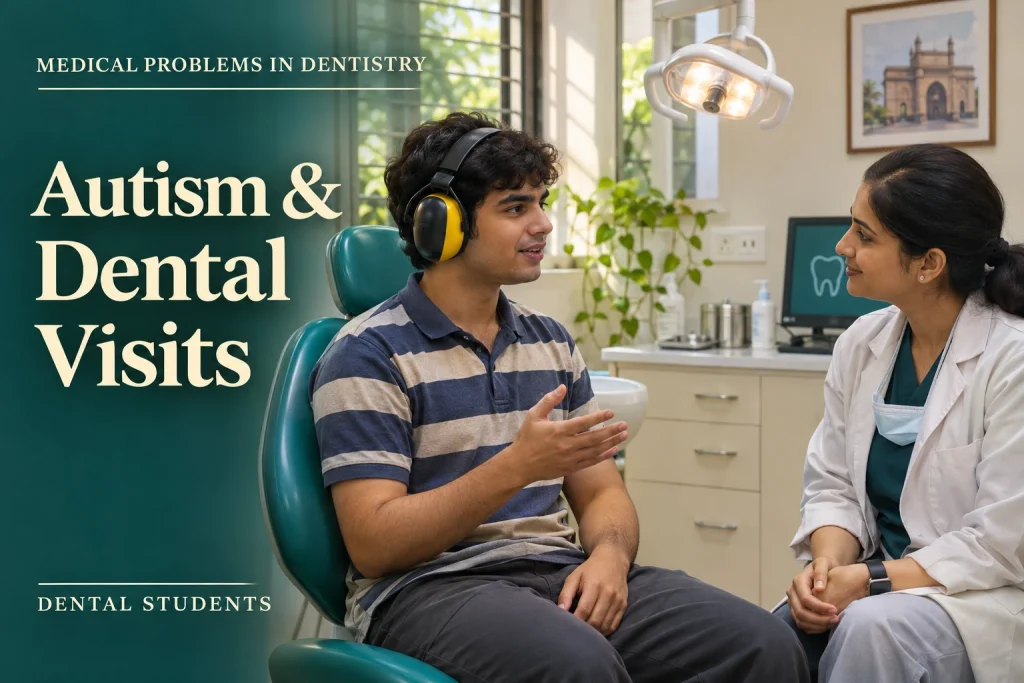
Medical Problems in Dentistry: Article 149 of 215 · Disability and special care · Complete student guide
Medical Problems in Dentistry · Student guide
Autism and intellectual disability are distinct, although they may coexist. Neither term tells you a person’s preferred communication style, sensory experience or ability to make a particular decision. Ask, adapt and check rather than assuming.
In this guide: Learning objectives · Start with this clinical case · Ask what matters to this patient · Adjust sensory demands and predictability · Distress is information, not a diagnosis · Consent and escalation · Rehearse the case · A follow-up learning exercise · Viva and self-check
Learning objectives
- Identify individual sensory and communication preferences.
- Plan preparation and a predictable visit.
- Recognise pain and distress while maintaining consent and continuity.
Start with this clinical case
Fictional teaching case. A 20-year-old autistic student says suction noise is uncomfortable and unexpected chair movement is frightening. He is happy to discuss treatment and prefers written steps before the visit. His parent asks the dentist to “just get it finished”. Plan a visit that addresses the patient’s expressed needs and the dental problem.
Ask what matters to this patient
Useful questions include how the person wants information, whether touch needs advance warning, what helps during uncertainty and how they signal a pause. Some people prefer direct speech; others use writing, pictures or communication devices. Intellectual disability may require additional explanation or support, but fluent speech and reading ability also cannot be assumed from an autism diagnosis.
NIDCR recommends learning the person’s capabilities and working with patients and caregivers. Its developmental-disability resource is broad; it does not mean every autistic person has the medical or oral conditions described there.
[DEV]Adjust sensory demands and predictability
NICE guidance for autistic adults advises attention to lighting, noise, personal space and visual supports. Apply this as clinical guidance rather than Indian law. Ask which adjustments are useful; an ear defender or dimmer light should be offered as an option, not imposed as a symbol of “autism care”. Keep adequate conditions for safe clinical work.
[NICEAUT]| Finding or question | Clinical implication | Student action |
|---|---|---|
| Before the visit | Reduce uncertainty | Offer a brief written sequence or familiarisation visit |
| Arrival | Avoid an unexpected queue when feasible | Agree a realistic appointment time and waiting plan |
| Before equipment use | Make sensations predictable | Explain or demonstrate and obtain agreement |
| During the visit | Allow a reliable pause | Use the agreed signal and respond to it |
| After the visit | Make the next step clear | Provide the preferred instructions and review arrangement |
Distress is information, not a diagnosis
A change in cooperation may reflect tooth pain, sensory overload, fear, fatigue or another illness. Ask what is happening and assess oral causes. Do not assume a person who communicates differently has a higher pain threshold or is simply being difficult. Shorter steps and a stop signal may help, but they do not replace adequate analgesia or diagnosis.
AAPD’s 2026 special-healthcare-needs guidance supports coordinated and adapted care for children. Adult patients require an adult-appropriate assessment, language and decision process. A familiar support person may help when the patient wants that involvement.
[AAPDSH]Consent and escalation
Explain the proposed procedure and alternatives in an accessible form and check understanding. A parent’s wish to complete treatment is not, by itself, authority to override an adult’s decision. Do not surprise the patient with a different procedure once they are in the chair. If support does not resolve uncertainty about authority or decision-making, seek the appropriate senior and local process before elective care.
Discuss referral if the needs exceed the clinic’s capabilities. Sedation or general anaesthesia involves separate assessment, risks and consent; it is not automatically required for an autistic person. This guide does not provide a restraint or sedation protocol.
Rehearse the case
Send a proposed sequence in advance: discussion, look at the chair, agree movement, examination, then decide on the next treatment step. Ask the patient to edit it. Offer to demonstrate suction away from the mouth and allow a pause or alternative plan if needed. Document his preferences and what was actually achieved.
If urgent disease is present, explain why the timetable may need to change and discuss feasible options. Avoid making a familiarisation-only visit an excuse to leave pain without a plan. A practical outcome might be a completed examination, a clear diagnosis and a booked supported treatment visit rather than an entire course forced into one appointment.
A follow-up learning exercise
Compare two notes: “patient uncooperative” and “stopped when suction began; tolerated mirror examination after warning; prefers written sequence”. The second supports the next clinician and preserves useful information. Ask what could be tested next time, what pain management is needed and whether the patient agrees. Review success through comfort, understanding and access to necessary care, not speed alone.
Viva and self-check
Are autism and intellectual disability interchangeable? No. They may coexist but describe different aspects of development and function.
MCQ: A standard sensory kit should be used for every autistic patient. False. Preferences differ; adaptations should be agreed and assessed.
What should be recorded after an interrupted visit? The trigger, symptoms, steps tolerated, agreed support and a definite plan for remaining dental needs.
Continue through the series
- Previous: Dental Care for Patients With Disabilities: An Individualised Assessment Framework
- Next: Cerebral Palsy and Dental Care: Positioning, Swallowing and Prevention
- Browse all 215 student guides by subject
More in Disability and special care: Dental Care for Patients With Disabilities: An Individualised Assessment Framework · Cerebral Palsy and Dental Care: Positioning, Swallowing and Prevention · Consent, Supported Decision-Making and Communication in Special Care Dentistry · Hearing, Vision and Mobility Impairment: Practical Dental Access Adaptations
Continue learning
- Informed consent in an Indian dental practice
- Structured medical history and examination
- Medical liaison and referral for complex dental patients
References and scope
Sources checked on 25 November 2026. This is an original student teaching guide. International clinical recommendations are identified by their issuing organisation; Indian legal provisions are identified separately. Use current local protocols, appropriate supervision and an individual clinical assessment.
- NIDCR: Developmental Disabilities and Oral Health
- NICE CG142: Autism Spectrum Disorder in Adults, Recommendations
- AAPD: Management of Dental Patients With Special Health Care Needs, revised 2026
Images are AI-generated educational illustrations of fictional people or equipment, not clinical records or diagnostic photographs.

Leave a Reply