
Medical Problems in Dentistry: Article 117 of 215 · Respiratory and ENT disease · Complete student guide
Medical Problems in Dentistry · Student guide
The dental question is not simply whether a person has asthma, but whether it is currently controlled, what increases their risk and how their treatment and action plan work. A patient without wheeze at this moment may still have substantial exacerbation risk.
In this guide: Learning objectives · Mechanism and assessment · Reconcile inhalers properly · Recognise equipment without overgeneralising · Oral findings and prevention · Appointment planning · Recognise acute deterioration · Two original cases · Viva and MCQ
Learning objectives
- Take an asthma-control and exacerbation history relevant to dental care.
- Identify the actual inhaler medicines and avoid assuming their role from colour.
- Plan oral prevention, appointment adjustments and an emergency response.
Mechanism and assessment
Asthma involves variable respiratory symptoms and variable airflow limitation, often in the setting of airway inflammation. Ask about wheeze, cough, breathlessness and chest tightness, their pattern and recent change. The medical diagnosis and management plan should be established through the appropriate respiratory assessment rather than inferred from a single dental observation.
GINA 2026 emphasises both current symptom control and future risk. Ask about night waking, activity limitation, reliever use, recent exacerbations, oral steroid courses, emergency attendance and previous severe attacks. A quiet chest examination today does not erase a significant recent history.[1]
Reconcile inhalers properly
Record generic ingredients, device, prescribed schedule and the role of each inhaler in the patient’s plan. In some regimens an inhaler is used for both maintenance and relief. “Blue inhaler when needed” is not an adequate medicine record, and colour is not a reliable universal identification system.
Ask whether the person has their prescribed reliever and written action plan, can use the device and has experienced recent difficulty obtaining medicines. Do not change controller therapy or recommend reliever-only treatment as a dental workaround. Refer concerns about control, adherence or technique to the treating clinician.
Recognise equipment without overgeneralising
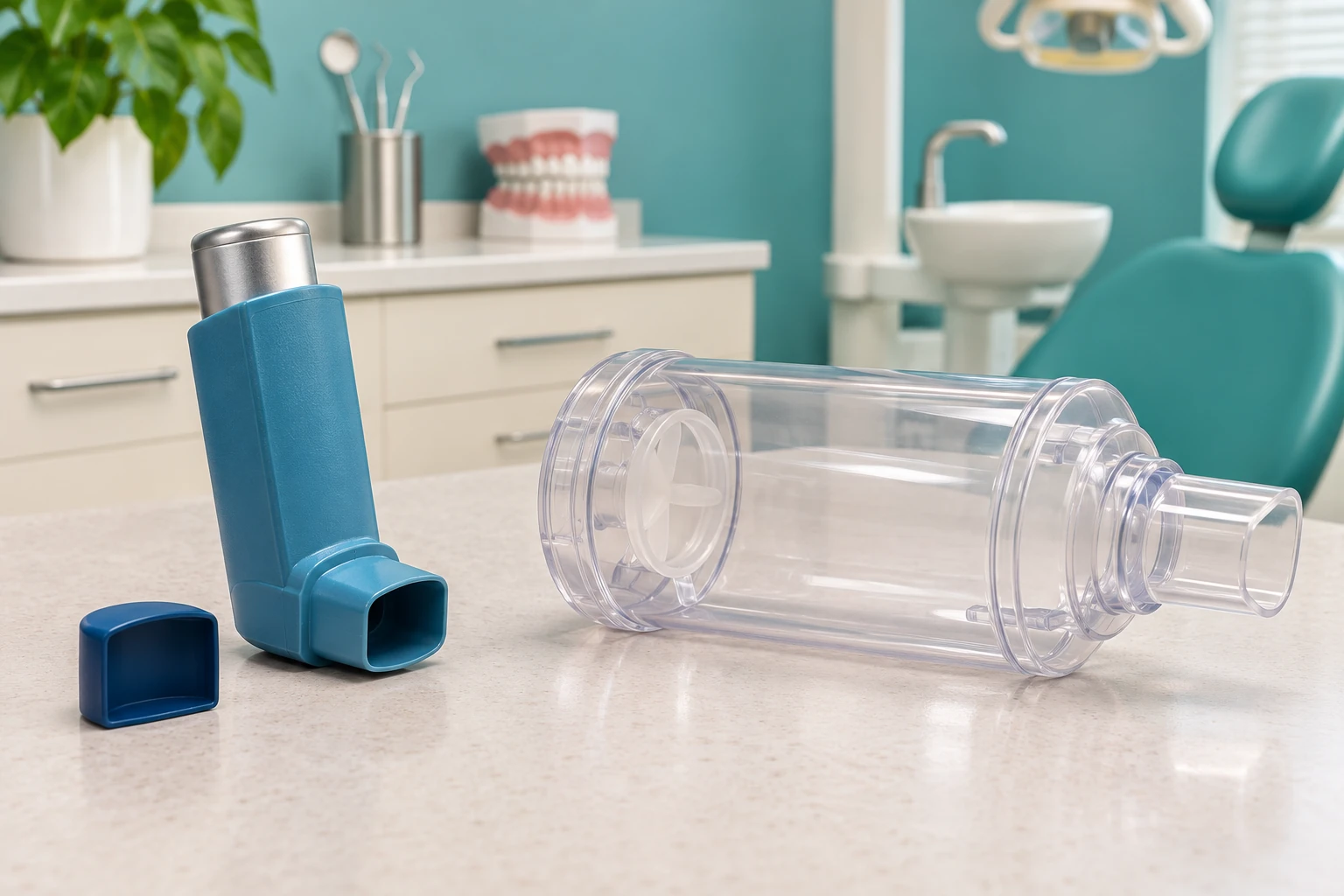
A pressurised metered-dose inhaler and a valved holding chamber are illustrated above. A spacer can be suitable for a compatible pressurised device; it is not an attachment for every dry-powder or breath-actuated inhaler. Device-specific instructions and the patient’s respiratory plan take precedence over an illustration.
If technique seems ineffective, request a practical review by an appropriately trained clinician or pharmacist. A medicine that is prescribed but not delivered effectively may leave an important gap in control.
Oral findings and prevention
Inhaled corticosteroids can contribute to oral candidiasis or irritation. For relevant devices and regimens, rinsing and spitting after use, and an appropriate spacer where compatible, can reduce local adverse effects. Do not advise stopping inhaled treatment to treat a sore mouth.
Assess the actual lesion, oral hygiene, dentures, dryness, diet and other risk factors. A white patch or burning symptom should not automatically be labelled thrush. Manage confirmed disease, review the technique and coordinate treatment when the diagnosis or control is uncertain.[2]
Appointment planning
| Assessment finding | Planning response |
|---|---|
| Stable symptoms and routine preventive care | Usual patient-centred care with relevant medicines and history documented |
| Recent exacerbation or increasing symptoms | Reassess stability and obtain medical advice before elective intervention |
| Known individual trigger | Reduce avoidable exposure and discuss the practical plan |
| Anxiety or prior difficult dental experience | Explain steps, agree a stop signal and provide adequate pain control |
| Current respiratory distress | Stop the routine pathway and assess urgently |
Ask about known sensitivity to aspirin or other NSAIDs, previous medicine reactions and any relevant allergies. Do not assume every person with asthma reacts to all NSAIDs, but do not ignore a previous respiratory reaction when prescribing. Check the chosen medicine and interaction information.
Systemic steroid exposure may add an adrenal-suppression question in selected patients; it is not resolved by the word asthma. Consider dose, duration, recent treatment and the planned intervention with the responsible team.
Recognise acute deterioration
If breathing becomes difficult, stop treatment, remove dental materials safely, call for assistance and assess with ABCDE. Help the person into a position they can tolerate. Follow the individual action plan and the clinic’s authorised emergency protocol, including trained use of appropriate reliever treatment and oxygen when indicated.
Severe difficulty speaking, exhaustion, altered consciousness, cyanosis or poor respiratory effort is concerning. Wheeze can become less obvious in severe airflow limitation, so “less wheeze” does not necessarily mean improvement. Activate emergency care promptly for severe symptoms or an inadequate response.
Use pulse oximetry as one observation, not a replacement for clinical assessment. If the person becomes unresponsive and is not breathing normally, initiate the trained resuscitation pathway.[3]
Two original cases
Case A: A patient looks comfortable but reports night waking and repeated reliever use this week. Do not classify the asthma as well controlled from appearance alone. Discuss the change and medical review before the planned elective procedure.
Case B: A patient has oral soreness while using an inhaled corticosteroid. Examine the lesion and technique, treat appropriately and preserve the respiratory plan. Automatically stopping the inhaler could worsen the more serious systemic problem.
Viva and MCQ
Why ask about previous emergency care? It adds future-risk information beyond symptoms at the dental visit.
Can every inhaler use the same spacer? No. Device compatibility and technique differ.
MCQ: Which statement is best? A, inhaler colour always identifies the medicine; B, current symptoms and exacerbation risk both matter; C, no wheeze means no risk. Answer: B.
Continue through the series
- Previous: Sleep Bruxism: Assessment, Comorbidity and Limits of Dental Treatment
- Next: COPD and Dental Care: Dyspnoea, Positioning and Respiratory Risk
- Browse all 215 student guides by subject
More in Respiratory and ENT disease: COPD and Dental Care: Dyspnoea, Positioning and Respiratory Risk · Tuberculosis and Dental Settings: Triage, Airborne Precautions and Referral in India · Maxillary Sinusitis or Dental Disease? Assessment and Referral for Dental Students · ENT Red Flags: Persistent Hoarseness, Dysphagia, Stridor and Neck Swelling
Continue learning
- taking a structured medical history
- assessment and medical liaison for complex patients
- medical emergency readiness in a dental clinic
References and scope
Sources checked on 25 November 2026. This is an original student teaching guide. International clinical guidance is identified by its issuing organisation; it is not presented as an Indian statutory rule. Apply the treating team’s current protocol and supervision to individual patients.
- GINA: Summary Guide for Asthma Management and Prevention, July 2026
- NHLBI: Asthma Care Quick Reference — inhaled corticosteroid oral-care advice
- Resuscitation Council UK: The ABCDE Approach, updated July 2024
Images are AI-generated educational illustrations of fictional people or equipment, not clinical records or diagnostic photographs.

Leave a Reply