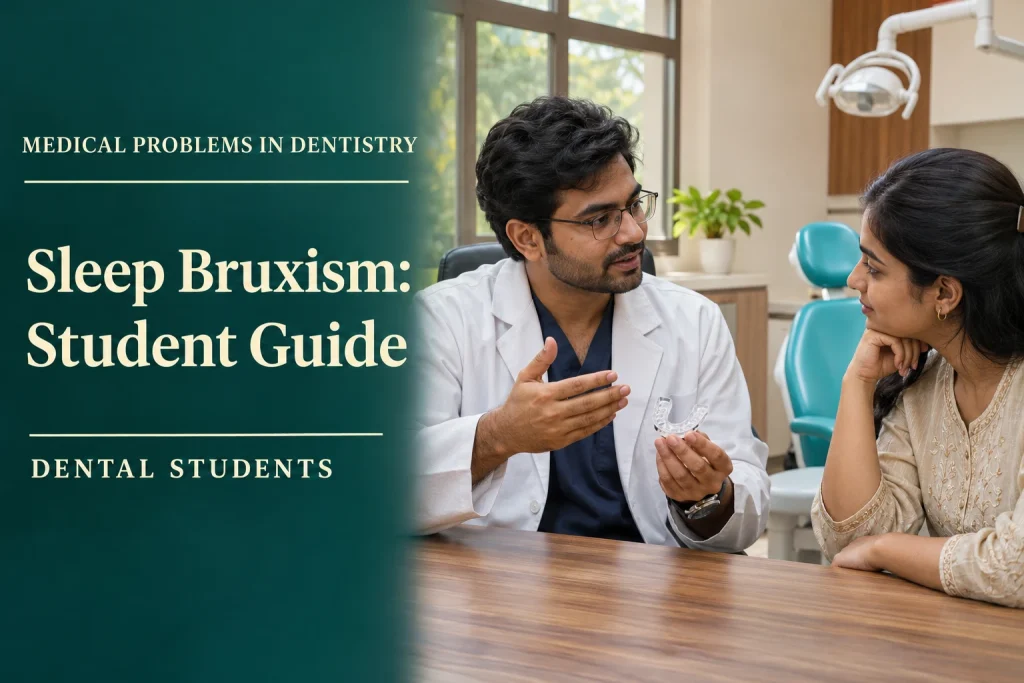
Medical Problems in Dentistry: Article 116 of 215 · Sleep, movement and cognitive disorders · Complete student guide
Medical Problems in Dentistry · Student guide
A patient with worn teeth may have past or current tooth grinding, but wear alone does not explain the whole clinical picture. Students need to separate reported sleep activity, observed damage, pain and other sleep concerns before deciding whether an appliance or another intervention is appropriate.
In this guide: Learning objectives · Start with this clinical case · Define the behaviour before naming a disorder · Take a history that can explain the patient’s concern · Assess damage and pain without jumping to causation · Decide when another assessment will help · Explain the purpose and limits of an appliance · Use review to test the working explanation · Viva and self-check
Learning objectives
- Distinguish sleep bruxism from awake behaviours and dental consequences.
- Build a history that considers wear, pain, medicines and sleep symptoms.
- Explain conservative care without promising a universal cure.
Start with this clinical case
Fictional teaching case. A 31-year-old woman has flattened incisors and requests crowns to “stop grinding.” Her partner has heard grinding only occasionally. She also reports daytime jaw clenching and reflux symptoms. What should be documented before concluding that current sleep bruxism explains all the tooth wear?
Define the behaviour before naming a disorder
The 2018 international consensus distinguishes masticatory muscle activity during sleep from awake activity. It cautions that bruxism in otherwise healthy people is not automatically a disorder. The clinical question is whether the activity is associated with important consequences or a condition that needs assessment.[BRUXCONS]
Ask the patient what they mean by grinding. A partner’s report of sleep sounds, a daytime habit of tooth contact and a dentist’s observation of worn restorations are different pieces of information. Keep those observations separate in the record rather than compressing them into a single unsupported label.
Take a history that can explain the patient’s concern
Clarify when symptoms occur, their duration, morning versus daytime jaw discomfort, headaches, sleep quality and any report from a sleeping partner. Ask about stress, caffeine, alcohol, tobacco and medicines; NIDCR identifies multiple factors associated with bruxism rather than a single cause.[BRUX]
List the patient’s main problem: pain, tooth damage, disturbing noise, reduced chewing comfort or fear about future teeth. The investigation and outcome measure should respond to that problem. A patient asking for a guard may actually need evaluation of a cracked tooth or persistent facial pain.
Assess damage and pain without jumping to causation
Record wear distribution, cracks, restoration problems and symptoms alongside an appropriate dental examination. Review acid exposure and other plausible contributors to wear. Existing wear records cumulative history; it does not measure last night’s muscle activity.
Examine jaw muscles and joints when pain or movement symptoms are present. NIDCR stresses that facial pain requires a differential diagnosis and that joint sounds without pain are common. Bruxism, TMD and tooth wear are related clinical questions, not interchangeable diagnoses.[TMD]
In the case, compare current findings with earlier photographs or records when available. If no baseline exists, document the uncertainty and establish one. Do not present a single wear facet as proof that irreversible treatment is required.
Decide when another assessment will help
| Finding or question | Clinical implication | Student action |
|---|---|---|
| Partner hears grinding | A history supports suspected sleep activity | Clarify frequency and associated symptoms. |
| Worn teeth or restorations | Damage may have more than one contributor | Assess progression, exposure and dental findings. |
| Daytime clenching | Awake activity may need separate management | Discuss awareness and reversible strategies. |
| Snoring, witnessed pauses or marked sleepiness | A sleep-breathing problem may coexist | Arrange appropriate medical sleep assessment. |
| Persistent or atypical facial pain | A guard alone may miss another diagnosis | Complete the pain differential or refer. |
NIDCR describes history, examination and, in selected circumstances, sleep testing. Referral should answer a clinical question rather than obtain a test for every person with mild wear. Do not promise that stopping grinding will cure snoring or sleep apnoea.[BRUX]
Explain the purpose and limits of an appliance
A protective appliance may help reduce dental damage, but it is not a guarantee that sleep muscle activity will cease. Fit, retention, tolerance and review matter. Explain what will be monitored and what symptoms should prompt reassessment. NIDCR includes mouth guards among possible management options rather than presenting them as necessary for every mild case.[BRUX]
Conservative management is particularly important when pain is involved. NIDCR cautions against treatments that permanently change teeth, the bite or jaw joints as routine TMD care. Do not offer occlusal grinding, orthodontics or extensive crowns merely as a presumed cure for bruxism.[TMD]
Use review to test the working explanation
Agree a baseline for symptoms, function and observed damage. Discuss appropriate care for sensitivity or fractured teeth while considering whether the risk factors remain active. If a medicine may contribute, contact the prescriber rather than stopping it independently.
For the teaching case, a useful plan investigates multiple wear contributors, addresses daytime behaviours and explains why crowns are not the first diagnostic step. At review, compare the person’s reported benefit with the clinical findings. A quieter night or reduced anxiety is valuable information, but neither replaces assessment of ongoing tooth or jaw problems.
Viva and self-check
Does wear prove active sleep bruxism? No. It can reflect cumulative and multifactorial damage.
Is a guard a guaranteed cure? No. Explain its protective purpose and review the outcome.
Why distinguish awake and sleep activity? The history, assessment methods and practical management may differ.
Continue through the series
- Previous: Multiple Sclerosis and Motor Neurone Disease: Dental Adaptations and Referral
- Next: Asthma and Dental Treatment: Control, Inhalers, Triggers and Appointment Planning
- Browse all 215 student guides by subject
More in Sleep, movement and cognitive disorders: Parkinson Disease: Dental Appointment Timing, Dysphagia and Oral Care · Dementia and Dentistry: Communication, Decision-Making and Carer Support · Obstructive Sleep Apnoea: Dental Screening, Referral and Sedation Risk · Multiple Sclerosis and Motor Neurone Disease: Dental Adaptations and Referral
Continue learning
- Structured medical history and examination
- Medical liaison and referral for complex dental patients
- Informed consent in an Indian dental practice
References and scope
Sources checked on 26 November 2026. This is an original student teaching guide. International clinical recommendations are identified by their issuing organisation. Emergency contact information is specific to India. Use current local protocols, appropriate supervision and an individual clinical assessment.
- Lobbezoo et al.: International Consensus on the Assessment of Bruxism (2018)
- NIDCR: Bruxism
- NIDCR: Temporomandibular Disorders
Images are AI-generated educational illustrations of fictional people or equipment, not clinical records or diagnostic photographs.

Leave a Reply