
Medical Problems in Dentistry: Article 113 of 215 · Sleep, movement and cognitive disorders · Complete student guide
Medical Problems in Dentistry · Student guide
Dental care for a person living with dementia begins with communication and a clear clinical purpose. The diagnosis does not describe every ability or remove the person from the conversation. Students should learn to make assessment accessible, identify oral discomfort and build a plan that can actually be delivered.
In this guide: Learning objectives · Start with this clinical case · Speak with the person and find the best way to communicate · Assess the decision rather than relying on a label · Look for oral pain when behaviour changes · Compare common assessment situations · Write a mouth-care plan another person can follow · Review comfort, feasibility and changing needs · Viva and self-check
Learning objectives
- Support the person’s participation in dental decisions.
- Distinguish a dementia diagnosis from an assessment about a particular decision.
- Create a practical mouth-care plan with appropriate carer involvement.
Start with this clinical case
Fictional teaching case. A 76-year-old woman attends with her son, who answers every question. She speaks slowly but can describe where a denture hurts. The son asks for all remaining teeth to be removed “before things get worse.” What information and communication support should come before a decision about irreversible treatment?
Speak with the person and find the best way to communicate
Use the person’s preferred name, explain one step at a time and allow a response. Reduce competing conversation and check whether hearing, vision, language or fatigue is making the interaction harder. NICE dementia guidance encourages people to express their own views and recommends modified communication when needed.[DEM]
Ask permission before involving a supporter in the discussion. A familiar person may explain routines and changes, while the patient still supplies essential preferences. Avoid speaking about the person as though they are absent. Record what helped: pictures, a quieter room, short explanations or a particular appointment time.
Assess the decision rather than relying on a label
The NHS capacity explanation illustrates that ability can vary with the decision and the time. A person may manage a simple choice but need more support with complex treatment. This is a teaching principle; the UK legal mechanisms on that page are not a substitute for applicable Indian requirements.[CAP]
For the proposed dental decision, document the explanation, support offered, the person’s response and any unresolved concern. An unusual preference or slow reply is not, by itself, a complete assessment. If authority to consent is uncertain, obtain senior advice and the relevant local legal or institutional guidance before nonurgent irreversible treatment. A relative’s request needs proper evaluation.
Look for oral pain when behaviour changes
A change in eating, resistance to cleaning or agitation may have several causes. NICE oral-care guidance draws attention to untreated dental pain or infection in people who cannot describe discomfort clearly. Examine within tolerance and consider teeth, gums, oral soft tissues and dentures rather than assuming every change is part of dementia.[CARE]
Ask the supporter what changed and when, but record their report separately from your observations. In the case above, denture-related pain deserves assessment before a broad extraction plan. If the examination is incomplete, document its limits and arrange an appropriate way to complete it.
Compare common assessment situations
| Finding or question | Clinical implication | Student action |
|---|---|---|
| Person answers after extra time | Communication support is useful | Keep addressing the person directly. |
| Carer reports new refusal of meals | Pain is one possible cause | Assess oral and medical explanations. |
| Person becomes distressed during examination | Continuing may not yield a reliable examination | Pause, reassess and plan supported care. |
| Complex treatment proposed | Benefits, burden and maintenance need discussion | Document options, preferences and decision arrangements. |
Do not turn the table into a capacity test. Its purpose is to prompt a reasoned next step and prevent assumptions. Record the exact treatment being considered rather than writing a permanent blanket conclusion about all future decisions.
Write a mouth-care plan another person can follow
Assess what the person can do, what assistance they accept, and who is available. A written plan can cover natural teeth, denture cleaning, discomfort, supplies and review. NICE NG48 addresses care homes, but its emphasis on assessed needs and recorded daily support is useful when discussing an individual home routine.[CARE]
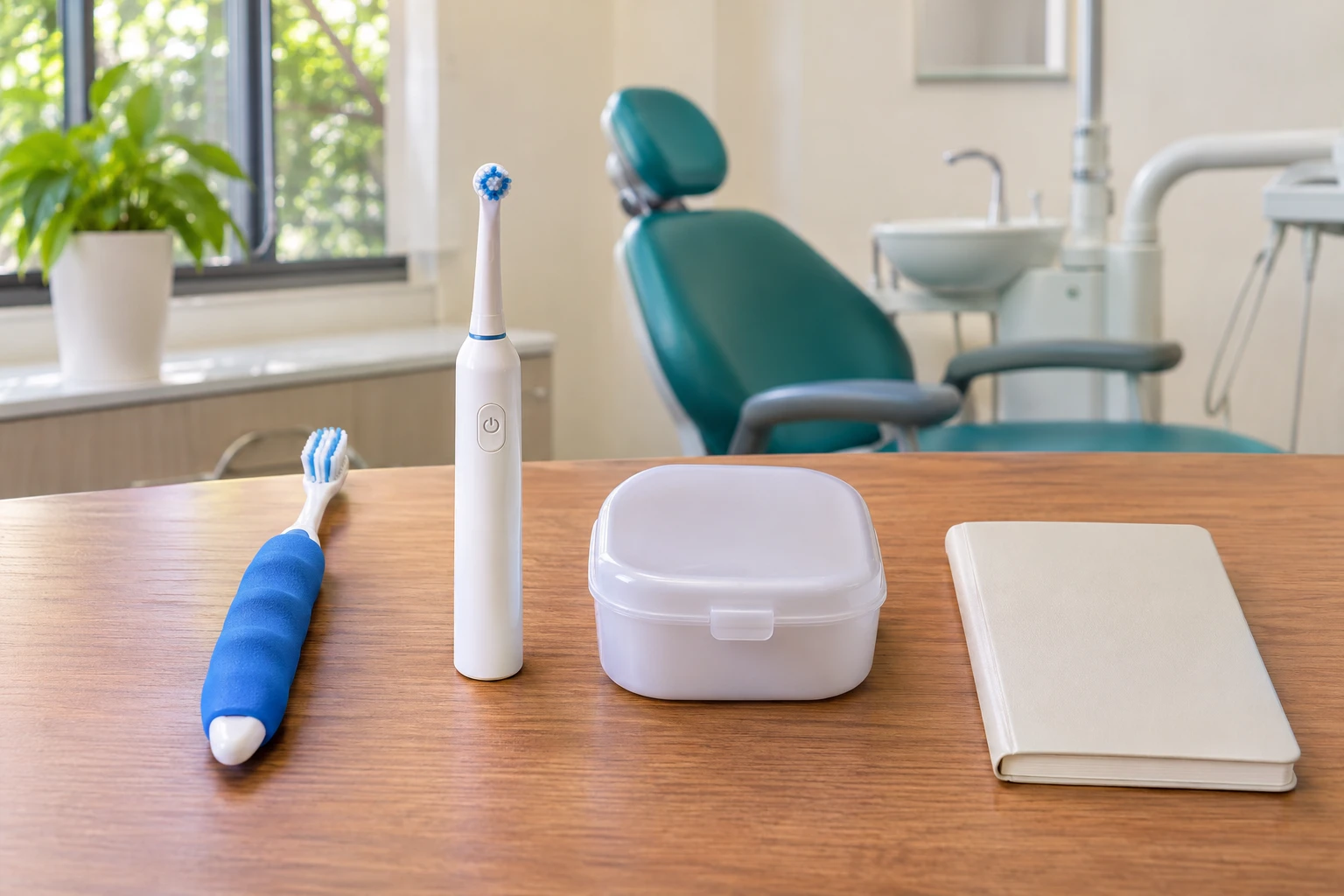
NIDCR suggests reminders, gently guided brushing and suitable handle adaptations when help is needed. Use a small-headed brush and fluoride toothpaste as part of an individual plan. If swallowing is impaired, obtain tailored advice rather than adding mouthwash or asking the person to rinse unsupervised.[BRUSH]
Review comfort, feasibility and changing needs
Agree achievable treatment priorities: relieve pain, control active disease and preserve useful comfortable function. Discuss how restorations or dentures will be maintained, what travel involves and whether specialist support is needed. Neither “treat everything immediately” nor “do nothing because of dementia” follows from the diagnosis alone.
At review, ask whether cleaning is happening, whether the person is comfortable and whether the supporter can carry out the plan. Update communication preferences and escalation contacts. If care is declined, explore the reason and seek appropriate support rather than using force or treating a signed form as permission to ignore distress.
Viva and self-check
Does dementia automatically establish inability to consent? No. Assess the particular decision with appropriate support and follow applicable Indian procedures.
Why ask about eating and behaviour? A person may show discomfort without being able to describe toothache clearly.
What makes a useful carer plan? Named tasks, realistic assistance, signs needing review and a clear follow-up arrangement.
Continue through the series
- Previous: Parkinson Disease: Dental Appointment Timing, Dysphagia and Oral Care
- Next: Obstructive Sleep Apnoea: Dental Screening, Referral and Sedation Risk
- Browse all 215 student guides by subject
More in Sleep, movement and cognitive disorders: Parkinson Disease: Dental Appointment Timing, Dysphagia and Oral Care · Obstructive Sleep Apnoea: Dental Screening, Referral and Sedation Risk · Multiple Sclerosis and Motor Neurone Disease: Dental Adaptations and Referral · Sleep Bruxism: Assessment, Comorbidity and Limits of Dental Treatment
Continue learning
- Informed consent in an Indian dental practice
- Structured medical history and examination
- Medical liaison and referral for complex dental patients
References and scope
Sources checked on 26 November 2026. This is an original student teaching guide. International clinical recommendations are identified by their issuing organisation. Emergency contact information is specific to India. Use current local protocols, appropriate supervision and an individual clinical assessment.
- NICE NG97: Dementia, Assessment, Management and Support
- NHS: Consent to Treatment—Assessing Capacity
- NICE NG48: Oral Health for Adults in Care Homes
- NIDCR: Brushing—Information for Caregivers
Images are AI-generated educational illustrations of fictional people or equipment, not clinical records or diagnostic photographs.

Leave a Reply