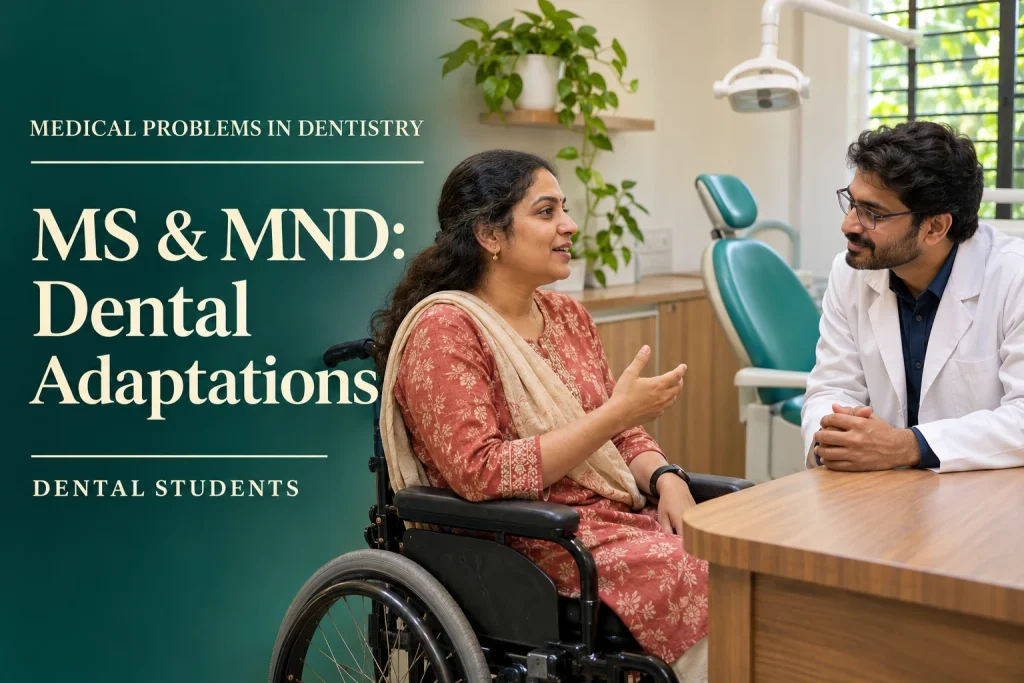
Medical Problems in Dentistry: Article 115 of 215 · Sleep, movement and cognitive disorders · Complete student guide
Medical Problems in Dentistry · Student guide
Multiple sclerosis and motor neurone disease are different conditions. They can nevertheless create overlapping dental challenges involving communication, mobility, fatigue or swallowing. Learn to assess those functions without assuming that a diagnosis describes the same disability in every person.
In this guide: Learning objectives · Start with this clinical case · Begin with two different clinical contexts · Assess MS-related barriers to prevention and attendance · Assess MND-related swallowing and respiratory needs · Turn the functional history into adaptations · Reconcile medicines and choose the care setting · Plan follow-up and recognise important changes · Viva and self-check
Learning objectives
- Distinguish MS-related needs from MND-related needs.
- Plan adaptations around the patient’s actual function.
- Recognise changes that require medical or multidisciplinary review.
Start with this clinical case
Fictional teaching case. Two patients attend the same teaching clinic. One has MS and struggles to brush during periods of fatigue. The other has MND, uses a communication device and reports that reclining makes breathing difficult. Why should neither appointment be booked from a generic “neurological disease” template?
Begin with two different clinical contexts
MS affects the brain and spinal cord and can involve sensory, visual, movement and fatigue symptoms; its course varies. MND requires particular attention to progressive motor, bulbar and respiratory changes. Neither condition should be diagnosed from a dental symptom such as facial pain or a weak tongue alone.[MS][MND]
Ask which diagnosis has been established, the treating team, recent changes and the person’s priorities. Distinguish the medical diagnosis from the specific difficulty you are trying to accommodate today. That distinction prevents both unsafe assumptions and unnecessary exclusion from routine dental care.
Assess MS-related barriers to prevention and attendance
Ask about hand control, balance, vision, fatigue, pain and access to the clinic. A Polish questionnaire study documented practical oral-hygiene limitations among people with MS, but does not establish an Indian prevalence or prove that MS itself causes every oral problem.[MSSTUDY]
NICE recommends an individual fatigue assessment and warns against attributing all tiredness to MS. Ask the person about a manageable visit time and duration, and whether heat or stress worsens fatigue. Review new or unexplained symptoms with the medical team rather than labelling them automatically as a relapse.[MSNICE]
Assess MND-related swallowing and respiratory needs
Ask how the patient communicates, breathes comfortably and manages saliva. Include their usual swallowing plan, respiratory support and the professional contacts who can advise on dental positioning. NICE considers saliva alongside swallowing, respiratory function, posture, diet and oral care.[MND]
MND Australia emphasises that the condition does not directly damage teeth or gums, but functional changes can make cleaning and dental visits harder. Adjust care to comfort and stop for fatigue, breathlessness or distress. A respiratory or swallowing difficulty needs an individual plan, not a standard instruction to lie flat or rinse.[MNDDENT]
Turn the functional history into adaptations
| Finding or question | Clinical implication | Student action |
|---|---|---|
| Hand weakness or visual difficulty | Independent cleaning may be less effective | Ask which aid or agreed assistance is practical. |
| Fatigue limits concentration | A long appointment may be unrealistic | Agree shorter tasks and pauses. |
| Speech is difficult | Speech and understanding are different functions | Use the person’s preferred communication method. |
| Reclining causes breathlessness | Position and setting need assessment | Pause and liaise with the respiratory/medical team. |
| Swallowing or secretion problems | Water and debris may be harder to manage | Obtain a procedure-specific plan and suitable support. |
Confirm adaptations with the patient before starting. Communication may require extra time, a written response or an established device. Avoid answering your own questions because speaking is slow. Check that a supporter is helping the person express their view rather than replacing it.
Reconcile medicines and choose the care setting
Record the exact medicines and relevant monitoring information. For MS, identify disease-modifying or immunosuppressive treatment and ask a focused question if infection, blood counts or planned surgery creates uncertainty. Do not independently stop treatment or give prophylactic antibiotics for a diagnostic label.
For a person with significant MND-related respiratory or swallowing limitations, ask whether the proposed procedure can be delivered in the current setting. State what equipment, trained support, recovery or transfer arrangements are required. Sedation is a separate risk assessment, not a routine solution to difficulty remaining in the chair.
Plan follow-up and recognise important changes
Document the baseline that made the visit possible and review it when health changes. New swallowing difficulty, declining intake or worsening breathing warrants medical contact. Sudden focal weakness, vision loss or other stroke-like symptoms require emergency assessment rather than being attributed to known MS. In India, activate the clinic emergency response and call 112 when indicated.[MS][INDIA]
For the teaching cases, propose different next steps: a practical prevention and fatigue plan for the first person, and respiratory/positioning liaison before treatment for the second. Measure success by comfort, disease control and an achievable routine, not just whether a procedure was completed.
Viva and self-check
Does difficulty speaking establish difficulty understanding? No. Provide an accessible way to communicate and assess the actual decision.
Should all new fatigue be attributed to MS? No. Other causes may need assessment.
What is a useful medical question? Describe the proposed procedure and ask about a specific functional, medicine or setting concern.
Continue through the series
- Previous: Obstructive Sleep Apnoea: Dental Screening, Referral and Sedation Risk
- Next: Sleep Bruxism: Assessment, Comorbidity and Limits of Dental Treatment
- Browse all 215 student guides by subject
More in Sleep, movement and cognitive disorders: Parkinson Disease: Dental Appointment Timing, Dysphagia and Oral Care · Dementia and Dentistry: Communication, Decision-Making and Carer Support · Obstructive Sleep Apnoea: Dental Screening, Referral and Sedation Risk · Sleep Bruxism: Assessment, Comorbidity and Limits of Dental Treatment
Continue learning
- Medical liaison and referral for complex dental patients
- Structured medical history and examination
- Informed consent in an Indian dental practice
References and scope
Sources checked on 26 November 2026. This is an original student teaching guide. International clinical recommendations are identified by their issuing organisation. Emergency contact information is specific to India. Use current local protocols, appropriate supervision and an individual clinical assessment.
- NHS: Multiple Sclerosis
- NICE NG220: Multiple Sclerosis in Adults
- Multiple Sclerosis: Oral Health, Behaviours and Limitations of Daily Oral Hygiene—2019 Questionnaire Study
- NICE NG42: Motor Neurone Disease, Assessment and Management
- MND Australia: Mouth and Dental Health
- Ministry of Home Affairs: Emergency Response Support System
Images are AI-generated educational illustrations of fictional people or equipment, not clinical records or diagnostic photographs.

Leave a Reply