Medical Problems in Dentistry: Article 198 of 215 · Younger and older patients · Complete student guide
Medical Problems in Dentistry · Student guide
Frailty and multimorbidity can change the benefit, burden and feasibility of dental treatment. Chronological age alone does not describe those factors. A good plan connects oral findings with function, support and what matters to the person, rather than selecting treatment from a list of diagnoses.
In this guide: Learning objectives · Start with this clinical case · Define the problem without reducing the person to age · Ask about daily function and treatment burden · Set dental priorities with the patient · Connect a finding to a practical decision · Consent, coordination and ongoing review · Viva and self-check
Learning objectives
- Assess practical and medical factors affecting dental priorities.
- Discuss benefits and burdens through shared decisions.
- Avoid assumptions about consent, age or the need to withdraw care.
Start with this clinical case
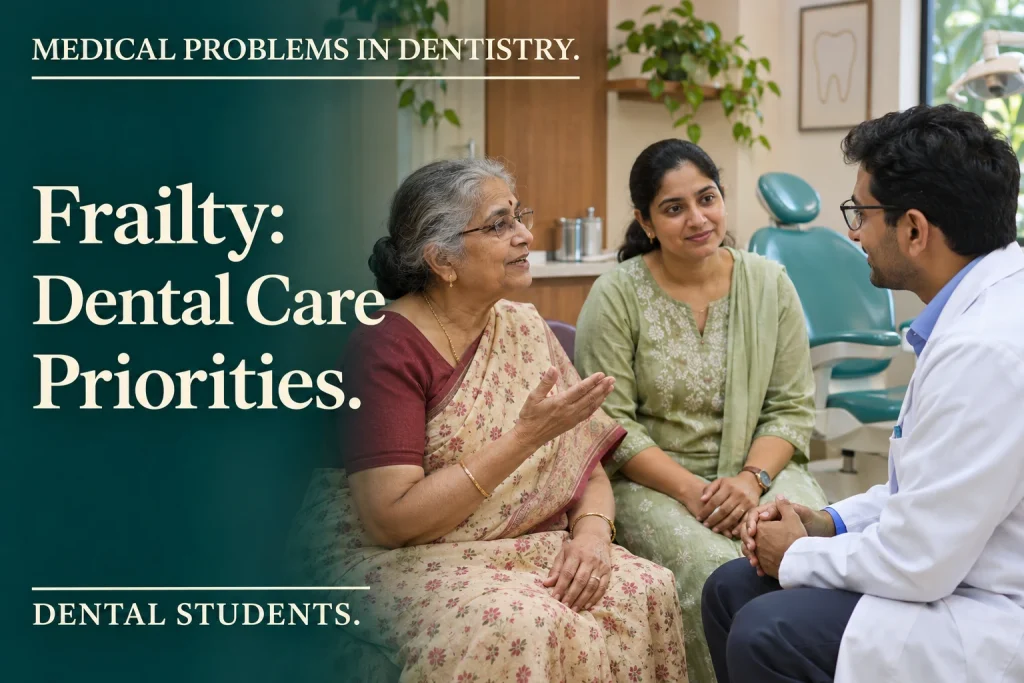
Fictional teaching case. An older adult with several conditions attends with a daughter. They struggle to travel to appointments and want to eat comfortably, but a proposed restorative plan involves many visits. The daughter answers most questions. Invite the patient’s own priorities, clarify the support they want and assess which oral problems need timely attention.
Define the problem without reducing the person to age
Multimorbidity refers to living with multiple health conditions. Frailty concerns vulnerability and reduced reserve; it is not synonymous with old age or simply counting diagnoses. Two people of the same age may have very different function, resilience, support and treatment preferences. An appearance or a photograph cannot establish frailty.
The British Geriatrics Society’s comprehensive geriatric assessment framework considers physical, psychological, functional, social, environmental and future-care dimensions. Dental assessment can draw attention to relevant issues and coordinate with the wider team, but it is not a complete geriatric assessment. Students should recognise the limits of a brief dental appointment.[CGA]
Ask about daily function and treatment burden
Explore eating, mouth comfort, brushing, denture handling, mobility, transfers, fatigue and the practicalities of attendance. Ask who supports daily care and whether that arrangement is reliable. Consider vision, hearing and communication needs. These questions can reveal why a technically sound treatment plan may be difficult to maintain.
Review current conditions, medicines, recent deterioration, falls, hospital care and any relevant nutrition concerns. Confirm the medication list rather than inferring it from diagnoses. Dry mouth, adverse effects and interactions may complicate oral care, but changes to essential medicines require the responsible prescribing team. The dentist should communicate concerns rather than independently deprescribing.
NICE’s multimorbidity guidance emphasises personal priorities and treatment burden. Recommendations for a single condition may not capture the situation of a person managing several conditions and many appointments. Use that principle to ask what benefit a dental intervention offers this patient and what it requires from them.[MULTI]
Set dental priorities with the patient
Identify pain, infection, suspicious lesions, problems affecting eating and other needs that merit timely assessment. Then discuss preventive, stabilising and definitive options in terms of likely benefit, burdens, alternatives and maintenance. A lengthy reconstruction may suit one person, while another values a more limited approach. Neither choice should be assumed from an age label.
Explain uncertainties and review points. A staged plan can allow reassessment of comfort, function and feasibility. Conversely, repeated temporary measures can become burdensome if they fail to address a recurring problem. Discuss the likely trajectory and establish what would prompt reconsideration. “Do nothing” also has consequences that should be explained.
Connect a finding to a practical decision
| Finding or question | Clinical implication | Student action |
|---|---|---|
| Several long journeys are needed | Attendance itself may impose fatigue, cost and disruption | Discuss sequencing, access options and realistic alternatives |
| Daily oral care is difficult | Maintenance assumptions may be unrealistic | Agree feasible support and preventive measures |
| The accompanying person answers everything | The patient’s preferences may be overlooked | Address the patient directly and clarify their desired support |
| Health or function has recently changed | An existing plan may no longer fit | Reassess and liaise with the wider team |
A frailty score, if used by appropriately trained clinicians, should inform context rather than operate as an automatic dental eligibility cutoff. It cannot by itself determine consent, justify withholding all care or select a specific procedure. Record the actual factors influencing the decision.
Consent, coordination and ongoing review
Do not assume that an older person or someone with frailty cannot make decisions. Support communication, provide accessible explanations and assess the particular decision under applicable Indian legal and professional arrangements. Family involvement can be valuable when the patient wants it, but an accompanying relative does not automatically replace the patient as decision-maker.
When medical or geriatric input is needed, communicate the dental problem, proposed choices, urgency and specific question. Clarify responsibility for follow-up, medicine concerns and practical support. The BGS and NICE sources are UK resources; their clinical principles do not substitute for Indian consent law, local services or an individual medical opinion.
In the teaching case, start with eating comfort, disease assessment and the patient’s own priorities. Explore whether visits and maintenance can be made manageable, then agree a reviewable plan. Document who will help with daily care and what should trigger earlier contact. Frailty-informed dentistry aims to make useful care achievable while preserving choice; it is not a label for abandoning treatment.
Viva and self-check
Is frailty the same as chronological age? No. Function, vulnerability, reserve and context need individual assessment.
Can a frailty score establish inability to consent? No. Consent is decision-specific and requires appropriate assessment and support.
Does a shorter plan always mean less burden? No. Recurrent temporary treatment can itself be burdensome; discuss likely outcomes and maintenance.
Continue through the series
- Previous: Medically Complex Children: Dental Assessment and Paediatric Medical Liaison
- Next: Polypharmacy in Older Adults: Xerostomia, Falls, Bleeding and Prescribing
- Browse all 215 student guides by subject
More in Younger and older patients: Medically Complex Children: Dental Assessment and Paediatric Medical Liaison · Polypharmacy in Older Adults: Xerostomia, Falls, Bleeding and Prescribing · Planning Prevention and Carer-Assisted Oral Care Across the Life Course
Continue learning
- Informed consent in an Indian dental practice
- Medical liaison and referral for complex dental patients
- Structured medical history and examination
References and scope
Sources checked on 26 November 2026. This is an original student teaching guide. International clinical recommendations are identified by their issuing organisation. Use current local protocols, appropriate supervision and an individual clinical assessment.
- British Geriatrics Society: Comprehensive Geriatric Assessment Hub
- NICE NG56: Multimorbidity — Recommendations
Images are AI-generated educational illustrations of fictional people or equipment, not clinical records or diagnostic photographs.

Leave a Reply