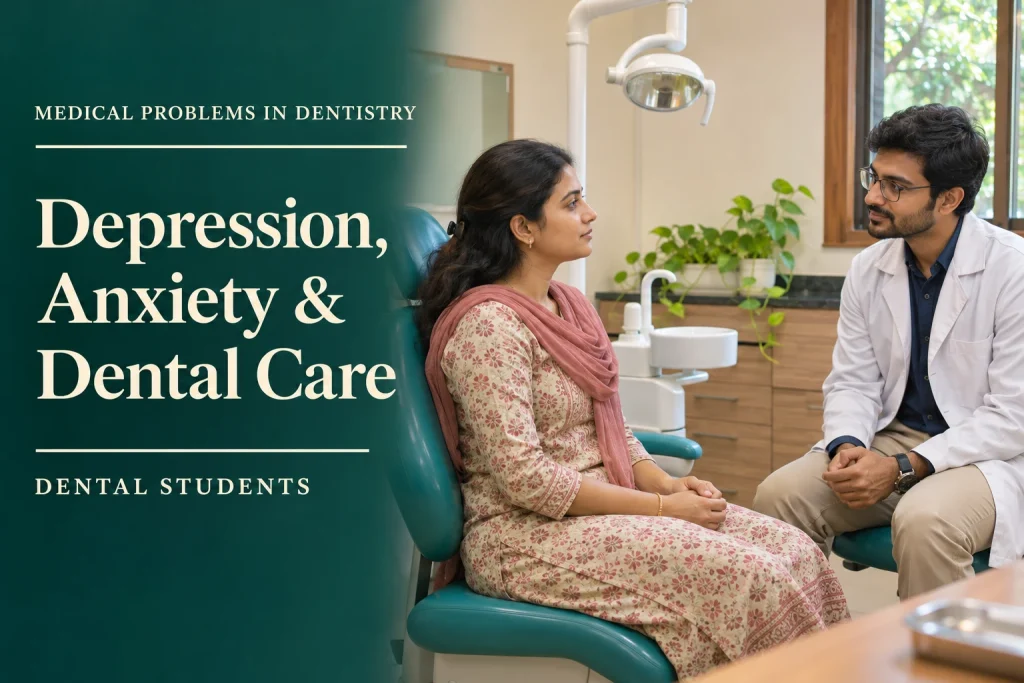
Medical Problems in Dentistry: Article 77 of 215 · Psychiatric disorders · Complete student guide
Medical Problems in Dentistry · Student guide
Depression and anxiety can affect the effort needed to attend appointments, manage oral care and discuss treatment. A useful dental response starts with listening and practical adjustments, while continuing to investigate dental symptoms properly.
In this guide: Learning objectives · Start with this clinical case · Ask about function and barriers first · Separate dental fear from a broader disorder · Make the consultation predictable · Assess the mouth and medicines without diagnostic overshadowing · Choose a small preventive plan and appropriate support · Resolve the case with an achievable next step · Viva and self-check
Learning objectives
- Explore barriers to dental care without judging the patient.
- Distinguish dental fear, broader anxiety and possible depressive symptoms.
- Adapt prevention, communication and referral to the person’s needs.
Start with this clinical case
Fictional teaching case. A patient has missed several visits and now attends with painful caries. They apologise, say they have struggled to get out of bed and describe a dry mouth after starting medication. The student considers labelling them “unmotivated” and delivering a long oral-hygiene lecture.
Ask about function and barriers first
Invite the patient to explain what has made care difficult. Pain, transport, cost, work, family demands and previous experiences can coexist with mental-health symptoms. Ask what would make the next step manageable rather than assuming why an appointment was missed.
NIMH describes depression as affecting mood, energy, concentration, sleep and daily functioning. These features can help explain a difficult period, but a dental consultation or missed visit alone cannot establish the diagnosis. Encourage appropriate medical assessment when symptoms suggest a wider problem.[DEPRESSION]
Separate dental fear from a broader disorder
Ask what the patient fears: pain, an injection, loss of control, embarrassment, cost or a previous event. Some anxiety is limited to a dental situation; persistent worry affecting many areas of life has a different assessment. Avoid diagnosing generalized anxiety disorder because someone is frightened in the chair.
NIMH emphasises a broader clinical evaluation for anxiety symptoms, including other health conditions that may contribute. New chest symptoms, faintness or breathlessness still require appropriate assessment rather than immediate attribution to anxiety.[ANXIETY]
Make the consultation predictable
| Finding or question | Clinical implication | Student action |
|---|---|---|
| Difficulty concentrating | A long explanation may be hard to retain | Use short sections and check understanding |
| Fear of losing control | Uncertainty may increase distress | Agree a stop signal and explain each stage |
| Low energy or disrupted routines | A complex home-care plan may fail | Agree one or two achievable priorities |
| Dryness after a medicine change | An oral adverse effect may contribute | Assess saliva and liaise with the prescriber |
Offer choices that are clinically realistic. Ask permission before examination and explain what will happen. Use plain language, a written plan and teach-back: ask the patient to describe the next step in their own words. Involve a chosen supporter when the patient wants this, while respecting privacy.
Assess the mouth and medicines without diagnostic overshadowing
Examine pain, caries, periodontal disease, mucosal change and oral function as you would for any patient. Psychological distress does not make pain imaginary or exclude infection. Equally, treating a tooth will not necessarily resolve a separate mental-health problem.
Reconcile medicines and ask about dryness, altered taste and new symptoms. NIDCR identifies medicines as a possible contributor to persistent dry mouth, which can increase oral disease risk. Discuss any proposed medication change with the prescriber; do not tell the patient to stop treatment because the mouth feels dry.[DRY]
Choose a small preventive plan and appropriate support
Prioritise relief of pain and infection, then agree realistic preventive actions. Demonstrate a manageable cleaning routine, assess fluoride needs and discuss food or drink patterns without blame. A review appointment can build on what became possible rather than treating an imperfect week as failure.
If the patient reveals immediate danger to themselves, severe deterioration or inability to stay safe, seek urgent senior and emergency support through the local pathway. Do not leave an imminent safety concern as a routine referral. This article does not supply a mental-health crisis assessment or import US contact numbers into Indian care.
Resolve the case with an achievable next step
Acknowledge the patient’s effort in attending and assess the painful teeth. Ask about current medical support and the medication change. Agree an initial treatment stage and a simple dryness/prevention plan, then provide written follow-up. With permission, communicate relevant concerns to the treating clinician.
Record the patient’s own account, the dental findings, communication preferences and agreed actions. Avoid judgmental shorthand such as “noncompliant” when the actual barrier is unknown. Good student practice makes the next visit easier while keeping the limits of dental and mental-health assessment clear.
Viva and self-check
Does nonattendance diagnose depression? No. Explore the barriers and broader clinical context.
Should oral pain be attributed to anxiety without examination? No. Assess possible dental and medical causes appropriately.
What is a useful first preventive goal? One the patient can realistically carry out, agreed alongside pain relief and follow-up.
Continue through the series
- Previous: Dental Treatment Before and After Liver Transplantation
- Next: Psychosis and Bipolar Disorder: Dental Assessment and Medicines Reconciliation
- Browse all 215 student guides by subject
More in Psychiatric disorders: Psychosis and Bipolar Disorder: Dental Assessment and Medicines Reconciliation · Psychotropic Medicines: Dry Mouth, Movement Disorders and Dental Drug Interactions · Mental Illness, Decision-Making and Dental Consent: Supported Communication · Trauma-Informed Dental Care: Building Safety and Predictability
Continue learning
- Structured medical history and examination
- Informed consent in an Indian dental practice
- Medical liaison and referral for complex dental patients
References and scope
Sources checked on 26 November 2026. This is an original student teaching guide. International clinical recommendations are identified by their issuing organisation. Emergency contact information is specific to India. Use current local protocols, appropriate supervision and an individual clinical assessment.
Images are AI-generated educational illustrations of fictional people or equipment, not clinical records or diagnostic photographs.

Leave a Reply