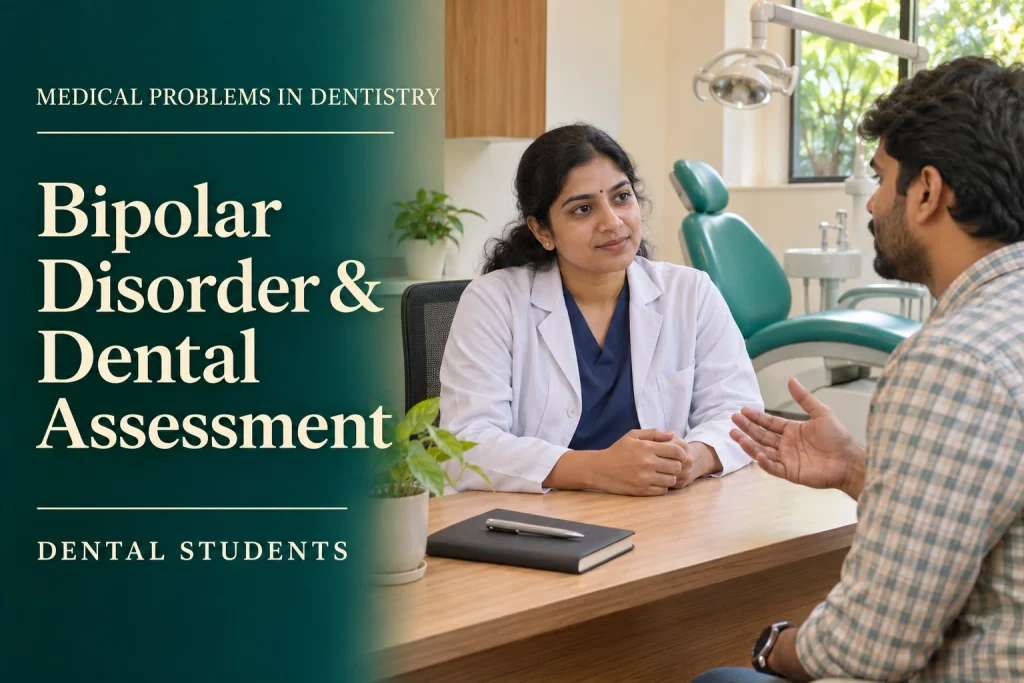
Medical Problems in Dentistry: Article 78 of 215 · Psychiatric disorders · Complete student guide
Medical Problems in Dentistry · Student guide
A history of psychosis or bipolar disorder should prompt an informed, respectful assessment. Current symptoms, medicines, physical health and the person’s ability to participate in the particular decision matter more than a label alone.
In this guide: Learning objectives · Start with this clinical case · Understand the terms without making a psychiatric diagnosis · Speak to the patient and support the decision · Assess current stability and physical health · Reconcile lithium and other mood medicines · Recognise clozapine and other treatment-specific issues · Resolve the case without removing the patient’s voice · Viva and self-check
Learning objectives
- Distinguish psychosis from bipolar disorder and avoid diagnostic assumptions.
- Assess current dental needs and communication requirements.
- Recognise medication-related issues requiring medical liaison.
Start with this clinical case
Fictional teaching case. A patient with bipolar disorder takes lithium and presents with toothache after several days of poor intake. A family member speaks for them throughout. A student assumes they cannot consent and considers prescribing an NSAID without checking the medicine list.
Understand the terms without making a psychiatric diagnosis
Psychosis describes symptoms involving altered perception or beliefs and can occur in different conditions. Bipolar disorder involves episodes of mood disturbance; some severe episodes can include psychotic symptoms. They are related concepts, not synonyms, and a dental student should not diagnose the underlying disorder from one unusual statement.[PSYCHOSIS][BIPOLAR]
Ask what diagnosis and support are already established, whether the patient is currently well and whether there has been a recent change. Record relevant information respectfully, focusing on how it affects safe care rather than reproducing unnecessary sensitive details.
Speak to the patient and support the decision
Address the patient directly, explain the proposed dental assessment and ask how they prefer information to be shared. A diagnosis does not by itself determine decision-making ability. Establish understanding and participation for the particular decision, using appropriate communication support and senior guidance.
Ask whether the patient wants the accompanying person involved. A relative can provide helpful information, but their presence should not automatically replace the patient’s voice or authorise disclosure. Follow applicable Indian consent requirements and the practice’s policy; this guide is not a substitute for a formal legal assessment.
Assess current stability and physical health
| Finding or question | Clinical implication | Student action |
|---|---|---|
| Established disorder, patient currently well | Routine dental needs still deserve care | Assess normally and adapt communication |
| Acute confusion or marked behavioural change | Medical or psychiatric deterioration may be present | Seek senior and appropriate urgent assessment |
| Lithium with poor intake or dehydration | Toxicity and interaction concerns may matter | Clarify symptoms and liaise before prescribing |
| Clozapine with fever or sore throat | Potential serious adverse effect or infection | Arrange urgent medical review |
Sleep disruption, poor intake, sedation or a recent admission may affect the appointment. Acute confusion also has medical causes; do not assume it is simply the known psychiatric condition. If meaningful cooperation is currently impossible, plan urgent needs through the appropriate team and setting rather than forcing elective care.
Reconcile lithium and other mood medicines
Obtain the exact medicine, dose, schedule, recent changes and treating clinician. Ask about over-the-counter products and oral intake. The Indian Psychiatric Society’s updated bipolar guidance highlights ongoing lithium monitoring and education about hydration and interactions.[IPS]
NSAIDs can increase lithium-related risk, and NICE’s patient information advises people taking lithium not to self-medicate with them. A dental analgesic decision should therefore include the prescriber or pharmacist when needed. Do not independently stop lithium or assume that a short course cannot cause a meaningful problem.[NICEBD]
Recognise clozapine and other treatment-specific issues
Clozapine has important monitoring and adverse-effect considerations. Fever or sore throat requires urgent medical assessment because neutropenia is one possible explanation. Significant sedation, new systemic symptoms or suspected toxicity also need prompt evaluation. The patient’s team should direct medication changes.[CLOZ]
Other psychotropic medicines have their own interaction and oral-effect profiles. Ask about dryness, excess saliva, movement symptoms and swallowing difficulties. Check the individual agent before adding an antimicrobial or planning sedation. Do not transfer UK brand-monitoring administrative rules into an Indian dental record as if they were local law.
Resolve the case without removing the patient’s voice
Ask the patient directly about the toothache, poor intake and current symptoms. Assess the dental problem and consider whether urgent medical review is indicated. Reconcile lithium before choosing pain relief, and request advice about dehydration or interactions where appropriate.
Support the consent discussion and involve the relative to the extent the patient wants and the clinical situation permits. Document the agreed treatment, advice obtained and review plan. A useful handover names the actual concern—such as poor intake while taking lithium—rather than simply stating that the patient has a psychiatric diagnosis.
Viva and self-check
Is psychosis synonymous with schizophrenia? No. Psychotic symptoms can occur in several clinical situations.
Does bipolar disorder automatically remove consent capacity? No. Assess the particular decision with appropriate support and guidance.
Why is toothache with poor intake relevant to lithium? Illness, hydration and added medicines can change risk and may require medical advice.
Continue through the series
- Previous: Depression and Anxiety: Oral Health, Attendance and Dental Communication
- Next: Psychotropic Medicines: Dry Mouth, Movement Disorders and Dental Drug Interactions
- Browse all 215 student guides by subject
More in Psychiatric disorders: Depression and Anxiety: Oral Health, Attendance and Dental Communication · Psychotropic Medicines: Dry Mouth, Movement Disorders and Dental Drug Interactions · Mental Illness, Decision-Making and Dental Consent: Supported Communication · Trauma-Informed Dental Care: Building Safety and Predictability
Continue learning
- Structured medical history and examination
- Informed consent in an Indian dental practice
- Medical liaison and referral for complex dental patients
References and scope
Sources checked on 26 November 2026. This is an original student teaching guide. International clinical recommendations are identified by their issuing organisation. Emergency contact information is specific to India. Use current local protocols, appropriate supervision and an individual clinical assessment.
- NIMH: Understanding Psychosis
- NIMH: Bipolar Disorder
- Indian Psychiatric Society: Bipolar Disorder Clinical Practice Guidelines, 2025 Update
- NICE: Bipolar Disorder, Information for the Public
- NHS SPS: Clinical Considerations for Clozapine
Images are AI-generated educational illustrations of fictional people or equipment, not clinical records or diagnostic photographs.

Leave a Reply