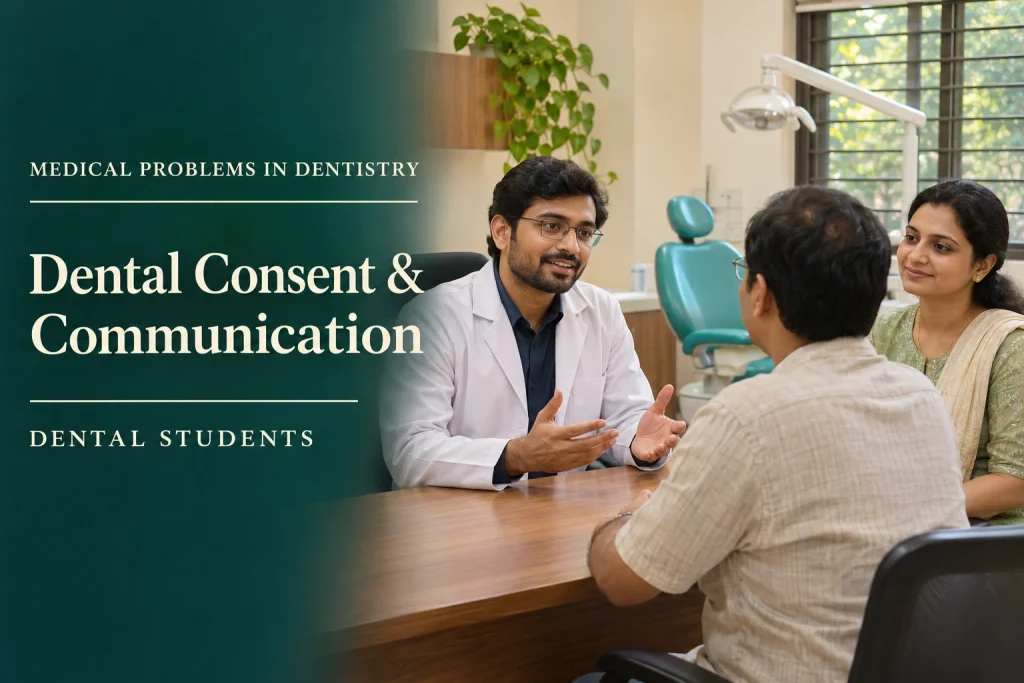
Medical Problems in Dentistry: Article 80 of 215 · Psychiatric disorders · Complete student guide
Medical Problems in Dentistry · Student guide
A mental-health diagnosis does not answer whether a person can make a particular dental decision. Start with the patient, improve communication and identify the actual decision before considering whether additional assessment is needed.
In this guide: Learning objectives · Start with this clinical case · Define the dental decision first · Do not substitute a diagnosis for assessment · Remove communication barriers before drawing conclusions · Clarify the supporter’s role and protect privacy · Handle unresolved ability and urgent need carefully · Resolve the case with a documented conversation · Viva and self-check
Learning objectives
- Separate diagnosis, communication difficulty and decision-making ability.
- Explain the limits of applying mental-health legislation to dental procedures.
- Document supported consent, uncertainty and appropriate escalation.
Start with this clinical case
Fictional teaching case. An adult with a previous psychiatric admission attends for an extraction. Their sibling answers every question and offers to sign the form. The patient asks to hear the options in Telugu before deciding. A student assumes the admission means the sibling must consent.
Define the dental decision first
Identify the tooth, diagnosis, proposed treatment, alternatives and urgency. Consent to an examination does not automatically cover an extraction. A signature cannot replace an understandable discussion, and agreement to one procedure is not permission for unrelated additional treatment.
The Supreme Court’s official summary of Samira Kohli emphasises valid, voluntary consent based on adequate information and distinguishes consent for different procedures. Use this as an important Indian consent principle, rather than treating a historical judgment summary as the whole current legal framework.[SAMIRA]
Do not substitute a diagnosis for assessment
Ask the patient directly what they understand and what matters to them. A person can have a mental illness, take psychiatric medication or have been hospitalised while still participating meaningfully in dental decisions. Disagreement with the dentist is not, by itself, evidence of inability to decide.
Sections 3 and 4 of India’s Mental Healthcare Act address mental illness and capacity for mental healthcare decisions. Section 4 includes accessible information and recognises that an apparently unwise decision does not alone establish incapacity. Its specific mental-health scope must not be presented as a complete statutory test or substitute-consent pathway for every dental procedure.[MHCA]
Remove communication barriers before drawing conclusions
| Finding or question | Clinical implication | Student action |
|---|---|---|
| Preferred language differs from the clinician’s | The explanation may not be understood | Arrange an appropriate interpreter or language support |
| Hearing, visual or speech difficulty | The response method may need adapting | Use suitable aids and allow time |
| Pain, distress or sedating medication | Participation may be temporarily affected | Address reversible problems and review timing |
| Supporter answers all questions | The patient’s own view may be obscured | Speak directly to the patient and clarify desired support |
Use short explanations, diagrams where helpful and a quiet setting. Ask the patient to describe the proposed choice in their own words. NICE’s UK guidance offers useful supported-communication methods, but its legal tests, advocates and substitute-decision structures belong to its own jurisdiction.[CAPACITY]
Clarify the supporter’s role and protect privacy
Ask whether the patient wants the sibling involved and what information may be shared. A supporter can help with recall, transport and communication without automatically becoming the decision-maker. Relationship alone should not be assumed to provide legal authority for an adult’s dental treatment.
If authority is claimed, verify its relevance and scope through the practice’s senior and legal processes. Do not assume that a mental-health nominated representative has unlimited authority over unrelated dental procedures. Record who was present, what support was requested and how the patient’s own preferences were established.
Handle unresolved ability and urgent need carefully
If meaningful decision-making remains uncertain after support, involve the supervising clinician and appropriate medical or specialist services. Record the particular difficulty and the assistance already tried. Consider whether the decision can safely wait for a better time or a more suitable setting.
Urgent infection and elective treatment require different planning. Do not invent an emergency exception merely because the clinic is busy or the patient is difficult to communicate with. Where immediate serious risk creates a genuine emergency, use the applicable clinical and legal pathway with senior involvement; this article does not authorise restraint or treatment by proxy.
Resolve the case with a documented conversation
Provide the requested Telugu explanation using appropriate support. Discuss the extraction and alternatives with the patient, then check their understanding and voluntary choice. The previous admission does not establish that the sibling must sign instead. If uncertainty persists, arrange a proportionate assessment rather than rushing the procedure.
The note should describe the decision, information provided, communication support, patient responses, choice and any unresolved issue. Record the planned review or referral and the response to urgent symptoms. Good consent documentation shows the process, rather than simply recording that a form was signed.
Viva and self-check
Does a psychiatric admission determine current dental decision-making ability? No. Assess the actual decision and present circumstances with appropriate support.
Does a relative automatically consent for an adult? No. Clarify the patient’s wishes and verify any claimed authority.
Is UK capacity legislation an Indian dental rule? No. Communication methods can inform care, but legal requirements must be grounded locally.
Continue through the series
- Previous: Psychotropic Medicines: Dry Mouth, Movement Disorders and Dental Drug Interactions
- Next: Trauma-Informed Dental Care: Building Safety and Predictability
- Browse all 215 student guides by subject
More in Psychiatric disorders: Depression and Anxiety: Oral Health, Attendance and Dental Communication · Psychosis and Bipolar Disorder: Dental Assessment and Medicines Reconciliation · Psychotropic Medicines: Dry Mouth, Movement Disorders and Dental Drug Interactions · Trauma-Informed Dental Care: Building Safety and Predictability
Continue learning
- Informed consent in an Indian dental practice
- Structured medical history and examination
- Medical liaison and referral for complex dental patients
References and scope
Sources checked on 26 November 2026. This is an original student teaching guide. International clinical recommendations are identified by their issuing organisation. Emergency contact information is specific to India. Use current local protocols, appropriate supervision and an individual clinical assessment.
- Supreme Court of India: Court News, January–March 2008, Samira Kohli
- India Code: Mental Healthcare Act 2017, Sections 3–4
- NICE NG108: Decision-making and Mental Capacity
Images are AI-generated educational illustrations of fictional people or equipment, not clinical records or diagnostic photographs.

Leave a Reply