Medical Problems in Dentistry: Article 81 of 215 · Psychiatric disorders · Complete student guide
Medical Problems in Dentistry · Student guide
For some people, features of a dental visit can feel threatening even when treatment is clinically routine. A trauma-informed approach changes how care is offered, while preserving proper diagnosis, pain control and patient choice.
In this guide: Learning objectives · Start with this clinical case · Understand the approach and its limits · Ask what helps instead of demanding a personal account · Make the visit predictable in small steps · Plan care around both comfort and clinical need · Respond to distress without forcing continuation · Resolve the case and improve the next visit · Viva and self-check
Learning objectives
- Apply safety, transparency and collaboration to ordinary dental care.
- Offer useful adjustments without requiring trauma disclosure.
- Respond to distress while respecting consent and clinical limits.
Start with this clinical case
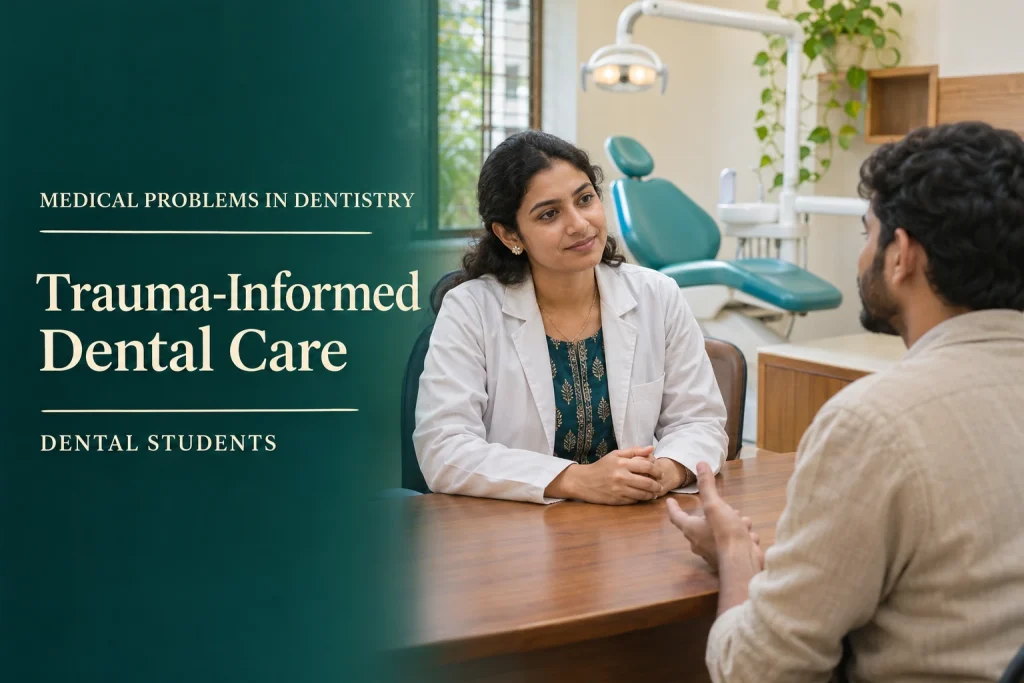
Fictional teaching case. A patient becomes distressed when the chair reclines and the dentist moves behind them. They say they do not want to explain why. The student considers insisting on the history before agreeing to any adjustment.
Understand the approach and its limits
SAMHSA describes a trauma-informed approach as recognising possible effects of trauma and organising services to avoid retraumatisation. Safety, trust, collaboration and meaningful choice are central principles. This is an approach to care, not a dental diagnosis or a claim that every anxious patient has experienced trauma.[TRAUMA]
The dental examples in this guide are practical applications of those principles. They do not establish a single validated treatment package for every patient or replace specialist psychological treatment. A clinician can adapt the visit while remaining clear about clinical uncertainty and required safety precautions.
Ask what helps instead of demanding a personal account
Invite a practical conversation: “Is there anything we can do to make the visit easier?” The patient may prefer an explanation before touch, a particular position, fewer people in the room or a chosen supporter. They do not need to provide a detailed traumatic history to request an ordinary reasonable adjustment.
If a disclosure occurs, listen without interrogation or promises of absolute confidentiality. Explain relevant safeguarding limits and involve appropriate senior services where needed. Record only information necessary for care and keep it secure; do not circulate sensitive personal details as a convenient explanation for behaviour.
Make the visit predictable in small steps
| Finding or question | Clinical implication | Student action |
|---|---|---|
| Reclining feels uncomfortable | Position may affect the sense of control | Explain the movement and agree a gradual change |
| Unexpected touch increases distress | The next step is unclear | Ask permission before each new stage |
| Too many voices or observers | The environment becomes overwhelming | Agree who needs to be present |
| Patient needs a pause | Continuing may increase distress | Use an agreed signal and stop safely |

Explain the examination before placing instruments in the mouth. Agree how the patient can request a pause and practise it before starting. A stop signal is useful only if the team actually responds. Avoid promising complete control over every circumstance; explain any clinical limit honestly.
Plan care around both comfort and clinical need
Ask about pain, infection, previous treatment and current health. A calm consultation does not remove the need for diagnosis, and distress should not be treated as evidence that the dental complaint is psychological. Agree what can be completed today and what requires another appointment or referral.
Start with manageable steps when clinically appropriate, and review the experience with the patient. NHS England’s anxiety guidance treats behavioural support and pharmacological options as potentially complementary. Sedation requires its own assessment, trained team and consent process; it is not a substitute for listening or a way to override refusal.[ANXIETY]
Respond to distress without forcing continuation
If the patient becomes distressed, stop treatment safely, remove immediate triggers where possible and ask what would help. Use a calm voice, allow space and avoid unexpected touch. Offer simple choices rather than several rapid instructions or a debate about whether the reaction is justified.
Assess new physical symptoms appropriately. Faintness, breathing problems or altered awareness can have medical causes and must not automatically be labelled a trauma response. Obtain trained support when safety or the ability to continue is uncertain, and use the emergency pathway if the clinical situation requires it.
Resolve the case and improve the next visit
The student should respect the patient’s wish not to explain the history. Discuss an upright starting position, advance warning before chair movement and an agreed pause signal. Explain any positioning needed for safe treatment and explore feasible alternatives together.
At the end, ask which adjustments helped and what should be different next time. Record the agreed preferences so the patient does not need to repeat a sensitive account to every team member. The outcome may be a limited examination and a workable return plan; completing every planned procedure is not the only measure of a successful visit.
Viva and self-check
Must a patient disclose trauma before care can be adapted? No. Ask about practical preferences and needs.
Does trauma-informed care diagnose PTSD? No. It is an approach to organising the interaction and environment.
Can sedation replace consent and communication? No. It requires its own safe assessment and does not authorise treatment against the patient’s wishes.
Continue through the series
- Previous: Mental Illness, Decision-Making and Dental Consent: Supported Communication
- Next: Dental Anxiety and Phobia: Assessment and Stepped Behavioural Support
- Browse all 215 student guides by subject
More in Psychiatric disorders: Depression and Anxiety: Oral Health, Attendance and Dental Communication · Psychosis and Bipolar Disorder: Dental Assessment and Medicines Reconciliation · Psychotropic Medicines: Dry Mouth, Movement Disorders and Dental Drug Interactions · Mental Illness, Decision-Making and Dental Consent: Supported Communication
Continue learning
- Informed consent in an Indian dental practice
- Structured medical history and examination
- Medical liaison and referral for complex dental patients
References and scope
Sources checked on 26 November 2026. This is an original student teaching guide. International clinical recommendations are identified by their issuing organisation. Emergency contact information is specific to India. Use current local protocols, appropriate supervision and an individual clinical assessment.
- SAMHSA: Practical Guide for a Trauma-Informed Approach
- NHS England: Clinical Standards for Dental Anxiety Management
Images are AI-generated educational illustrations of fictional people or equipment, not clinical records or diagnostic photographs.

Leave a Reply