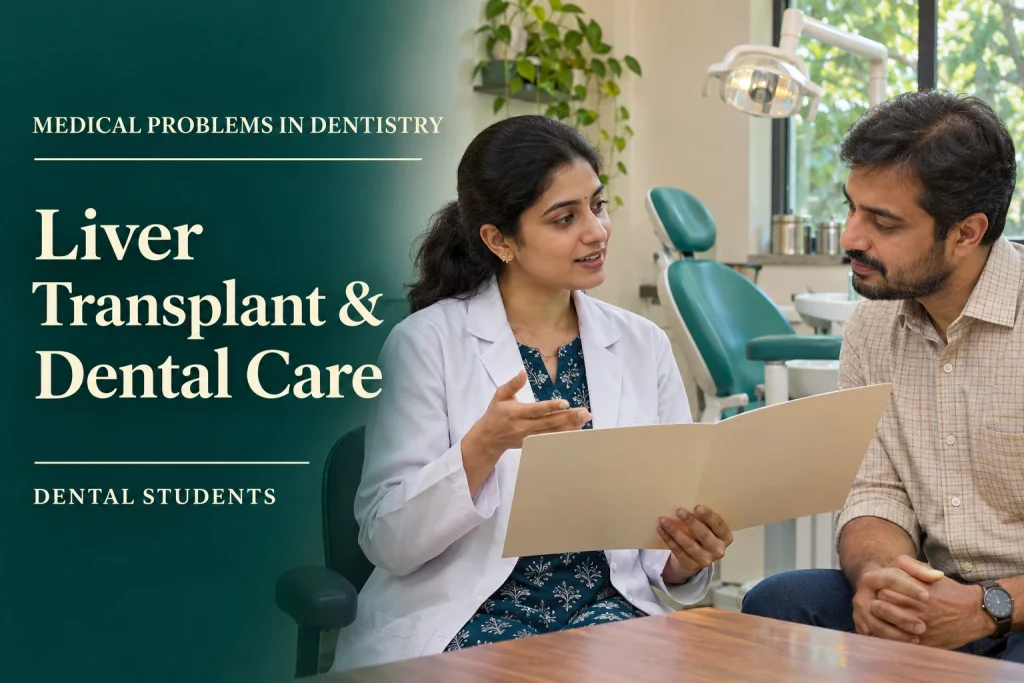
Medical Problems in Dentistry: Article 76 of 215 · Liver disease · Complete student guide
Medical Problems in Dentistry · Student guide
Dental care around liver transplantation should reduce avoidable infection and maintain function while respecting the urgency of the medical treatment. A transplant date or a generic clearance letter cannot replace an individual dental plan.
In this guide: Learning objectives · Start with this clinical case · Know which phase of care you are planning · Prioritise infection and realistic treatment before transplantation · Reassess current health after transplantation · Use local transplant advice without turning it into a universal rule · Check oral complications and prescriptions carefully · Resolve the two cases with different plans · Viva and self-check
Learning objectives
- Prioritise dental findings before transplantation with the medical team.
- Assess current graft health, medicines and complications afterward.
- Separate routine prevention, urgent infection and elective invasive care.
Start with this clinical case
Fictional teaching case. A patient awaiting liver transplantation has one painful nonrestorable tooth and several asymptomatic restorations. Another patient is two months after transplantation and develops facial swelling. Should both receive the same instruction to wait six months?
Know which phase of care you are planning
Before transplantation, the patient may have complications of advanced liver disease as well as a time-sensitive medical pathway. After transplantation, immune treatment, graft function, rejection episodes and other organ problems may change risk. Record the stage and the responsible transplant service before arranging invasive care.
NIDDK explains that anti-rejection medicines and ongoing monitoring are central to care after liver transplantation. Patients should discuss additional medicines with their team. Do not advise them to omit immune therapy for a dental appointment.[TRANSPLANT]
Prioritise infection and realistic treatment before transplantation
Examine teeth, periodontium, mucosa, dentures and oral hygiene. Use imaging when indicated by the findings and treatment question. Identify pain, active infection, nonrestorable teeth and sources of trauma, and distinguish these from lower-priority elective concerns.
Agree what can be completed safely within the available time, with a plan for healing and review. Avoid reflex extraction of every heavily restored but serviceable tooth. Describe uncertainty and prognosis explicitly so the transplant team can balance dental needs against the medical timetable.
Reassess current health after transplantation
| Finding or question | Clinical implication | Student action |
|---|---|---|
| Pretransplant pain or infection | A possible infection focus needs timely attention | Coordinate dental diagnosis, timing and medical support |
| Early post-transplant swelling or systemic symptoms | Infection needs prompt assessment | Contact the transplant team and urgent dental service |
| Stable recipient requesting elective surgery | Procedure and current treatment need review | Agree timing, support and medicine checks |
| New persistent oral ulcer or mass | The transplant history does not explain every lesion | Examine and arrange appropriate specialist assessment |
Ask about recent rejection treatment, infection, hospitalisation, current immunosuppressants, relevant blood results and renal as well as liver function. A person years after transplant may have a recent high-risk treatment change; a calendar alone cannot establish stability.
Use local transplant advice without turning it into a universal rule
Transplant centres may specify their own intervals for routine elective dental work and instructions for contacting the team. UCSF’s handbook gives one centre’s approach while also emphasising prompt attention to tooth or gum pain. Its calendar is not a universal rule to delay every recipient’s care.[UCSF]
A liver transplant alone should not be treated as an automatic antibiotic prescription. Ask whether a separate cardiac indication, the degree of immune suppression, an active infection or the planned procedure changes the recommendation. Prophylaxis and treatment of established infection require separate reasoning.
Check oral complications and prescriptions carefully
Review dry mouth, gingival enlargement, ulceration, caries and periodontal disease. Establish whether a finding may relate to medicines, local disease or another cause. New suspicious mucosal change needs timely assessment rather than repeated attribution to immunosuppression.
Before adding an antimicrobial, analgesic or sedative, check the exact immune regimen and current organ function. Do not assume a short course or a locally applied medicine cannot interact. Give the transplant team a specific proposed medicine and procedure, and record their advice and follow-up arrangements.
Resolve the two cases with different plans
The pretransplant patient’s painful nonrestorable tooth deserves priority assessment with the team; the other restorations need prognosis-based review, not automatic extraction. The early post-transplant patient with facial swelling requires prompt coordinated assessment, with urgent escalation for systemic illness, airway concerns or rapid progression.
For both, document the dental diagnosis, uncertainty, actions completed, healing status and outstanding treatment. A report should describe findings and limitations rather than promise the mouth is permanently “infection-free”. Arrange a preventive recall plan that remains feasible after medical appointments, fatigue and treatment changes are considered.
Viva and self-check
Is “six months after transplant” a universal rule? No. Local protocols, current health, urgency and the procedure must be considered together.
Should immune therapy be stopped for dental treatment? Not independently. Changes require the transplant team’s advice.
What should a dental report say? The actual findings, treatment completed, healing and remaining risks, with relevant uncertainty.
Continue through the series
- Previous: Dental Analgesics, Antibiotics and Local Anaesthetics in Hepatic Impairment
- Next: Depression and Anxiety: Oral Health, Attendance and Dental Communication
- Browse all 215 student guides by subject
More in Liver disease: Liver Disease for Dental Students: Oral Findings, History and Clinical Stability · Cirrhosis and Dental Bleeding Risk: Why INR Alone Does Not Tell the Whole Story · Hepatitis B and C: Transmission, Vaccination and Dental Care · Dental Analgesics, Antibiotics and Local Anaesthetics in Hepatic Impairment
Continue learning
- Medical liaison and referral for complex dental patients
- Explain liver disease and dental precautions to a patient
- Infection-control programme for an Indian dental clinic
References and scope
Sources checked on 26 November 2026. This is an original student teaching guide. International clinical recommendations are identified by their issuing organisation. Emergency contact information is specific to India. Use current local protocols, appropriate supervision and an individual clinical assessment.
Images are AI-generated educational illustrations of fictional people or equipment, not clinical records or diagnostic photographs.

Leave a Reply