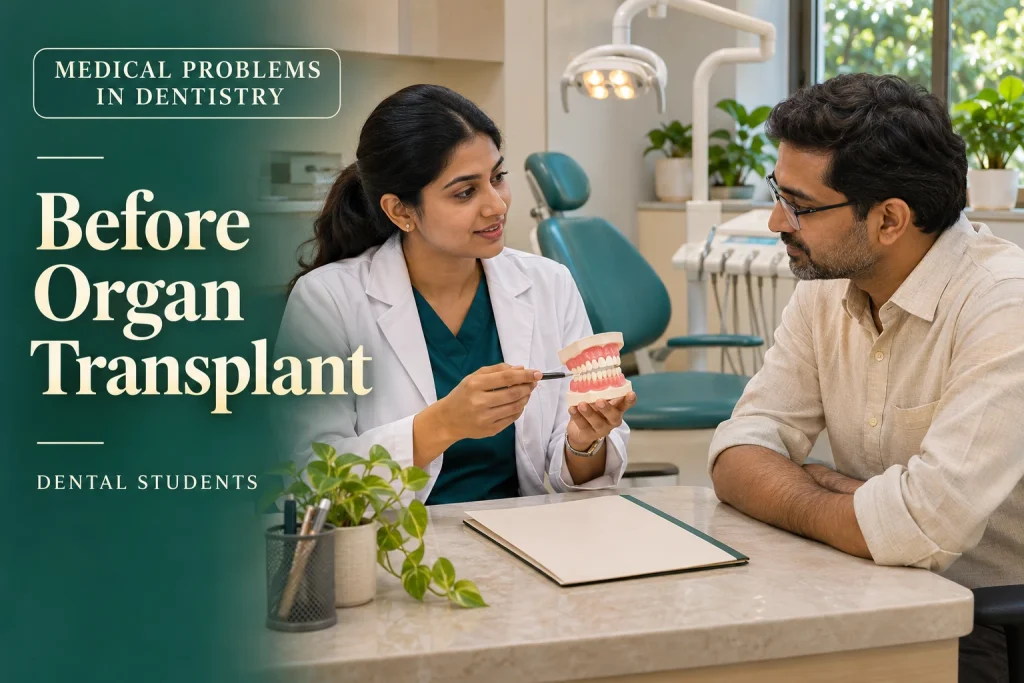
Medical Problems in Dentistry: Article 170 of 215 · Organ and stem-cell transplantation · Complete student guide
Medical Problems in Dentistry · Student guide
Before a solid-organ transplant, dental assessment should identify and manage relevant oral disease while respecting the patient’s medical condition and transplant timetable. “Dental clearance” is a communication task, not a guarantee that future infection is impossible.
In this guide: Learning objectives · Start with this clinical case · Define the transplant and timetable · Assess disease and medical constraints · Manage infection without overtreatment · Coordinate timing, medicines and healing · Write a report the team can use · Prevention and continuity · Viva and self-check
Learning objectives
- Distinguish solid-organ transplantation from stem-cell transplantation.
- Prioritise dental infection and feasible preventive care.
- Write a specific report for the transplant team.
Start with this clinical case
Fictional teaching case. A man awaiting a kidney transplant is referred for dental assessment. He has a painful nonrestorable molar, an asymptomatic tooth with an old restoration and plaque-related gingival inflammation. His transplant date may change. Explain why neither extracting every doubtful tooth nor signing a disease-free certificate without assessment is a useful plan.
Define the transplant and timetable
Record the organ, stage of assessment, responsible unit, urgency and anticipated treatment window. Kidney, liver, heart and lung disease have different implications for dental tolerance and prescribing. Solid-organ transplantation also differs from haematopoietic stem-cell transplantation; conditioning, recovery and GVHD concerns cannot be transferred wholesale between them.
KDIGO’s 2020 kidney-transplant candidate guideline suggests dental evaluation according to local general-population guidance to screen for dental and periodontal disease. Its recommendation is kidney-specific and should be presented with its evidence grade and scope, not as an Indian legal requirement for every transplant.
[TRANSPLANT]Assess disease and medical constraints
Take a complete dental and medical history, examine teeth, periodontium, mucosa and prostheses, and obtain clinically indicated imaging. Clarify bleeding history, medicines, infection, recent investigations and organ-related limitations. Ask what information the transplant team needs and how urgently. A standard checklist is useful only if it leads to decisions about the person’s actual disease.
| Finding or question | Clinical implication | Student action |
|---|---|---|
| Painful dental infection or nonrestorable infected tooth | Potential immediate problem | Assess urgency and arrange appropriate treatment with medical liaison |
| Restorable disease without acute symptoms | May still need care | Judge prognosis, available time and stabilisation options |
| Poor plaque control or traumatic appliance | Preventable ongoing burden | Provide feasible hygiene support and remove irritation |
| Suspicious mucosal lesion | Different diagnostic pathway | Arrange investigation and inform the relevant team |
| Uncertain transplant timing | Treatment window may be short | Communicate unfinished care and review arrangements |
Manage infection without overtreatment
NIDCR’s transplant resource emphasises identifying and stabilising oral infection before immunosuppression where possible. Treat nonrestorable disease appropriately, but assess each tooth’s prognosis rather than applying a blanket extraction policy. If medical status or time prevents definitive care, discuss reasonable stabilisation and the remaining risk with the transplant unit.
[TXORAL]For the teaching case, establish the painful molar’s diagnosis and likely treatment needs first. Assess the restored tooth on evidence rather than age of the restoration alone. The gingival condition calls for prevention and periodontal assessment. Communicate the proposed sequence and whether healing can be reviewed before transplantation.
Coordinate timing, medicines and healing
Ask the medical team about stability, relevant counts or coagulation findings, dialysis or other treatment schedules, and any special perioperative instructions. Medication decisions depend on the actual organ dysfunction and proposed procedure. Transplant status alone is not a complete antibiotic prescription. Do not change anticoagulants, immunosuppressive plans or steroids independently.
NIDCR provides background on pre- and post-transplant dental management, but its older time intervals are not an individual treatment order. The transplant service’s current protocol and the patient’s recovery govern timing. Document tissue healing and unresolved symptoms instead of assuming a fixed number of days guarantees readiness.
[TXORAL]Write a report the team can use
An original report template can contain: date and scope of assessment; significant oral findings; investigations; completed treatment; healing status; unfinished care; proposed next steps; and a contact for questions. State what was not assessed if the examination was limited. Avoid absolute phrases such as “no possibility of dental infection”.
Make uncertainty visible. For example, an asymptomatic tooth may need planned reassessment, while a treated extraction site may still require a healing review. The transplant team needs those facts to integrate with its wider clinical decision. The dentist does not decide transplant eligibility from an oral examination.
Prevention and continuity
Agree a cleaning and preventive routine the patient can sustain during medical treatment. Explain how to report new swelling, pain, bleeding or mucosal change. Give both patient and transplant team the follow-up arrangement and update the report if the timetable or oral findings change.
For a viva, finish with the handover rather than the procedure: who confirms the transplant window, who reviews healing, what remains outstanding and how urgent deterioration will be managed? A coordinated plan is more useful than a letter containing only the word “cleared”.
Viva and self-check
Can a stem-cell transplant dental protocol be copied to every solid-organ candidate? No. The treatments and risks differ.
MCQ: Pre-transplant dental assessment requires extraction of every heavily restored tooth. False. Diagnosis, prognosis, medical context and timing should guide the plan.
What should a report say about uncertainty? Identify limitations, unresolved disease and review needs so the team can use the information appropriately.
Continue through the series
- Previous: Cancer Immunotherapy and Targeted Therapy: Oral Adverse Effects Dental Students Should Recognise
- Next: Dental Care After Solid-Organ Transplantation: Medicines, Infection and Surveillance
- Browse all 215 student guides by subject
More in Organ and stem-cell transplantation: Dental Care After Solid-Organ Transplantation: Medicines, Infection and Surveillance · Haematopoietic Stem-Cell Transplantation: Oral Care Before, During and After Treatment · Transplant Immunosuppressants: Gingival Enlargement, Oral Infection and Prescribing Interactions
Continue learning
- Structured medical history and examination
- Medical liaison and referral for complex dental patients
- Informed consent in an Indian dental practice
References and scope
Sources checked on 25 November 2026. This is an original student teaching guide. International clinical recommendations are identified by their issuing organisation; Indian legal provisions are identified separately. Use current local protocols, appropriate supervision and an individual clinical assessment.
- KDIGO: Kidney Transplant Candidate Guideline 2020, section 10.4
- NIDCR: Dental Management of Organ or Stem Cell Transplant Patients, background resource
Images are AI-generated educational illustrations of fictional people or equipment, not clinical records or diagnostic photographs.

Leave a Reply