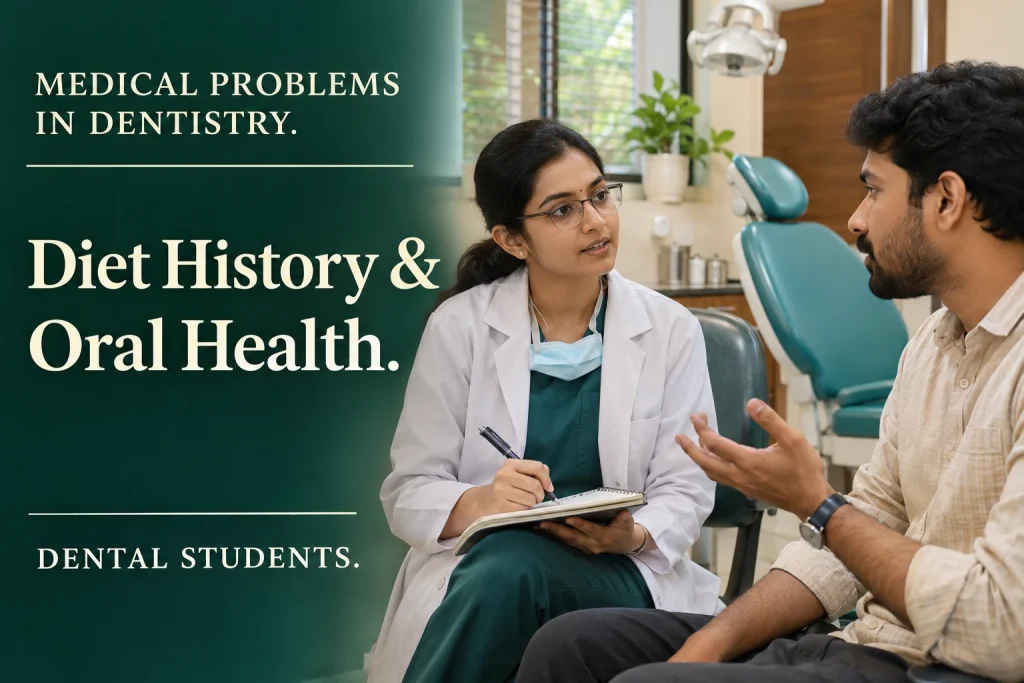
Medical Problems in Dentistry: Article 183 of 215 · Dietary factors, health and disease · Complete student guide
Medical Problems in Dentistry · Student guide
“Do you eat sweets?” is too narrow a diet history. Sweetened drinks, repeated sipping, meal patterns and acidic exposures may be missed, while an overly restrictive response can undermine adequate nutrition. Students should connect the patient’s real day to the clinical findings and agree practical changes.
In this guide: Learning objectives · Start with this clinical case · Ask for a real day, then test whether it is typical · Explain what free sugars include · Assess amount and pattern together · Separate sugar-related caries from acid-related wear · Look beyond the diet when the findings require it · Choose one or two achievable changes · Document the plan and review what happened · Viva and self-check
Learning objectives
- Identify free-sugar and acid exposures without treating them as the same risk.
- Assess total amount alongside frequency and duration of exposure.
- Offer achievable advice that respects medical nutrition needs and resources.
Start with this clinical case
Fictional teaching case. A student tells a patient with caries and tooth wear to stop all fruit. The patient rarely eats sweets but sips sweetened tea throughout the day and frequently drinks a sugar-free acidic beverage. Which questions would produce a more useful assessment?
Ask for a real day, then test whether it is typical
Explore meals, snacks, drinks and anything consumed overnight. Ask about preparation, added ingredients, serving size and how long a drink lasts. A brief recall can reveal patterns, but one day may not represent weekends, work shifts, fasting periods or days affected by pain.
A diary can help when the pattern is unclear, provided the patient can realistically complete it. Ask what changed recently and whether chewing difficulties, dry mouth, nausea or dental pain influence choices. Do not mistake a limited food record for a complete nutritional assessment.
Explain what free sugars include
WHO includes sugars added by a manufacturer, cook or consumer, as well as sugars in honey, syrups, fruit juices and concentrates. A “natural” sweetener or juice label therefore does not make an exposure free of this consideration. Whole fruit should not be treated as nutritionally equivalent to fruit juice.[SUGAR]
WHO recommends limiting free sugars to below 10% of energy intake, ideally below 5%. These are population dietary goals, not a personalised teaspoon allowance for every patient. Avoid presenting a particular gram number as suitable regardless of age, energy needs or medical circumstances.[SUGAR]
Assess amount and pattern together
Ask how much is consumed, how often and whether exposure is prolonged by sipping or grazing. Sweetened tea, biscuits, packaged drinks and repeated snacks are useful questions in an Indian consultation, but do not assume that every patient follows the same pattern.
The ADA notes that amount and frequency are closely related and difficult to separate. Do not tell students that frequency always matters more than total intake or that a large amount becomes harmless simply because it is taken with one meal. The history should identify both dimensions.[DIET]
Separate sugar-related caries from acid-related wear
| Finding or question | Clinical implication | Student action |
|---|---|---|
| Repeated sweetened tea or drinks | Free-sugar amount and exposure pattern may matter | Ask about additions, portion and duration of sipping |
| Sugar-free acidic drinks | Absence of sugar does not exclude erosive exposure | Assess acidity-related habits and clinical tooth wear |
| Fruit juice described as natural | It still contains free sugars | Distinguish juice from whole fruit in counselling |
| Soft sweet foods chosen because chewing hurts | Oral disease is affecting intake | Treat the cause and preserve adequate nutrition |
| A medically prescribed nutrition supplement | Nutrition and dental risks require coordination | Do not remove it without an appropriate alternative plan |
Look beyond the diet when the findings require it
Erosive tooth wear involves acids of non-bacterial origin, whereas caries involves a different disease process. A sugar-free beverage can still be acidic. Tooth wear may also involve intrinsic acid exposure or other mechanical and biological factors, so diet alone should not be declared the cause from appearance.
Ask about relevant symptoms and refer when the history suggests a medical problem. The ADA nutrition resource discusses the bidirectional relationship: oral problems can alter intake, and intake can affect oral health. That framework is more useful than assigning every damaged tooth to one food.[DIET]
Choose one or two achievable changes
Explore what the patient is willing and able to change. An example might be reducing added sugar and repeated sipping of sweetened tea, or replacing a routine acidic drink with water where medically appropriate. Agree the change together rather than handing over a long list of prohibitions.
Maintain adequate overall intake. People with diabetes, renal disease, malnutrition or cancer may need coordinated dietary advice. Do not remove a prescribed nutrition product simply because it contains sugar; involve the treating team and dietitian in a plan that balances nutrition and dental prevention.
Document the plan and review what happened
Record the relevant pattern, clinical findings, agreed goal and follow-up. Ask about cost, access, preparation and family or work routines that may affect the change. A plan the patient cannot carry out is not improved by stronger wording.
At review, ask what changed and what was difficult. Continue appropriate oral hygiene, fluoride prevention and treatment alongside dietary advice. For a viva, show the chain from history to interpretation to practical action, without claiming that dietary counselling alone cures established disease.
Viva and self-check
Does sugar-free mean non-erosive? No. A drink may contain acids despite having no sugar.
Is honey excluded from free sugars because it is natural? No. WHO includes honey among free-sugar sources.
Should a prescribed nutrition supplement be stopped automatically for dental reasons? No. Coordinate an adequate nutrition and oral-prevention plan.
Continue through the series
- Previous: Communicating About Traditional Remedies Respectfully in Dental Practice
- Next: Malnutrition and Oral Findings: Assessing Risk and Arranging Medical Referral
- Browse all 215 student guides by subject
More in Dietary factors, health and disease: Malnutrition and Oral Findings: Assessing Risk and Arranging Medical Referral · Vitamin and Mineral Deficiencies: Glossitis, Ulceration, Bleeding and Diagnostic Limits · Nutrition After Dental Surgery and During Cancer Care: Maintaining Safe Intake · Dietary Supplements and Oral Health: When Evidence Supports a Recommendation
Continue learning
- Structured medical history and examination
- Explaining diabetes and gum disease to a patient
- Medical liaison and referral for complex dental patients
References and scope
Sources checked on 26 November 2026. This is an original student teaching guide. International clinical recommendations are identified by their issuing organisation. Use current local protocols, appropriate supervision and an individual clinical assessment.
Images are AI-generated educational illustrations of fictional people or equipment, not clinical records or diagnostic photographs.

Leave a Reply