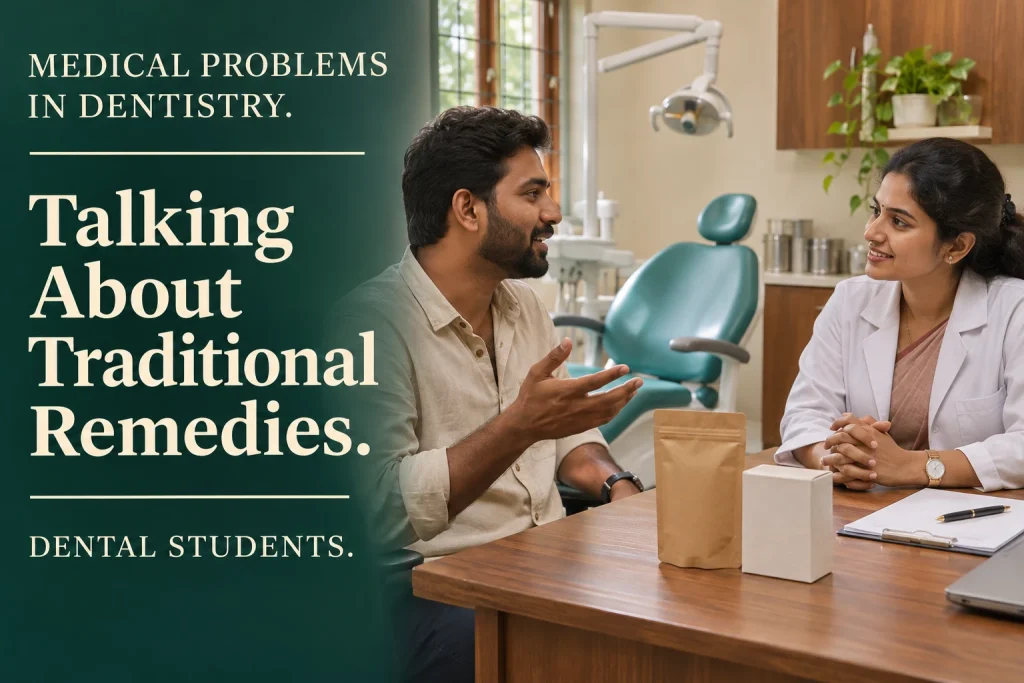
Medical Problems in Dentistry: Article 182 of 215 · Complementary and herbal therapies · Complete student guide
Medical Problems in Dentistry · Student guide
Respectful communication makes clinically important information easier to share. It does not require agreeing with every treatment claim. A student can acknowledge why a remedy matters to the patient, ask precise questions and explain a specific concern while keeping the patient involved in an evidence-informed care plan.
In this guide: Learning objectives · Start with this clinical case · Begin with curiosity and a clinical purpose · Understand the goal and the practical context · Acknowledge experience without endorsing causation · Use wording that preserves both clarity and trust · Explain a specific concern rather than condemning a tradition · Agree practical next steps and check understanding · When views differ, preserve continuity · Viva and self-check
Learning objectives
- Explore goals and beliefs without making cultural assumptions.
- Explain an identified concern without shaming the patient.
- Use teach-back and an explicit follow-up plan when views differ.
Start with this clinical case
Fictional teaching case. A patient uses a family-recommended powder on a painful oral area and is reluctant to discuss it after a previous clinician laughed. The student notices a persistent lesion needing assessment. How can the conversation protect trust while making the need for examination and referral clear?
Begin with curiosity and a clinical purpose
A useful opening is: “Many people use home or traditional products. What have you tried for this problem, and what were you hoping it would do?” Explain that the information helps assess the symptoms and check treatment decisions. Ask permission to look at the product or its package where appropriate.
Do not infer a patient’s practices from language, clothing, age or community. People within the same family may make different choices. Equally, do not assume that a patient who uses a traditional preparation rejects all conventional treatment.
Understand the goal and the practical context
Ask who recommended the product, how it is used, whether it helps and what concerns the patient has about dental care. Cost, previous experiences, pain, fear and access can all shape choices. Explore these as individual circumstances rather than explanations imposed on the patient.
NCCIH’s communication guidance encourages an open discussion of complementary approaches alongside other medicines. The teaching application is to make disclosure routine and useful. It is not a reason to interrogate the patient about beliefs unrelated to the dental problem.[TALK]
Acknowledge experience without endorsing causation
If the patient says the product helped, acknowledge that the symptom felt better. Then explain that improvement alone does not identify the cause or establish that the underlying disease has resolved. This distinction respects the account while preserving clinical reasoning.
Avoid labels such as “uneducated”, “non-compliant” or “irrational”. Record the actual use, concern and agreed plan. A patient who is uncertain or disagrees should not be described as refusing care before the proposed options and consequences have been explained understandably.
Use wording that preserves both clarity and trust
| Finding or question | Clinical implication | Student action |
|---|---|---|
| The patient fears being judged | Disclosure may be incomplete | Explain why you ask and use neutral language |
| The patient reports symptom relief | Experience and disease resolution are different | Acknowledge the relief while assessing the cause |
| The product has uncertain ingredients | A precise safety answer is not yet possible | Ask for packaging and explain the uncertainty |
| A lesion needs investigation | Delay may carry clinical consequences | Describe the finding and the reason for referral |
| The patient is not ready to agree | Understanding and barriers need exploration | Discuss options, document and arrange follow-up |
Explain a specific concern rather than condemning a tradition
Say what you found, what remains uncertain and how that affects care. For example: “This area has not healed, so we need to assess it even if the powder makes it feel more comfortable.” Explain the next examination or referral in plain language and check for questions.
If an interaction concern exists, identify the actual combination and the need for qualified checking. Do not say all traditional products are contaminated, ineffective or dangerous. NCCIH’s supplement guidance supports an individual assessment of evidence and safety rather than assumptions from a label.[WISE]
Agree practical next steps and check understanding
Offer an understandable plan for the dental problem, any product clarification and the review. Ask the patient to describe what they will do next in their own words. Present teach-back as a check of your explanation, not a test of intelligence.
If language support is needed, use the appropriate communication arrangement, particularly for complex or sensitive decisions. Include a caregiver only with appropriate consent and respect the patient’s voice. Avoid relying on a rushed family translation when it prevents a clear account or informed discussion.
When views differ, preserve continuity
Explain reasonable options, expected benefits, uncertainties and consequences of delay. Explore what makes the proposed care difficult. Document the discussion and the patient’s decision accurately, with senior guidance and the applicable consent process where needed. Respectful disagreement is compatible with a clear recommendation.
Give a return route and define which symptoms require earlier assessment. Do not abandon the patient because they continue a practice you have questioned. A good student consultation leaves an accurate record and a workable next step, even when agreement is incomplete.
Viva and self-check
Does respectful discussion require endorsing an unsupported claim? No. Acknowledge the person and experience while explaining the evidence and clinical concern.
Should a cultural background be used to predict product use? No. Ask the individual without stereotypes.
Why use teach-back? To check that the explanation and next steps were understood, not to test or blame the patient.
Continue through the series
- Previous: Complementary Therapies for Oral Symptoms: Distinguishing Evidence From Marketing
- Next: Diet History for Dental Students: Free Sugars, Acids, Frequency and Practical Advice
- Browse all 215 student guides by subject
More in Complementary and herbal therapies: Herbal and Traditional Medicines in Dental History: Asking About Hidden Exposures · Herbal Supplements, Bleeding and Dental Surgery: Evaluating Claims and Interactions · Herb-Drug Interactions With Dental Medicines: A Structured Checking Method · Complementary Therapies for Oral Symptoms: Distinguishing Evidence From Marketing
Continue learning
- Structured medical history and examination
- Informed consent in an Indian dental practice
- Oral cancer warning signs: biopsy and referral
References and scope
Sources checked on 26 November 2026. This is an original student teaching guide. International clinical recommendations are identified by their issuing organisation. Use current local protocols, appropriate supervision and an individual clinical assessment.
- NCCIH: Talking With Health Care Providers About Complementary Approaches
- NCCIH: Using Dietary Supplements Wisely
Images are AI-generated educational illustrations of fictional people or equipment, not clinical records or diagnostic photographs.

Leave a Reply