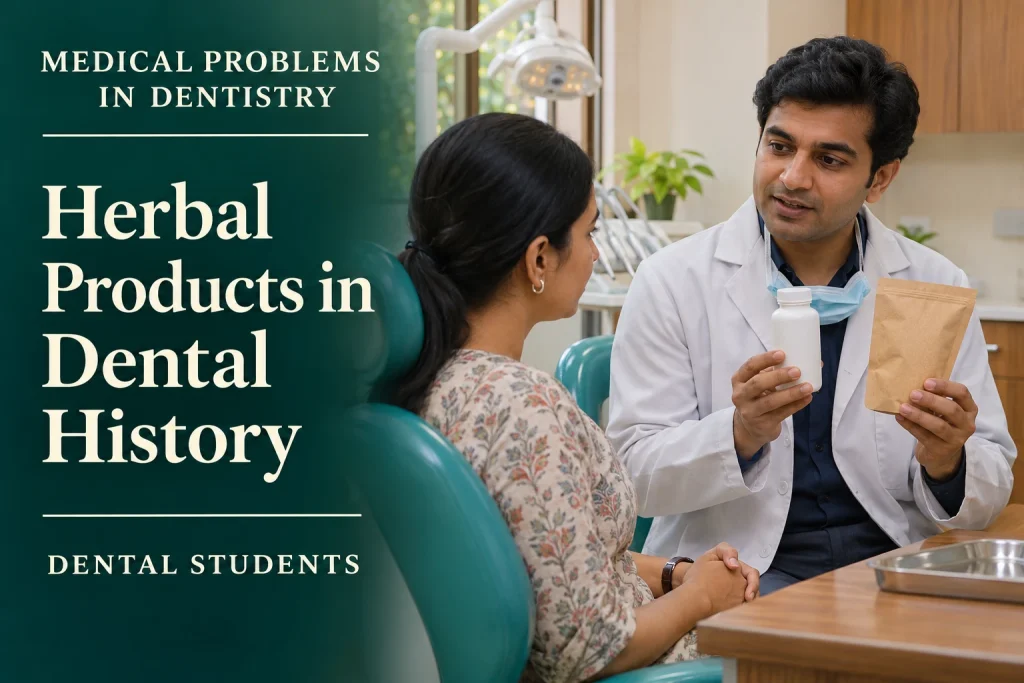
Medical Problems in Dentistry: Article 178 of 215 · Complementary and herbal therapies · Complete student guide
Medical Problems in Dentistry · Student guide
A patient may answer “no medicines” while regularly taking a herbal mixture, a wellness supplement or a traditional preparation. The missing information may be a matter of wording rather than concealment. Dental students need a respectful, specific exposure history and a plan for checking the actual product.
In this guide: Learning objectives · Start with this clinical case · Ask in language the patient uses · Record the exact exposure · Natural origin does not settle safety or effectiveness · Turn a broad label into a usable record · Use a documented interaction to understand the process · Address composition concerns proportionately · Plan changes and follow-up with a reason · Viva and self-check
Learning objectives
- Ask about products that may not be considered medicines by the patient.
- Document formulation, route, amount and timing rather than a broad label.
- Distinguish a documented interaction from an uncertain or theoretical concern.
Start with this clinical case
Fictional teaching case. A patient awaiting a dental procedure reports no medicines except prescriptions. Further conversation reveals a daily herbal mixture, a supplement bought online and a powder applied directly to a sore area. The ingredients are unclear. How should the student clarify the history without dismissing the patient’s choices?
Ask in language the patient uses
Ask about tablets, powders, tonics, teas, drops, oils, mixtures, supplements and products applied inside the mouth. Include preparations from family advice, traditional practitioners, shops and online sellers. Ask what each product is intended to do and whether it replaces or accompanies prescribed treatment.
Explain that the question helps check interactions and treatment decisions. Avoid the assumption that non-disclosure is deliberate. A non-judgemental conversation makes it easier for the patient to bring the package or describe an uncertain exposure accurately.
Record the exact exposure
Document the product name, manufacturer, ingredients as listed, batch details when relevant, route, amount, frequency, duration and last use. Ask about recent starts, stops or formulation changes. A photograph of the packaging, obtained and stored through the appropriate consent process, may help a qualified reviewer identify the product.
A common name such as “herbal tonic” does not establish the contents or dose. Different formulations may share a marketing name. Record unknown information as unknown and identify how it will be clarified rather than inventing a standard formulation.
Natural origin does not settle safety or effectiveness
NCCIH advises assessing supplement safety and interactions, recognising limits in evidence. A natural label does not guarantee benefit, purity or freedom from adverse effects. Conversely, lack of information about one mixture does not prove that every product from a tradition is harmful.[SUPPLEMENTS]
Separate evidence for a claimed dental benefit from evidence about safety in this patient. A marketing claim, testimonial or laboratory finding is not the same as demonstrated clinical effectiveness. Do not import US regulatory rules or survey figures as facts about Indian products.
Turn a broad label into a usable record
| Finding or question | Clinical implication | Student action |
|---|---|---|
| An unnamed mixture | Ingredients and exposure remain uncertain | Ask for packaging or an appropriate product review |
| A product is applied to an oral lesion | Local irritation or delayed diagnosis may be relevant | Examine the lesion and document the application |
| A supplement is taken with transplant medicines | A clinically important interaction may exist | Check the exact ingredients and seek prescribing advice |
| A procedure is planned | The relevance depends on product and patient factors | Use an individual assessment rather than a blanket stop rule |
| A possible adverse effect is suspected | Timing alone does not prove causation | Document, assess and involve the appropriate clinical team |
Use a documented interaction to understand the process
St John’s wort illustrates why this history matters: the official tacrolimus label identifies it as an inducer that can reduce tacrolimus exposure. That is a specific interaction, not a reason to label all herbal products as equivalent.[TACRO]
Identify the actual product and communicate with the transplant team or pharmacist when relevant. Do not tell the patient to compensate by adjusting transplant doses. For other products, state whether evidence is established, limited or theoretical rather than presenting every possible interaction as a confirmed event.
Address composition concerns proportionately
NCCIH’s Ayurvedic safety overview notes that some preparations may contain harmful metals. This should support careful product history and appropriate medical assessment when there is a concern. It does not establish that all Ayurvedic or traditional products are contaminated.[AYURVEDA]
Consider symptoms, product information and other exposures when deciding the need for medical referral. Do not recommend universal heavy-metal testing based only on a tradition’s name. Unknown composition is a reason to clarify and assess, not to make a confident diagnosis.
Plan changes and follow-up with a reason
Do not tell every patient to stop every supplement for an arbitrary number of days. Any procedural recommendation should identify the product, relevant evidence, clinical risk and responsible clinician. Preserve essential prescribed treatment unless the appropriate prescriber makes a coordinated change.
Pregnancy, breastfeeding, significant organ disease or complex prescriptions may require additional expertise. Record advice, unresolved questions and who will follow up. Recheck the history at later visits because wellness products and mixtures may change more often than the patient’s prescription list.[SUPPLEMENTS]
Viva and self-check
Does “no prescribed medicines” exclude relevant products? No. Ask specifically about supplements, mixtures and topical traditional preparations.
Does a traditional label prove contamination or safety? Neither. Assess the actual product and evidence.
Is one arbitrary stop interval appropriate for every herbal product? No. A relevant individual assessment and coordinated plan are needed.
Continue through the series
- Previous: Menopause, Oral Dryness and Bone Health: Assessment Without Overattribution
- Next: Herbal Supplements, Bleeding and Dental Surgery: Evaluating Claims and Interactions
- Browse all 215 student guides by subject
More in Complementary and herbal therapies: Herbal Supplements, Bleeding and Dental Surgery: Evaluating Claims and Interactions · Herb-Drug Interactions With Dental Medicines: A Structured Checking Method · Complementary Therapies for Oral Symptoms: Distinguishing Evidence From Marketing · Communicating About Traditional Remedies Respectfully in Dental Practice
Continue learning
- Structured medical history and examination
- Medical liaison and referral for complex dental patients
- Explain liver disease and dental precautions to a patient
References and scope
Sources checked on 26 November 2026. This is an original student teaching guide. International clinical recommendations are identified by their issuing organisation. Use current local protocols, appropriate supervision and an individual clinical assessment.
- NCCIH: Using Dietary Supplements Wisely
- NCCIH: Ayurvedic Medicine — In Depth
- DailyMed: Tacrolimus capsule — official US prescribing information
Images are AI-generated educational illustrations of fictional people or equipment, not clinical records or diagnostic photographs.

Leave a Reply