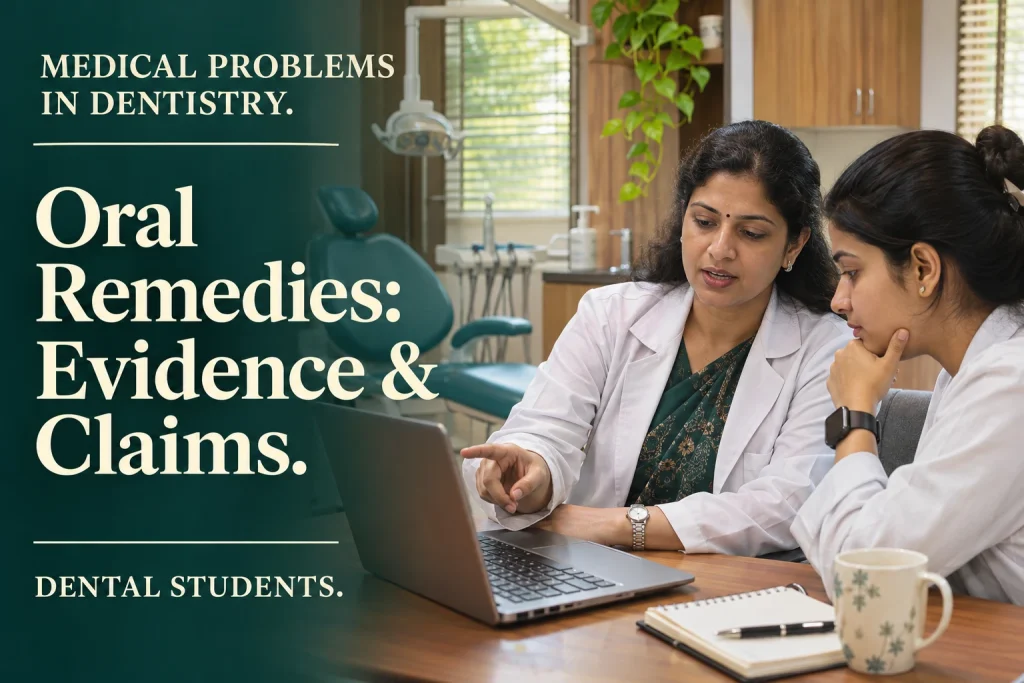
Medical Problems in Dentistry: Article 181 of 215 · Complementary and herbal therapies · Complete student guide
Medical Problems in Dentistry · Student guide
A claim can sound scientific while answering the wrong clinical question. A preparation that changes a laboratory measurement has not necessarily been shown to relieve a patient’s symptoms or prevent disease. Dental students should define the claim, inspect the evidence and explain what remains uncertain before recommending an oral remedy.
In this guide: Learning objectives · Start with this clinical case · Identify the symptom and diagnosis first · Turn the advertisement into an answerable question · Examine outcomes and study design · Match the evidence to the actual claim · Use oil pulling as a worked example · Safety and effectiveness are separate assessments · Give the patient a usable conclusion · Viva and self-check
Learning objectives
- Translate a marketing statement into a precise clinical question.
- Distinguish patient-important outcomes from surrogate measurements.
- Discuss uncertain benefit while preserving diagnosis and effective care.
Start with this clinical case
Fictional teaching case. A patient brings an advertisement claiming that an oil-based routine “detoxifies the mouth, reverses decay and cures gum disease”. A small study on a different preparation reports a change in a bacterial measurement. How should the student assess the advertisement without either endorsing it or ridiculing the patient?
Identify the symptom and diagnosis first
Ask what the patient wants to improve: pain, bleeding, dryness, ulcers, appearance or something else. Examine appropriately and establish the working diagnosis. The same symptom can have different causes, and a remedy discussion should not delay investigation of an unexplained persistent lesion.
A product that claims to soothe discomfort does not thereby treat the cause. A temporary improvement is compatible with continuing disease. Keep the diagnostic and treatment questions separate so the patient understands why a dental assessment still matters even if a home practice feels helpful.
Turn the advertisement into an answerable question
Specify the population, actual preparation, intended use, comparator, outcome and duration. Ask whether the claim concerns an adjunct to normal care or a replacement. “Improves oral health” is too vague to test without defining what improves and how it is measured.
Check whether the marketed product matches the one studied. Differences in ingredients, concentration, route, frequency and accompanying treatment can prevent a study from supporting the advertisement. NCCIH highlights the gap between consumer products and preparations evaluated in research.[WISE]
Examine outcomes and study design
Pain relief, ability to eat, ulcer healing, new caries and meaningful periodontal outcomes answer different questions. A laboratory antimicrobial effect or short-term change in a surrogate does not automatically establish prevention or cure. Statistical significance alone does not establish a worthwhile benefit.
Look for an appropriate comparison, adequate follow-up, participant selection and reporting of harms. Small samples, lack of blinding where feasible, selective outcomes and uncertain formulation can limit confidence. An observational association should not be described as proof that a product caused an improvement.
Match the evidence to the actual claim
| Finding or question | Clinical implication | Student action |
|---|---|---|
| What condition was diagnosed? | Different causes need different treatment | Check the clinical assessment before discussing a remedy |
| Was this exact preparation studied? | Product differences limit transferability | Compare ingredients, concentration and use |
| What outcome improved? | A surrogate is not necessarily a clinical benefit | Identify patient-important outcomes and follow-up |
| What are the harms and opportunity costs? | Delay or replacement of effective care can matter | Assess safety, interaction and lost treatment time |
| What does the evidence justify saying? | Uncertainty should not be disguised as certainty | Give a proportionate conclusion and review plan |
Use oil pulling as a worked example
The ADA’s MouthHealthy page does not recommend oil pulling as a dental hygiene practice because of insufficient reliable evidence for the claimed oral benefits. Attribute that position clearly. Do not turn it into the different claim that no study of any kind has ever investigated an oil-based practice.[OIL]
A patient asking about oil pulling still needs advice about the actual disease and routine preventive care. A broad marketing claim that it reverses established decay or replaces periodontal treatment requires evidence for those outcomes; a favourable result on an unrelated measurement does not supply it.
Safety and effectiveness are separate assessments
Even convincing evidence of benefit would not remove the need to assess adverse effects, product composition, interactions and patient suitability. Likewise, a product that seems well tolerated has not necessarily been shown to work. Avoid using “natural”, “ancient” or “clinically tested” as a complete argument.
Consider the harm of delayed diagnosis or abandoning effective care. A persistent ulcer treated repeatedly with a soothing mixture may still require referral. The decision should include the time, cost and practical burden of the proposed practice, not only its advertised ingredients.
Give the patient a usable conclusion
State what is supported, what is uncertain and which part of the advertisement goes beyond the evidence. Explain the recommended dental care and agree what will be reviewed. Avoid promising benefit or dismissing personal experience; symptoms can change for several reasons.
For a student journal discussion, conclude with the exact claim the evidence can answer. A clear limited statement is better than calling a whole tradition proven or disproven. If new evidence is cited, assess its methods and applicability rather than accepting the headline.
Viva and self-check
Does a laboratory antimicrobial effect prove that a product prevents caries? No. Clinical outcomes require relevant clinical evidence.
Does “clinically tested” establish effectiveness? No. The study design, preparation, comparator and outcomes matter.
Can symptom relief remove the need to investigate a persistent lesion? No. The underlying diagnosis still requires assessment.
Continue through the series
- Previous: Herb-Drug Interactions With Dental Medicines: A Structured Checking Method
- Next: Communicating About Traditional Remedies Respectfully in Dental Practice
- Browse all 215 student guides by subject
More in Complementary and herbal therapies: Herbal and Traditional Medicines in Dental History: Asking About Hidden Exposures · Herbal Supplements, Bleeding and Dental Surgery: Evaluating Claims and Interactions · Herb-Drug Interactions With Dental Medicines: A Structured Checking Method · Communicating About Traditional Remedies Respectfully in Dental Practice
Continue learning
- Oral cancer warning signs: biopsy and referral
- Structured medical history and examination
- Informed consent in an Indian dental practice
References and scope
Sources checked on 26 November 2026. This is an original student teaching guide. International clinical recommendations are identified by their issuing organisation. Use current local protocols, appropriate supervision and an individual clinical assessment.
Images are AI-generated educational illustrations of fictional people or equipment, not clinical records or diagnostic photographs.

Leave a Reply