Medical Problems in Dentistry: Article 184 of 215 · Dietary factors, health and disease · Complete student guide
Medical Problems in Dentistry · Student guide
A dental visit can reveal that a person is eating much less than usual. Oral pain, poorly tolerated dentures or swallowing concerns may contribute, while systemic illness and social barriers may also be involved. Students should recognise nutritional risk without diagnosing it from appearance or treating a new denture as the whole solution.
In this guide: Learning objectives · Start with this clinical case · Ask about change rather than judging body shape · Look for dental barriers that can be treated · Distinguish chewing difficulty from swallowing difficulty · Use the history to determine urgency · Consider illness, medicines and practical barriers · Refer with a clear question and useful facts · Keep responsibility for the dental part of care · Viva and self-check
Learning objectives
- Ask about weight change, intake and the reasons eating has become difficult.
- Distinguish dental barriers from swallowing and systemic concerns.
- Communicate a focused referral and maintain dental follow-up.
Start with this clinical case
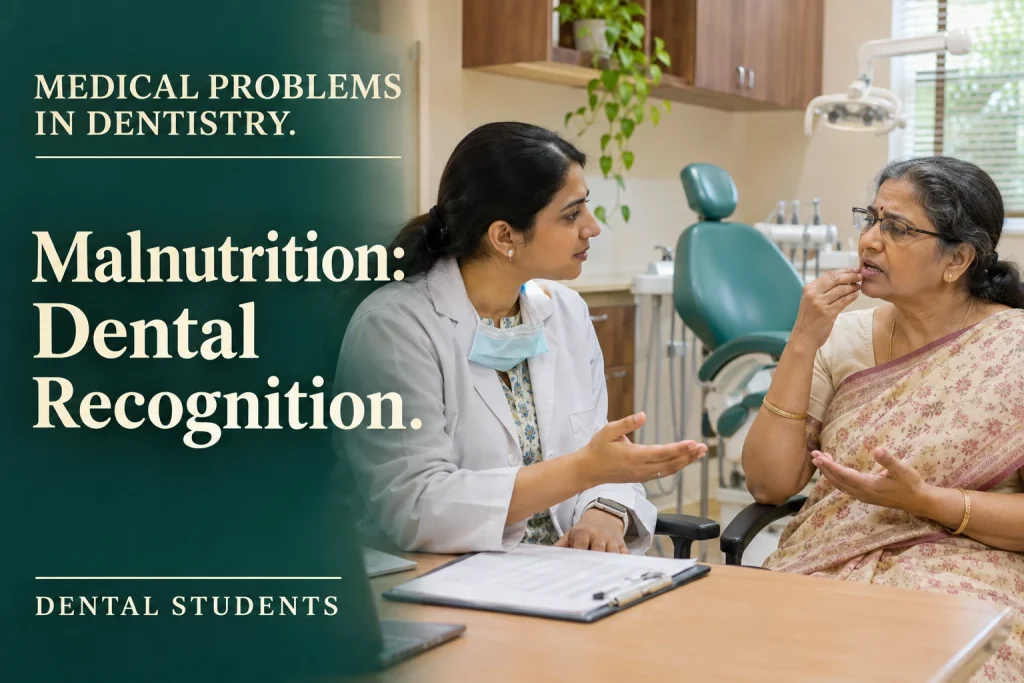
Fictional teaching case. An older patient asks for a denture adjustment. They mention loose clothing and living mostly on tea because eating is uncomfortable. The student plans only to smooth the denture. What information would show whether a wider assessment is required?
Ask about change rather than judging body shape
Explore unintentional weight change, appetite, usual intake and how long the change has lasted. Use reliable previous measurements where available and record uncertainty. A visual impression or one weight does not describe the trajectory or establish nutritional status.
Do not assume a person with a larger body size cannot be at nutritional risk, or that a thin person necessarily has the same problem. The history should identify what has changed, its functional effect and what support is needed. Screening is a prompt for assessment, not a complete diagnosis.
Look for dental barriers that can be treated
Assess pain, infection, denture fit, missing functional contacts, oral dryness, mucosal disease and restricted opening. Ask which textures or foods are difficult and whether the patient avoids eating because of anticipated pain. Treating an oral cause can help but does not exclude a concurrent medical problem.
Record the actual effect on meals, not just a dental finding. A small ulcer or sore denture area may substantially change intake for one patient. The proposed dental intervention should have a review that checks whether eating improves, rather than assuming success when a procedure is completed.
Distinguish chewing difficulty from swallowing difficulty
Ask whether the problem is biting or chewing, initiating a swallow, food sticking, coughing during intake or another experience. New or progressive swallowing difficulty requires appropriate assessment. Do not conduct an informal feeding trial or recommend a universal texture solely because food looks soft.
NICE CG32 identifies impaired swallowing and reduced intake among concerns relevant to nutrition assessment. Direct guideline pages were unavailable during this review; the relevant official indexed recommendations were checked. This guide uses those screening principles, not a complete feeding or dysphagia protocol.[NUTRISK]
Use the history to determine urgency
| Finding or question | Clinical implication | Student action |
|---|---|---|
| Unintentional weight loss or sustained reduced intake | A broader nutritional assessment may be needed | Document the trend and arrange appropriate referral |
| Pain or an ill-fitting denture prevents eating | A treatable oral barrier may contribute | Provide indicated dental care and reassess function |
| Progressive swallowing difficulty | Dental chewing advice may be insufficient | Arrange medical and swallowing assessment |
| Unable to maintain fluids or acutely unwell | The situation may require urgent care | Escalate promptly according to the clinical findings |
| Very limited intake for a prolonged period | Restarting nutrition may require monitored care | Seek skilled medical/dietetic assessment rather than an aggressive home feeding plan |
Consider illness, medicines and practical barriers
Ask about current diagnoses, recent treatment, nausea, altered taste, gastrointestinal symptoms and relevant medicines. Cancer and its treatments can affect intake through several pathways. A patient’s difficulty should not be attributed to poor motivation when pain, fatigue or systemic illness may be central.[NCI]
Explore food access, preparation, finances, isolation, manual ability and support without assuming the answer from age or housing status. Ask what the patient can obtain and prepare. A theoretically ideal diet is not a workable plan if the foods or assistance are unavailable.
Refer with a clear question and useful facts
Send the relevant clinician or dietitian the history of intake and weight change, oral findings, symptoms affecting eating, treatment provided and remaining concerns. State the urgency and the question requiring assessment. Avoid a vague note saying only “needs vitamins”.
Prolonged very low intake can raise concern about refeeding complications when nutrition is increased. NICE recommends expert care for people at high risk. Do not prescribe a rapid high-calorie correction, electrolyte regimen or supplement schedule from this student summary.[NUTRISK]
Keep responsibility for the dental part of care
Arrange review of the oral barrier and ask whether the patient reached the referred service. With appropriate consent, coordinate care so nutrition and dental goals support each other. Do not stop necessary nutrition support simply because a product contains sugar; adapt oral prevention alongside the broader plan.
A good referral does not end the dentist’s role. Track pain, oral function and the patient’s ability to follow advice. In a case presentation, distinguish the screening concern, possible contributors, immediate needs and named next steps rather than declaring malnutrition from a photograph or one oral sign.
Viva and self-check
Can nutritional risk be excluded by a larger body size? No. Intake, weight trajectory and clinical assessment matter.
Does correcting a denture prove the wider problem is solved? No. Reassess eating and investigate persistent or systemic concerns.
Should prolonged very low intake be corrected with an aggressive unsupervised feeding plan? No. Skilled assessment may be needed because of refeeding risk.
Continue through the series
- Previous: Diet History for Dental Students: Free Sugars, Acids, Frequency and Practical Advice
- Next: Vitamin and Mineral Deficiencies: Glossitis, Ulceration, Bleeding and Diagnostic Limits
- Browse all 215 student guides by subject
More in Dietary factors, health and disease: Diet History for Dental Students: Free Sugars, Acids, Frequency and Practical Advice · Vitamin and Mineral Deficiencies: Glossitis, Ulceration, Bleeding and Diagnostic Limits · Nutrition After Dental Surgery and During Cancer Care: Maintaining Safe Intake · Dietary Supplements and Oral Health: When Evidence Supports a Recommendation
Continue learning
- Structured medical history and examination
- Medical liaison and referral for complex dental patients
- Explain Sjögren disease and dry mouth to a patient
References and scope
Sources checked on 26 November 2026. This is an original student teaching guide. International clinical recommendations are identified by their issuing organisation. Use current local protocols, appropriate supervision and an individual clinical assessment.
- NICE CG32: Nutrition Support for Adults — Recommendations
- NCI: Nutrition in Cancer Care — Health Professional PDQ
Images are AI-generated educational illustrations of fictional people or equipment, not clinical records or diagnostic photographs.

Leave a Reply