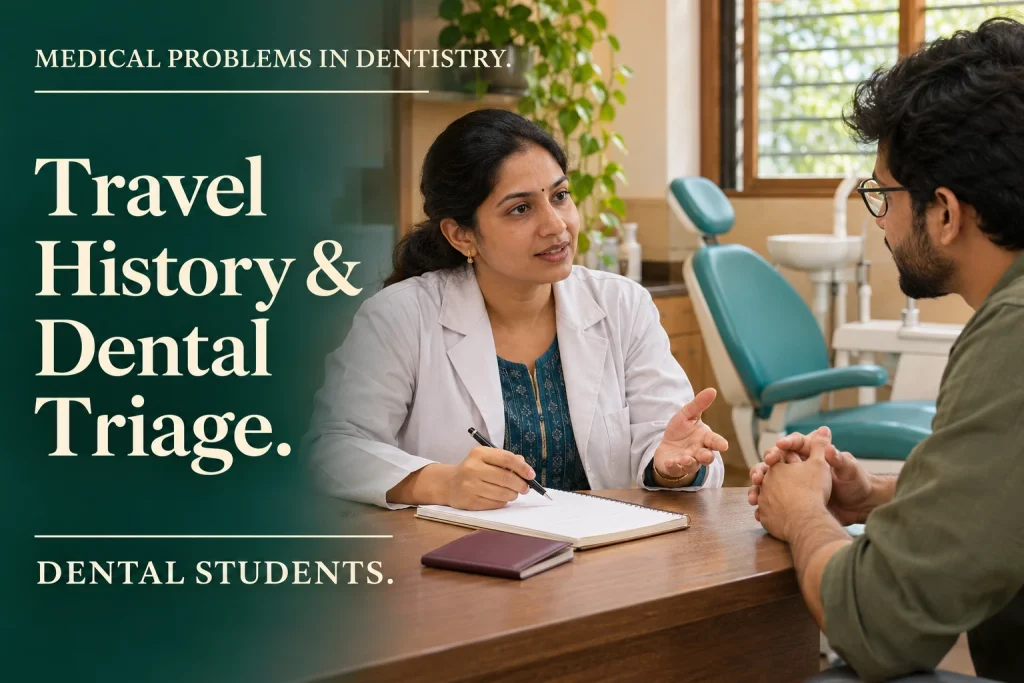
Medical Problems in Dentistry: Article 194 of 215 · Travel, sport and leisure · Complete student guide
Medical Problems in Dentistry · Student guide
Recent travel becomes relevant when it helps explain symptoms or changes the safety of care. The useful history describes places, dates, exposures and the illness timeline. Nationality or a country name alone does not establish infection risk. A dental appointment may be the first opportunity to recognise that an unwell traveller needs medical assessment.
In this guide: Learning objectives · Start with this clinical case · Start with illness severity · Build a place-and-time history · Fever after travel needs an independent explanation · Make referral information usable · Infection control and resuming dental care · Viva and self-check
Learning objectives
- Ask focused travel questions without stereotyping patients.
- Recognise fever and systemic illness that require medical referral.
- Communicate relevant findings while maintaining appropriate infection control.
Start with this clinical case
Fictional teaching case. An adult attends for tooth discomfort after returning from a trip. During history-taking they mention recent fever and chills, but they feel cooler today after taking a medicine. Do not assume the tooth explains the systemic illness. Establish the travel timeline, current condition and need for medical assessment before routine treatment.
Start with illness severity
Assess the patient’s current condition before taking a lengthy itinerary. Marked deterioration, confusion, breathing difficulty, significant bleeding or other signs of acute instability require an appropriate urgent response. A routine dental examination should not delay necessary medical care. Follow the clinic’s emergency arrangements and obtain help within your competence.
The CDC Yellow Book emphasises that post-travel assessment combines severity, timing and exposure. A patient may not be febrile at the moment of examination despite a history of fever. Antipyretic use or intermittent symptoms can complicate a single temperature reading. Do not offer reassurance solely because a waiting-room measurement is normal.[TRAVEL]
Build a place-and-time history
Ask where the person travelled, including regions within a country, rural or urban settings, dates and stopovers where relevant. Record when symptoms started relative to travel and return, and whether they have changed. Domestic travel within India can also provide relevant exposures; an international border is not the defining feature of a useful travel history.
Ask proportionately about mosquito or other insect exposure, food and water, freshwater contact, animal contact, sick contacts and healthcare received elsewhere. Include medicines, vaccinations and any prophylaxis, together with adherence when relevant. Ask sensitive questions privately and explain their clinical purpose. Do not collect an indiscriminate checklist without connecting it to the presentation.
Travel-associated illness is broader than infections. Existing disease, medication changes, disrupted routines and treatment obtained away from home may also matter. Record the actual exposure and timing rather than using occupation, language or ethnicity as substitutes for evidence.
Fever after travel needs an independent explanation
CDC guidance identifies malaria as an important consideration in a febrile person who has visited an endemic area. Relevant fever warrants urgent medical assessment, including when the patient is currently afebrile. Taking malaria prophylaxis does not exclude malaria. Risk varies within and between countries; consult current specialist information rather than assuming every destination has the same risk.[TRAVEL]
The dental student’s role is recognition, escalation and useful communication, not empirical antimalarial treatment or a self-devised testing schedule. A dental infection may coexist with another illness. Conversely, facial or oral discomfort may not be odontogenic. Establish what the examination actually supports before attributing all symptoms to the tooth or prescribing an antibiotic.
Make referral information usable
| Finding or question | Clinical implication | Student action |
|---|---|---|
| Travel dates and specific regions | Helps clinicians interpret exposure and incubation | Record a clear timeline rather than “recent foreign travel” |
| Fever or chills, even if absent now | Potentially important systemic illness | Arrange appropriate prompt medical assessment |
| Prophylaxis or vaccination | May modify risk but does not exclude every illness | List the actual product and relevant history |
| Dental findings and medicines already taken | Prevents unsupported attribution to dental infection | Communicate findings, uncertainties and treatment given |
State why the referral is urgent and how the patient will access care. Include observed condition, symptom onset, relevant itinerary and dental findings. If you speak to another clinician, record their name, advice and the agreed responsibility for follow-up. A generic note saying “please clear for dentistry” fails to communicate the problem.
Infection control and resuming dental care
Use the clinic’s standard infection-prevention programme for every patient. Where the presentation suggests a transmissible condition needing additional measures, obtain appropriate advice and follow local pathways. Avoid exposing staff or other patients through unnecessary movement or routine procedures while the assessment is unresolved. Do not improvise isolation or reporting rules from a foreign guideline.
Explain the decision without stigmatising travel or identity: the concern is the patient’s symptoms and specific exposure. Arrange continuity for urgent dental needs, including how the dental and medical teams will communicate. Deferral should have a reason and a review plan rather than become indefinite exclusion.
For Indian practice, the CDC Yellow Book is an international clinical reference, not Indian reporting law. Use current local public-health and institutional arrangements. This guide does not claim an active outbreak at any destination, list country-wide clearance rules or provide infection-specific treatment. In the teaching case, the fever history requires attention in its own right while the tooth complaint is assessed on its findings.
Viva and self-check
Can malaria be excluded because prophylaxis was taken? No. A relevant travel and fever history still needs appropriate medical assessment.
Is nationality an adequate exposure history? No. Ask about actual places, timing and exposures.
Does a dental infection explain every fever after travel? No. Coexisting or alternative systemic illness must be considered.
Continue through the series
- Previous: Barodontalgia and Dental Barotrauma: Flying, Diving and Pressure-Related Pain
- Next: Scuba Diving and Dental Fitness: Restorations, Pain and Specialist Advice
- Browse all 215 student guides by subject
More in Travel, sport and leisure: Sports Dentistry: Risk Assessment, Mouthguards and Injury Prevention · Barodontalgia and Dental Barotrauma: Flying, Diving and Pressure-Related Pain · Scuba Diving and Dental Fitness: Restorations, Pain and Specialist Advice · Exercise, Supplements and Sports Drinks: Oral Health Questions for Dental Students
Continue learning
- Structured medical history and examination
- Infection-control programme for an Indian dental clinic
- Dental clinic medical emergency readiness
References and scope
Sources checked on 26 November 2026. This is an original student teaching guide. International clinical recommendations are identified by their issuing organisation. Use current local protocols, appropriate supervision and an individual clinical assessment.
Images are AI-generated educational illustrations of fictional people or equipment, not clinical records or diagnostic photographs.

Leave a Reply