Medical Problems in Dentistry: Article 192 of 215 · Travel, sport and leisure · Complete student guide
Medical Problems in Dentistry · Student guide
Sports dentistry begins before an injury. The dental team can identify individual risk, help an athlete choose an appropriate mouthguard and arrange review as the mouth or sport changes. Protection depends on actual use and fit; owning an expensive appliance does not protect teeth when it stays in a kit bag.
In this guide: Learning objectives · Start with this clinical case · Risk assessment is more than naming a contact sport · What mouthguards can and cannot promise · Compare options using fit and use · A practical student consultation · Care, review and emergency preparation · Viva and self-check
Learning objectives
- Take a sport-specific dental injury history.
- Discuss mouthguard options and the limits of protective claims.
- Build a practical fitting, use and review conversation.
Start with this clinical case
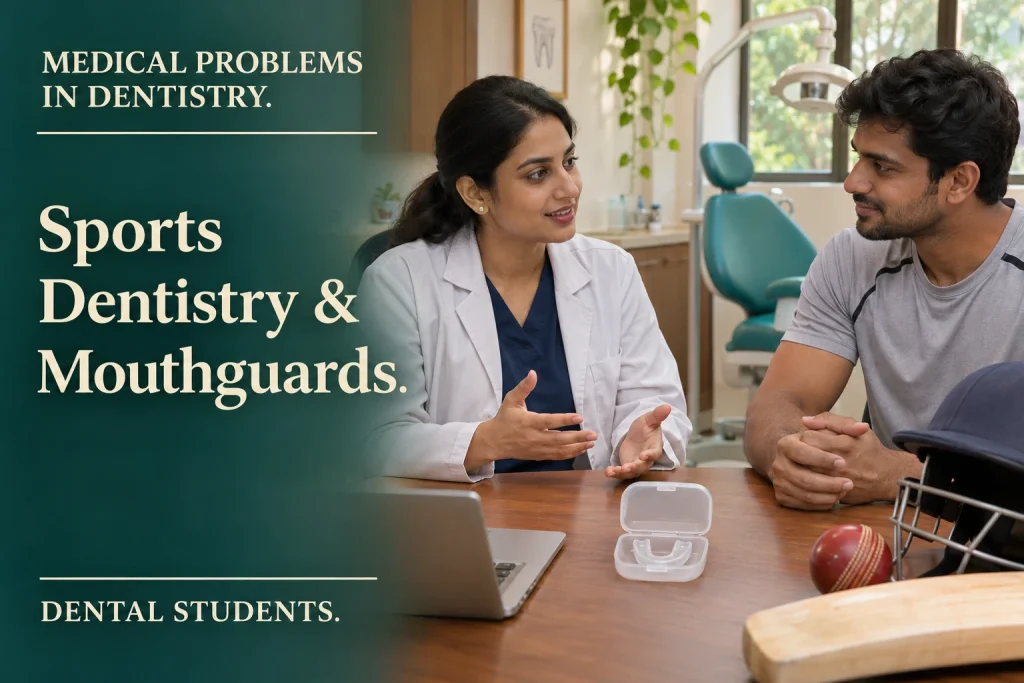
Fictional teaching case. A college student plays cricket and recreational basketball. They own a loose shop-bought mouthguard but remove it because speaking and breathing feel awkward. They are starting orthodontic treatment. Ask about both sports, previous trauma and why the guard is not being worn before recommending a replacement.
Risk assessment is more than naming a contact sport
Ask about the sport, playing position, level, frequency, practice as well as competition, and exposure to balls, sticks, falls or collisions. Non-contact activities can still involve dental trauma. Review previous injuries, existing restorations, tooth position, missing teeth, orthodontic appliances and any symptoms. Consider access to emergency dental care during events or travel.
Listen for practical barriers: a guard may feel bulky, unstable, painful or difficult to clean. Cost, availability and embarrassment can affect use. Ask the athlete to describe when they remove it. A realistic solution should address these barriers without implying that discomfort must simply be tolerated. Growth and active orthodontic treatment mean fit may change.
What mouthguards can and cannot promise
The ADA supports mouthguards as a way to reduce sports-related dental and orofacial injury risk. No appliance makes participation injury-free. Protection must be discussed alongside sport-specific safety equipment, safe participation and an appropriate response if an injury occurs. Do not promise that a mouthguard guarantees protection for every type of impact.[MOUTHGUARD]
Claims about concussion prevention require particular care. Evidence is mixed, and a mouthguard is not a substitute for concussion assessment or return-to-play decisions by the appropriate team. A dental student should not clear a player with possible head injury merely because the teeth appear intact or the guard looks undamaged.
Compare options using fit and use
Stock, mouth-formed and custom-made appliances differ in adaptation, comfort, retention, cost and the professional input involved. Discuss these differences without assuming every product in a category performs identically. A custom-made device still needs careful assessment and review; the label alone does not establish successful fit or continued suitability.
Professional assessment should consider retention, coverage, comfort and function for the individual. An athlete who cannot comfortably retain a device may stop wearing it. Existing orthodontic appliances, erupting teeth and changes in restorations can require a different approach. Coordinate with the treating orthodontist where needed rather than adapting around brackets without a plan.
A practical student consultation
| Finding or question | Clinical implication | Student action |
|---|---|---|
| Guard removed during practice | Real-world protection is absent during those periods | Explore comfort, communication and fit barriers |
| Previous dental trauma or extensive restorations | Individual consequences of further injury may be significant | Document baseline findings and discuss suitable protection |
| Growth or orthodontic changes | A previously acceptable fit may no longer be suitable | Arrange reassessment with the responsible dental team |
| Possible concussion or serious associated injury | Dental appearance does not exclude head injury | Follow the appropriate urgent assessment pathway |
Explain the agreed appliance choice, what will be assessed at fitting and when review is needed. Have the athlete explain their use plan for both practice and matches. Where a parent, coach or team organiser is involved, include them appropriately while respecting the athlete’s preferences and consent.
Care, review and emergency preparation
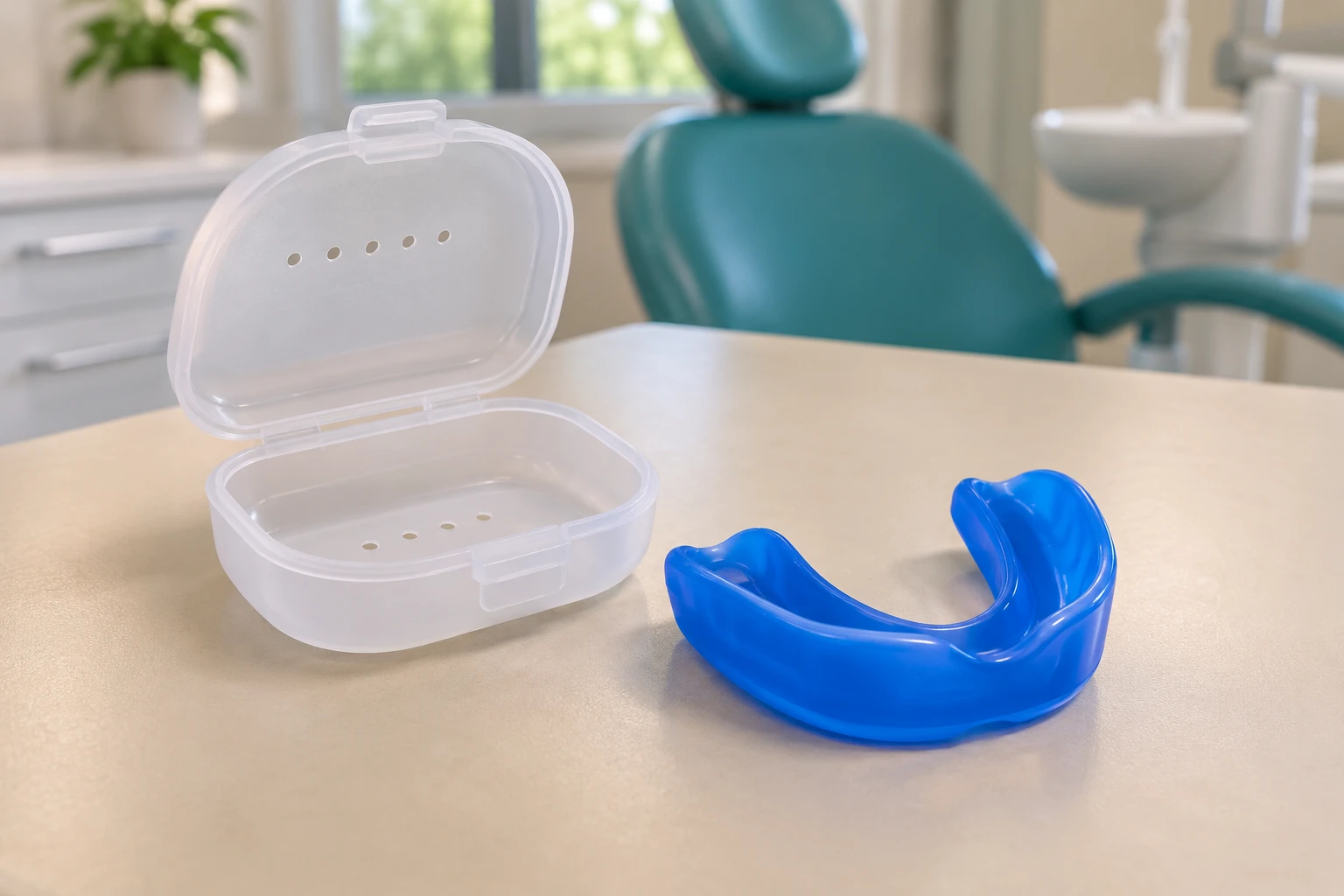
Give product-specific care and storage advice and check the athlete can follow it. Inspect for wear, tears, distortion and changes in fit at review. The accompanying illustration shows a generic mouthguard and case; it does not demonstrate adequate thickness, a validated protective design, correct fit or a fabrication technique. Do not use an image as a clinical specification.
Athletes and teams also need a clear route to urgent assessment after injury. Establish who will seek help, how transport and communication will work and where dental care is available. A prevention appointment can identify gaps in the team’s emergency arrangements. Detailed trauma management requires appropriate training and condition-specific guidance beyond this mouthguard overview.
In the teaching case, discomfort and orthodontic change are central to the plan. Recommending a new device without assessing those issues may repeat the same failure. Document the discussion, baseline examination, chosen option, fitting outcome and review arrangements. For Indian colleges and sports clubs, check the relevant sport or event’s actual equipment rules rather than importing requirements from American organisations.
Viva and self-check
Does a custom-made mouthguard eliminate injury risk? No. Fit, use and the nature of the injury still matter.
Should a guard be worn only in matches? Discuss risk during practice too; exposure is not confined to competition.
Can an intact guard rule out concussion? No. Concussion assessment and return-to-play decisions require the appropriate clinical pathway.
Continue through the series
- Previous: Analgesic Selection in Medically Complex Patients: Contraindications, Interactions and Limits
- Next: Barodontalgia and Dental Barotrauma: Flying, Diving and Pressure-Related Pain
- Browse all 215 student guides by subject
More in Travel, sport and leisure: Barodontalgia and Dental Barotrauma: Flying, Diving and Pressure-Related Pain · Travel-Related Illness in Dental History: Exposure, Fever and Referral · Scuba Diving and Dental Fitness: Restorations, Pain and Specialist Advice · Exercise, Supplements and Sports Drinks: Oral Health Questions for Dental Students
Continue learning
- Structured medical history and examination
- Dental clinic medical emergency readiness
- Informed consent in an Indian dental practice
References and scope
Sources checked on 26 November 2026. This is an original student teaching guide. International clinical recommendations are identified by their issuing organisation. Use current local protocols, appropriate supervision and an individual clinical assessment.
Images are AI-generated educational illustrations of fictional people or equipment, not clinical records or diagnostic photographs.

Leave a Reply