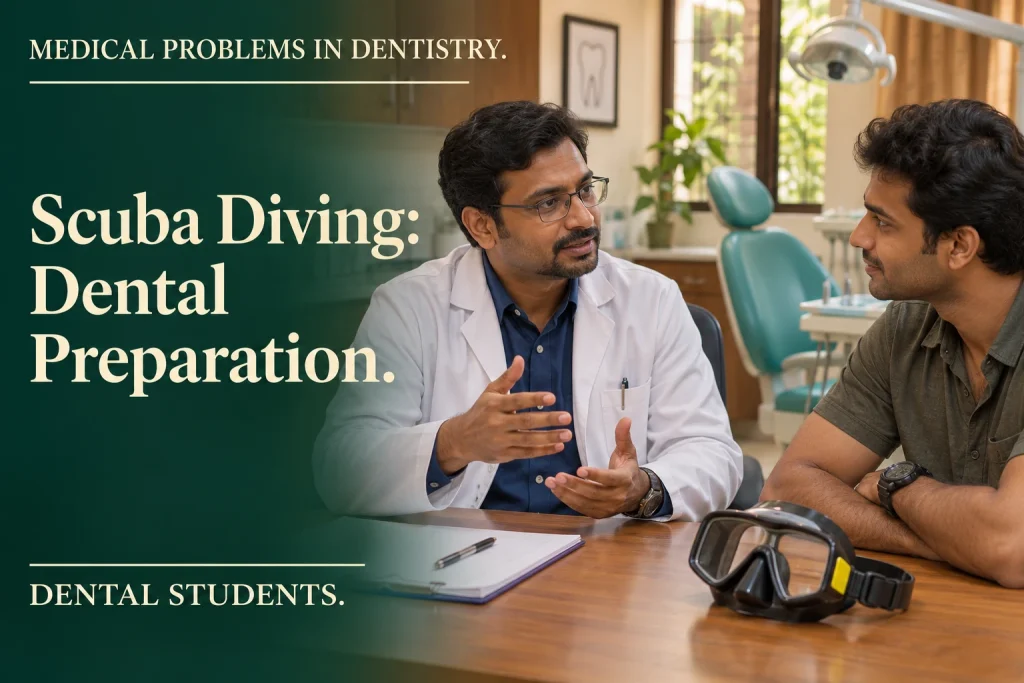
Medical Problems in Dentistry: Article 195 of 215 · Travel, sport and leisure · Complete student guide
Medical Problems in Dentistry · Student guide
A pre-diving dental consultation is an opportunity to identify unresolved oral disease and treatment-related concerns before a person is far from care or underwater. It is not a whole-person certificate of fitness to dive. Dental findings, procedure recovery, medicines and the person’s wider medical status may require different clinicians to contribute.
In this guide: Learning objectives · Start with this clinical case · Begin before an imminent departure if possible · Examine the mouth and treatment status · Surgery, implants and recovery · Organise the assessment into separate questions · Medicines, communication and follow-up · Viva and self-check
Learning objectives
- Identify dental questions relevant before scuba diving.
- Distinguish dental assessment from overall diving medical fitness.
- Explain why healing and return-to-diving advice must be individual.
Start with this clinical case
Fictional teaching case. A person planning a diving trip has an implant-related appointment, a temporary restoration elsewhere and occasional jaw discomfort when biting. They ask for one letter saying they can dive. Clarify the symptoms, treatment stage and planned activity; a single generic clearance statement would conceal several separate questions.
Begin before an imminent departure if possible
Ask about planned dates, diving experience, location, access to dental and medical care and previous pressure-related pain. Record current symptoms, recent treatment and unfinished work. The purpose is to identify issues early enough for assessment and recovery, rather than offer last-minute reassurance that cannot be supported.
Divers Alert Network discusses the importance of addressing caries, defective restorations and pain that could interfere with diving. Its educational examples explain why symptoms and restoration quality matter. They do not support replacing every older filling or assuming all restored teeth are unsuitable for diving.[DANCASE][DANQA]
Examine the mouth and treatment status
Assess relevant teeth, restorations, periodontal tissues and the status of ongoing endodontic or surgical care. Investigate symptoms in the ordinary clinical way rather than diagnosing from the patient’s diving plans. A temporary restoration, unresolved pain or an uncertain seal needs a clear treatment and review plan; a visual inspection alone may not resolve the question.
Ask about removable prostheses, loose components and comfort when the jaw is held in the position required for a regulator mouthpiece. Biting and clenching can be relevant to discomfort. The dental team may assess oral factors and coordinate advice, but students should not provide equipment modifications or underwater trials outside their competence.[DANQA]
A photograph of a mask or regulator cannot establish safe fit or function. Do not use a test dive to diagnose a painful tooth or prove that a restoration is satisfactory. Equipment-related concerns should be discussed with appropriately trained diving professionals alongside the clinical assessment.
Surgery, implants and recovery
Recent extraction, implant surgery, bone grafting or sinus-related procedures raise questions about healing, symptoms, complications and the planned activity. Obtain the treating surgeon’s advice where appropriate. A healed, restored implant is not automatically a lifelong prohibition on diving, but the presence of an implant also does not guarantee that every stage of treatment is compatible with an imminent trip.[DANIMPLANT]
DAN Europe’s implant article is an older educational discussion from 2009. Its useful themes include healing and communication with the surgeon. Historical time intervals should not be copied as a universal current return-to-diving calendar. Procedure extent, sinus involvement, recovery, medicines and individual medical factors can differ substantially.
Organise the assessment into separate questions
| Finding or question | Clinical implication | Student action |
|---|---|---|
| Unresolved pain or defective restoration | A problem may become difficult to manage underwater or remotely | Investigate, treat as indicated and review |
| Recent surgery or grafting | Healing and complications need individual consideration | Seek treating surgeon advice on the actual procedure |
| Prosthesis or jaw discomfort with mouthpiece use | Oral comfort and stability may affect use | Assess dental factors; liaise with trained diving professionals |
| Systemic disease or medicines affecting fitness | Dental findings alone cannot settle whole-person fitness | Refer to a clinician experienced in diving medicine |
Document what was assessed and what remains outside the dental opinion. If a letter is required, describe relevant findings, treatment status, recovery concerns and any advice sought. Avoid an unrestricted “fit to dive” conclusion when only a dental examination has taken place.
Medicines, communication and follow-up
Ask about prescribed and non-prescription medicines, why they are being taken and any adverse effects. Sedation, impaired alertness or the underlying illness may be relevant to diving decisions. A medicine being legally prescribed does not itself establish diving suitability. Do not tell a patient to stop an essential treatment to make a trip possible; seek appropriate medical advice.[DANQA]
Explain the agreed sequence: investigation, any necessary treatment, review of healing and liaison about unresolved fitness questions. The person should know whom to contact if pain, swelling or another problem occurs before departure. Remoteness and limited care access make a clear plan especially valuable, but they do not justify speculative treatment of healthy teeth.
In the teaching case, the temporary restoration, bite-related symptoms and implant treatment stage each need assessment. Coordinate the information rather than compressing it into one unsupported assurance. This article focuses on preparation and responsibility. Assessment of an actual pressure-pain episode requires a symptom history and differential diagnosis, and overall diving fitness requires expertise beyond dentistry.
Viva and self-check
Does a satisfactory dental examination establish complete fitness to dive? No. Systemic disease and diving-specific medical issues may require a separate assessment.
Is there one waiting period after every dental procedure? No. Recovery advice depends on the actual procedure and individual circumstances.
Should every restored tooth be replaced before diving? No. Clinical findings and treatment need should determine intervention.
Continue through the series
- Previous: Travel-Related Illness in Dental History: Exposure, Fever and Referral
- Next: Exercise, Supplements and Sports Drinks: Oral Health Questions for Dental Students
- Browse all 215 student guides by subject
More in Travel, sport and leisure: Sports Dentistry: Risk Assessment, Mouthguards and Injury Prevention · Barodontalgia and Dental Barotrauma: Flying, Diving and Pressure-Related Pain · Travel-Related Illness in Dental History: Exposure, Fever and Referral · Exercise, Supplements and Sports Drinks: Oral Health Questions for Dental Students
Continue learning
- Structured medical history and examination
- Medical liaison and referral for complex dental patients
- Informed consent in an Indian dental practice
References and scope
Sources checked on 26 November 2026. This is an original student teaching guide. International clinical recommendations are identified by their issuing organisation. Use current local protocols, appropriate supervision and an individual clinical assessment.
- Divers Alert Network: Diver Loses Five Fillings on One Dive
- Divers Alert Network: Cardiovascular Disease and Diving — Dental and Medicines Q&A
- DAN Europe: Scuba Diving and Dental Implants (2009)
Images are AI-generated educational illustrations of fictional people or equipment, not clinical records or diagnostic photographs.

Leave a Reply