Medical Problems in Dentistry: Article 193 of 215 · Travel, sport and leisure · Complete student guide
Medical Problems in Dentistry · Student guide
Barodontalgia describes dental pain associated with changes in ambient pressure. Dental barotrauma refers to pressure-related tissue or restoration injury. The terms describe a problem in a particular setting; they do not identify the tooth, underlying disease or treatment. A symptom-free patient on the ground may still need investigation after an episode.
In this guide: Learning objectives · Start with this clinical case · Why pressure is relevant without being the whole explanation · Take a reproducible account of the episode · Investigate dental and non-dental explanations · Separate the observation from the decision · Advice after the episode · Viva and self-check
Learning objectives
- Distinguish pressure-related pain from a definitive diagnosis.
- Take a focused flying or diving symptom history.
- Avoid unsupported treatment and clearance assumptions.
Start with this clinical case
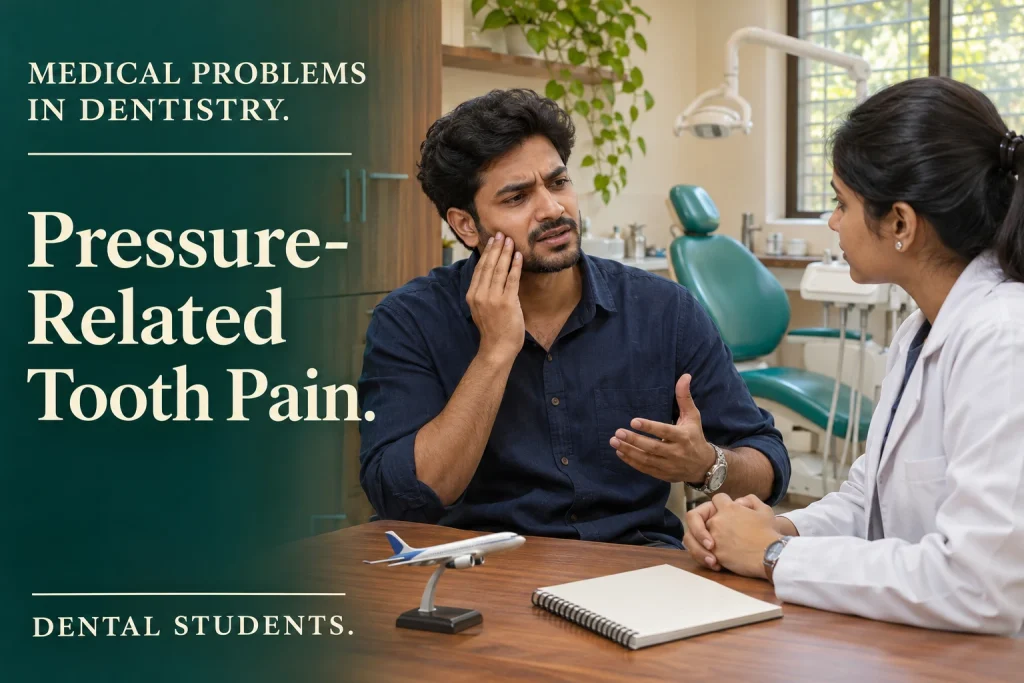
Fictional teaching case. A patient reports severe upper-jaw pain during a recent flight, which settled after landing. A friend says it must be trapped air under an old filling. The patient wants the filling replaced immediately before a diving holiday. Assess the episode and investigate possible causes before deciding whether the restoration is responsible.
Why pressure is relevant without being the whole explanation
Changes in pressure can contribute to pain or problems involving teeth and restorations. Divers Alert Network describes dental cases in which underlying restoration defects were important. Such case reports illustrate a possible mechanism and consequence; they do not show that all fillings contain dangerous air pockets or that every painful tooth will fracture.[DANCASE]
Pre-existing caries, pulpal or periapical disease and defective restorations may be relevant to assessment. The pressure change may expose an existing problem rather than create an entirely new disease in a previously healthy tooth. Avoid sensational descriptions of teeth “exploding,” which can obscure the need for ordinary, careful dental diagnosis.
Take a reproducible account of the episode
Ask whether the event involved commercial flying, another aviation setting or diving. Record when pain began, its location, character, duration and whether it persisted afterwards. For diving, obtain the relevant account in the patient’s own words without turning the dental interview into a technical dive investigation. Ask about similar episodes and any associated symptoms.
Explore recent restorations, endodontic treatment, extractions, trauma, sinus symptoms, pain on biting and sensitivity outside pressure exposure. Establish whether the patient can identify a tooth or only a region. Ask what they did, whether a restoration was lost and whether another clinician assessed them. Retain relevant treatment records and photographs when available.
Timing during ascent or descent is a clue to record, not a sufficiently reliable rule for assigning a specific pulpal diagnosis. “Pain during ascent equals this disease” is an unsafe examination shortcut. An apparently clear history still needs correlation with clinical findings.
Investigate dental and non-dental explanations
Perform a full relevant examination with appropriate supervision. Assess restorations, caries, cracks, periodontal findings and the suspected tooth’s pulpal and periapical status. Use indicated tests and imaging in context; neither a single sensibility response nor an isolated radiographic finding should be interpreted without the rest of the examination.
Referred pain or sinonasal disease may need consideration, particularly where localisation is uncertain or several upper teeth seem involved. Refer through an appropriate pathway if the findings suggest a non-dental cause or the diagnosis remains unclear. Do not perform empirical root-canal treatment simply because pain occurred under pressure.
Separate the observation from the decision
| Finding or question | Clinical implication | Student action |
|---|---|---|
| Pain disappeared after landing | Resolution does not identify or exclude underlying disease | Examine and investigate the episode |
| Pain occurred during ascent or descent | Timing is not a stand-alone pulpal diagnosis | Correlate with tests and clinical findings |
| A restoration is old | Age alone does not prove failure | Assess integrity and the tooth’s condition |
| No obvious dental cause is found | Referred or non-dental pain remains possible | Seek appropriate further assessment rather than treating blindly |
State a working diagnosis and the uncertainty that remains. If treatment is indicated, explain which finding supports it and how the outcome will be reviewed. A patient seeking a rapid repair before travel may need help understanding why investigation cannot be replaced by a promise of immediate fitness.
Advice after the episode
Advise against deliberately repeating a flight or dive as a diagnostic test. An episode underwater can distract a diver and complicate safe decision-making. Managing an event during a dive belongs within recognised diving training and emergency procedures; this dental article is not an in-water response manual.[DANCASE]
Pressure-related pain, recent treatment and any ongoing symptoms should be resolved or appropriately assessed before a return-to-activity decision. There is no single waiting period that covers all restorations, surgery, sinus involvement, medicines and patient circumstances. Historical intervals in educational articles should not be converted into universal clearance rules.
For the teaching case, examine the tooth and neighbouring structures, review the proposed travel and explain the separate need for diving fitness advice if appropriate. Document the assessment, treatment plan, advice and referral. This guide focuses on the presenting symptom; a preparation appointment before scuba diving also considers healing, prosthesis security, regulator comfort and wider medical fitness. Dental assessment alone cannot establish overall fitness to dive.
Viva and self-check
Is barodontalgia a pulpal diagnosis? No. It describes pain associated with pressure change and requires investigation of the cause.
Does symptom resolution exclude dental disease? No. A transient episode can still warrant assessment.
Should a patient take a test dive to see whether a repair worked? No. Deliberate re-exposure is not an appropriate dental diagnostic test.
Continue through the series
- Previous: Sports Dentistry: Risk Assessment, Mouthguards and Injury Prevention
- Next: Travel-Related Illness in Dental History: Exposure, Fever and Referral
- Browse all 215 student guides by subject
More in Travel, sport and leisure: Sports Dentistry: Risk Assessment, Mouthguards and Injury Prevention · Travel-Related Illness in Dental History: Exposure, Fever and Referral · Scuba Diving and Dental Fitness: Restorations, Pain and Specialist Advice · Exercise, Supplements and Sports Drinks: Oral Health Questions for Dental Students
Continue learning
- Structured medical history and examination
- Medical liaison and referral for complex dental patients
- Informed consent in an Indian dental practice
References and scope
Sources checked on 26 November 2026. This is an original student teaching guide. International clinical recommendations are identified by their issuing organisation. Use current local protocols, appropriate supervision and an individual clinical assessment.
- Divers Alert Network: Diver Loses Five Fillings on One Dive
- Divers Alert Network: Cardiovascular Disease and Diving — Dental and Medicines Q&A
Images are AI-generated educational illustrations of fictional people or equipment, not clinical records or diagnostic photographs.

Leave a Reply