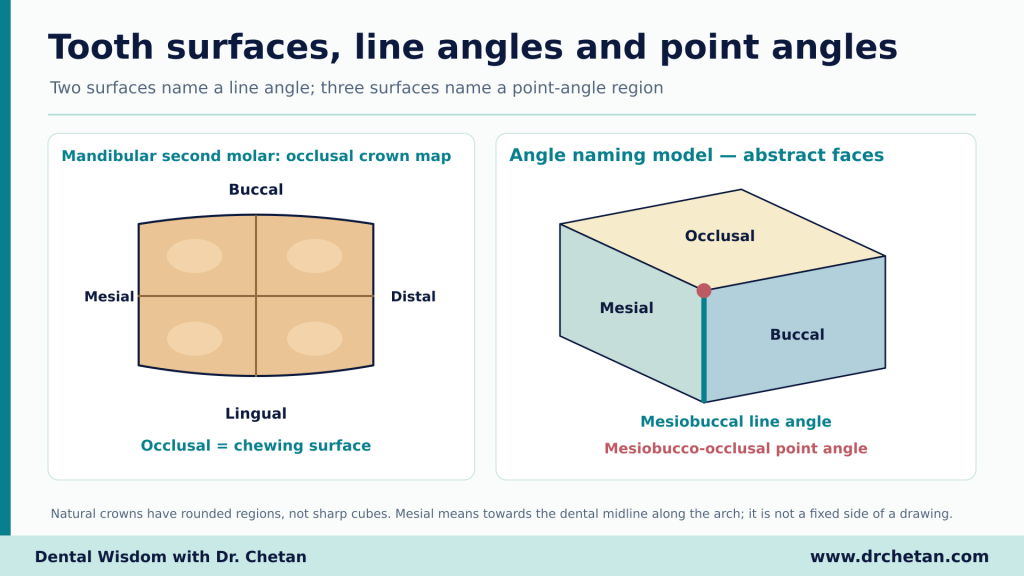
Dental surface names let you describe an exact part of a tooth without pointing at it. Start with the patient’s arch and side, then identify the surface. A line angle names the junction of two surfaces; a point angle names the junction of three. These are descriptive regions, not necessarily sharp corners on a natural crown.
The reference point is the dental midline
The midline separates the right and left halves of an arch between its central incisors. Mesial means towards that midline along the arch, and distal means away from it. They do not mean the left and right edges of a drawing. On a facing-patient chart, the patient’s right appears on the viewer’s left.
The curved arch is important: the mesial surface of a molar faces the neighbouring premolar region, whereas the mesial surfaces of the two central incisors face each other. Turning a specimen in your hand changes the view but does not change which surface is mesial.
The five surfaces of a crown
| Term | Meaning | Example |
|---|---|---|
| Mesial | Towards the midline along the dental arch | Surface of a lateral incisor facing the central incisor |
| Distal | Away from the midline along the dental arch | Surface of a first premolar facing the second premolar |
| Facial | Towards the face; an umbrella term | Labial on anterior teeth and buccal on posterior teeth |
| Labial or buccal | Towards the lips or cheek, respectively | Labial surface of a canine; buccal surface of a molar |
| Lingual or palatal | Towards the tongue; palatal is commonly used for the inner surface of upper teeth | Palatal surface of a maxillary incisor |
| Incisal or occlusal | Cutting region of anterior teeth or chewing surface of posterior teeth | Incisal edge of an incisor; occlusal surface of a premolar |
Mesial and distal are the two proximal surfaces. The four surfaces surrounding the crown are axial surfaces. A canine has a cusp tip with mesial and distal cusp ridges, so its incisal aspect does not look like the straight incisal edge of an incisor.
Line angles: combine two surface names
An incisor or canine is conventionally described with six crown line angles. Posterior crowns have eight because an occlusal surface meets four axial surfaces.
| Anterior line angles | Surfaces meeting |
|---|---|
| Mesiolabial / distolabial | Mesial or distal plus labial |
| Mesiolingual / distolingual | Mesial or distal plus lingual |
| Labioincisal / linguoincisal | Labial or lingual plus incisal |
| Posterior line angles | Surfaces meeting |
|---|---|
| Mesiobuccal / distobuccal | Mesial or distal plus buccal |
| Mesiolingual / distolingual | Mesial or distal plus lingual |
| Mesio-occlusal / disto-occlusal | Mesial or distal plus occlusal |
| Bucco-occlusal / linguo-occlusal | Buccal or lingual plus occlusal |
Different teaching resources use slightly different hyphenation, such as mesioocclusal and mesio-occlusal. The anatomical meaning is the same. Keep the surface names clear rather than treating punctuation as a different structure.
Point angles: combine three surface names
| Crown group | Four conventional point angles |
|---|---|
| Anterior | Mesiolabioincisal, distolabioincisal, mesiolinguoincisal, distolinguoincisal |
| Posterior | Mesiobucco-occlusal, distobucco-occlusal, mesiolinguo-occlusal, distolinguo-occlusal |
For example, mesiobuccal describes a line-angle region; mesiobucco-occlusal adds the occlusal surface and describes a point-angle region. Neither term identifies a particular tooth until you also name the tooth or its notation.
Crown thirds make a description more precise
Divide crown height into cervical, middle and incisal thirds for anterior teeth, or cervical, middle and occlusal thirds for posterior teeth. From a facial view, you can also divide the crown into mesial, middle and distal thirds. Roots are divided into cervical, middle and apical thirds. A “cervical labial prominence” and an “incisal labial prominence” therefore describe different locations.
A specimen-orientation exercise
- Find the crown, CEJ and root before assigning surfaces.
- Identify the facial and lingual sides using the crown form.
- Establish mesial and distal with several tooth-specific features.
- Name the view you are looking at.
- Point to a two-surface junction, then add the incisal or occlusal surface to identify a three-surface junction.
Practise describing a region without using “here” or “this side”. A useful complete phrase is “the mesiolabial line angle of the permanent maxillary right central incisor”. The wording separates tooth identity from surface identity.
Revision questions with answers
Is buccal the same as mesial?
No. Buccal faces the cheek. Mesial faces the dental midline along the arch. They can meet at a mesiobuccal line angle.
Which term describes three surfaces meeting on a lower molar?
Mesiobucco-occlusal is one example. Mesiobuccal alone combines only two surfaces.
Why is a natural point angle often rounded?
The name is a regional convention for a curved crown. It does not require a sharp geometrical vertex.
Related guides on DrChetan.com
- Anatomy of the tooth: structure and surface landmarks
- FDI, Palmer and Universal tooth numbering
- How to identify permanent teeth

Leave a Reply